Semiconductor Fundamentals
Atomic Structure
The Building Blocks of Matter
Everything around us is made of atoms. At the center of each atom is a nucleus, containing protons and neutrons. Whizzing around this nucleus are tiny particles called electrons. These electrons don't just fly around randomly; they occupy specific energy levels, or shells, much like nested Russian dolls.
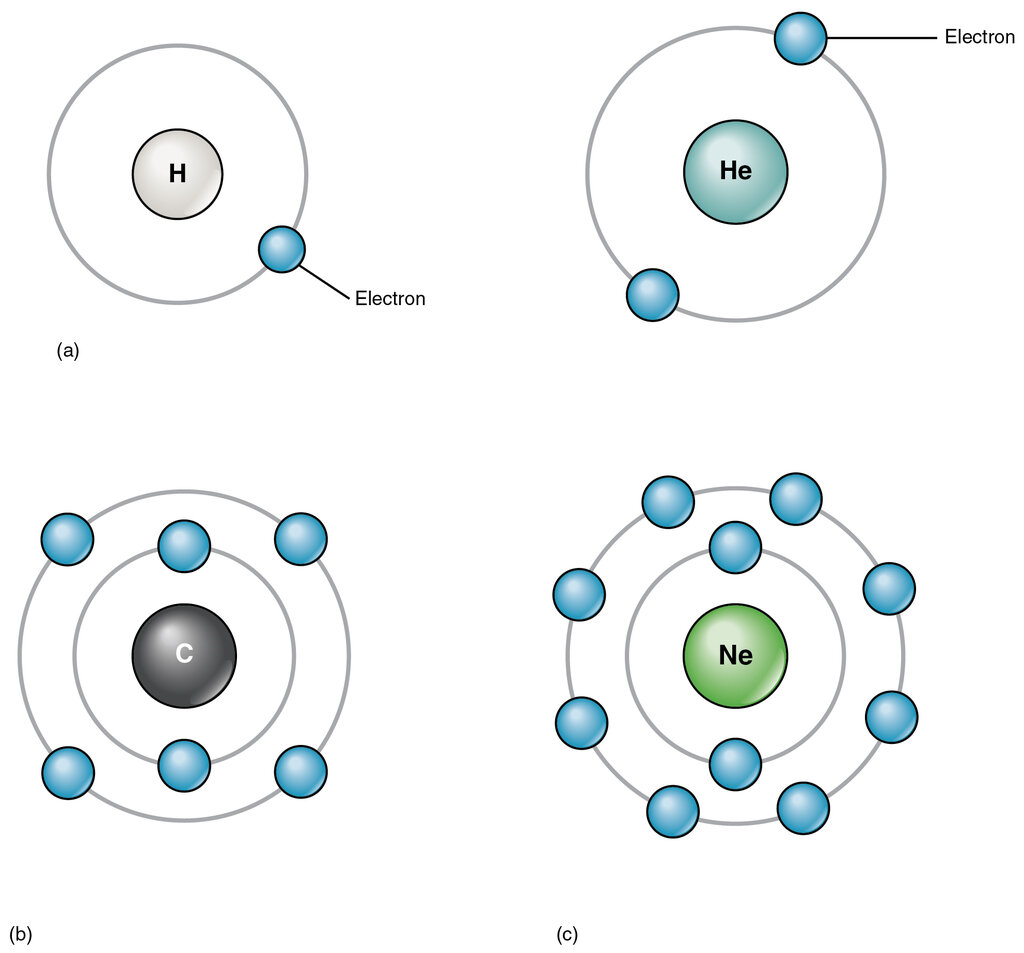
The first shell, closest to the nucleus, can hold a maximum of two electrons. The second shell can hold up to eight, the third can hold eighteen, and so on. Electrons fill the innermost shells first before moving to outer ones. This arrangement, known as the electron configuration, is unique to each element and dictates how an atom behaves.
Valence Electrons
The electrons in the outermost shell are the most important for understanding electrical properties. They're called valence electrons. Because they are farthest from the nucleus, they feel the weakest pull and are the most likely to interact with other atoms. They are the key players in both chemical bonding and the flow of electricity.
Think of an atom as a concert hall. The electrons closest to the stage (the nucleus) are stuck in their seats, but the ones in the back row (the valence shell) can easily get up and move around.
An atom is most stable when its valence shell is completely full. For example, Neon has a full outer shell of eight electrons, which makes it very stable and unwilling to react with other elements. It's a noble gas for this reason. In contrast, Silicon, a key ingredient in electronics, has four valence electrons. Its shell is half full, leaving it ready to interact with its neighbors.
A Tale of Three Materials
The behavior of valence electrons sorts materials into three main categories: conductors, insulators, and semiconductors.
The concept of electrons confined to a crystal lattice or a potential well in a semiconductor forms the cornerstone of understanding materials from a quantum mechanical perspective.
This difference is often described using energy bands. The valence band is the energy range of the valence electrons. For an electron to move freely and conduct electricity, it must jump to a higher energy level called the conduction band. The gap between these two bands determines the material's properties.
Conductors, like copper and silver, have valence and conduction bands that overlap. Their valence electrons are very loosely held and can move into the conduction band with almost no effort. This creates a "sea of electrons" that flows easily when a voltage is applied, making them excellent at conducting electricity.
Insulators, like glass or rubber, have a very large energy gap between their valence and conduction bands. It takes a huge amount of energy to push a valence electron across this gap. Under normal conditions, electrons stay put, so insulators don't conduct electricity.
Semiconductors, such as silicon, are the interesting middle case. They have a small, manageable energy gap. While they act like insulators at very low temperatures, applying a modest amount of energy, like heat or light, can give valence electrons the boost they need to jump into the conduction band. This unique ability to switch between insulating and conducting states is what makes semiconductors the foundation of all modern electronics.
Ready to test your knowledge on atomic structure?
What are the electrons located in the outermost shell of an atom called?
If an atom has its valence shell completely full of electrons, it is considered to be:
Understanding how electrons are arranged in an atom is the first step to understanding the electrical properties that make our technology possible.