Semiconductor Fundamentals
Introduction to Semiconductors
The In-Between Material
In the world of electronics, materials are often sorted into two simple groups: conductors and insulators. Conductors, like copper and gold, let electricity flow through them easily. Insulators, like rubber and glass, stop the flow of electricity almost completely.
But there's a fascinating group of materials that live in the middle: semiconductors. They aren't great conductors, but they aren't perfect insulators either. This 'in-between' property is what makes them so special. Materials like silicon (Si) and germanium (Ge) are the most well-known semiconductors, forming the backbone of modern electronics.
A semiconductor can be coaxed into acting more like a conductor or more like an insulator under different conditions, giving us precise control over electrical currents.
To understand what makes a semiconductor tick, we need to look at its atomic structure. The atoms in a solid material don't just float around randomly; they arrange themselves into a highly ordered, repeating pattern called a crystal lattice.
In silicon, each atom has four electrons in its outermost shell. It forms strong connections, called covalent bonds, with four neighboring atoms, sharing one electron with each. This creates a stable, tightly-bound structure. In this perfect lattice, there are no free electrons to move around and carry a current, which is why a pure semiconductor at very low temperatures behaves like an insulator.
Energy Bands and Gaps
Electrons in an atom can only exist at specific energy levels. When many atoms come together to form a crystal, these discrete energy levels merge into continuous ranges, or 'bands', of allowed energy. For our purposes, two of these bands are crucial.
Valence Band
noun
The outermost energy band of a material that is filled with electrons at absolute zero temperature. These electrons are typically involved in bonding between atoms.
The Valence Band is the lower band, containing electrons that are tied to their atoms. Think of them as workers on the factory floor, busy holding the crystal structure together. They are not free to move around the material.
Conduction Band
noun
The range of electron energy levels in a material where electrons are free to move and conduct electricity. It is located above the valence band.
The Conduction Band is the higher band. If an electron can get enough energy to jump into this band, it breaks free from its atom and can move throughout the crystal, carrying an electrical current. These are the free agents, able to transport charge.
A principal element of advanced solid state physics is understanding that energy bands and band gaps dictate the electrical properties of the material.
Between these two bands is a forbidden zone where no electron energy states can exist. This is the band gap.
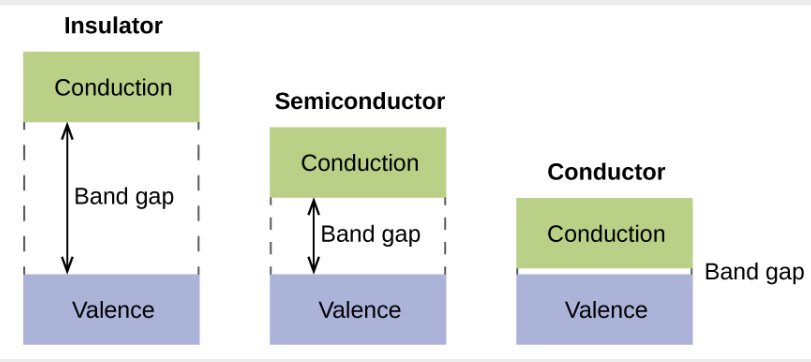
The size of this band gap is what separates insulators, semiconductors, and conductors.
- Insulators have a very large band gap. It takes a huge amount of energy to kick an electron from the valence band to the conduction band, so it rarely happens. Electricity doesn't flow.
- Conductors have no band gap at all. The valence and conduction bands overlap, so electrons can move freely with very little encouragement. Electricity flows easily.
- Semiconductors have a small, but not zero, band gap. It takes a modest amount of energy—like the energy from heat or light—to excite an electron into the conduction band.
| Material Type | Band Gap Size | Electron Behavior |
|---|---|---|
| Conductor | Overlapping Bands (Zero Gap) | Electrons move freely |
| Semiconductor | Small Gap (~1 eV) | Electrons can jump the gap with some energy |
| Insulator | Large Gap (>4 eV) | Electrons are tightly bound; rarely jump |
When an electron in a semiconductor jumps to the conduction band, it leaves behind an empty spot in the valence band. This vacancy is called a hole. A nearby electron can move into this hole, effectively causing the hole to move. This moving hole acts like a positive charge carrier, also contributing to electrical current.
This ability to create and control charge carriers—both electrons and holes—is the key to why semiconductors are so incredibly useful.
Time to check your understanding of these fundamental ideas.
What is the primary characteristic that distinguishes a semiconductor from a conductor or an insulator?
In a semiconductor, what is a "hole"?
Understanding these core principles—the ordered crystal lattice, the crucial energy bands, and the all-important band gap—is the first step to seeing how we build the modern world from simple materials like silicon.