Semiconductor Diode Laser Physics
Stimulated Emission Dynamics
From Random Light to Coherent Beams
In a semiconductor, light is born when an electron in the high-energy conduction band recombines with a hole in the lower-energy valence band. This releases a photon. But not all photons are created equal. This process can happen in two very different ways: spontaneously or through stimulation.
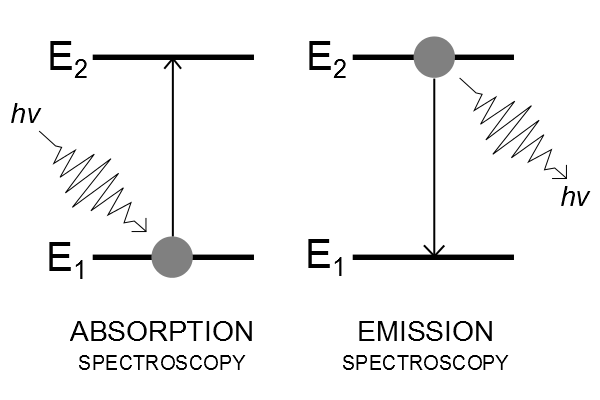
Spontaneous emission is a random process. Electrons fall back to the valence band on their own schedule, emitting photons in random directions with random phases. This is the mechanism behind a light-emitting diode (LED). The light is incoherent, like the chatter of a crowd where everyone is speaking at once.
Stimulated emission is different. It occurs when an incoming photon, with just the right amount of energy, encounters an already excited electron. The photon doesn't get absorbed; instead, it coaxes the electron to fall and release a second photon. This new photon is a perfect clone of the first: it has the same energy, phase, and direction. This is how laser light is made—a cascade of identical photons creating a coherent, focused beam.
For a laser to work, stimulated emission must overpower both spontaneous emission and absorption, where an incoming photon is consumed to excite an electron from the valence to the conduction band.
Creating an Unnatural State
Under normal thermal equilibrium, there are far more electrons in the lower-energy valence band than in the higher-energy conduction band. This means an incoming photon is much more likely to be absorbed than to stimulate emission. To create a laser, we need to flip this situation on its head.
This is called , a state where more electrons occupy the conduction band than the valence band in the active region of the device. We achieve this by heavily forward-biasing the semiconductor diode, a process known as pumping. This injects a massive number of electrons into the conduction band and holes into the valence band, creating a high concentration of charge carriers ready to recombine.
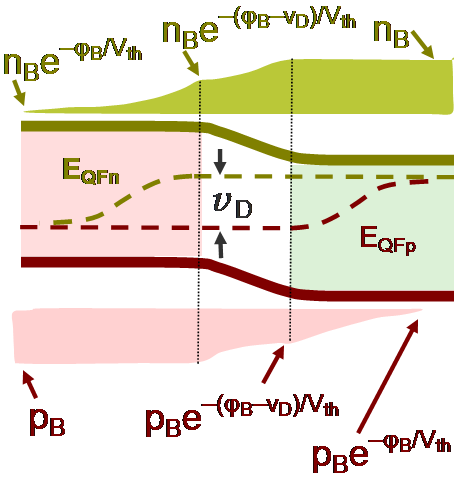
This high-injection scenario drives the system far from equilibrium. The energy distribution of electrons and holes can no longer be described by a single Fermi level. Instead, we use separate — for electrons in the conduction band and for holes in the valence band. The more current we pump into the diode, the further these two levels are pushed apart.
The Gain Condition
So, how much separation is enough? A semiconductor starts to act as a light amplifier only when the energy separation between the quasi-Fermi levels is greater than the energy of the photons being emitted. This fundamental requirement is known as the for optical gain.
When the pump current is low, , and the material absorbs light. As we increase the current, we reach a point where . At this specific point, the rate of stimulated emission exactly balances the rate of absorption. The material is effectively transparent to photons of energy . The current required to achieve this is called the transparency current.
To get lasing, we need to go further. Pushing the current above the transparency threshold makes . Now, stimulated emission dominates absorption, and we have net optical gain. The material amplifies light. The strength of this amplification is described by the optical gain coefficient, . The higher the injection current, the larger the population inversion, and the greater the value of .
This gain is what allows a handful of spontaneously emitted photons to trigger an avalanche of stimulated emission, building up into the powerful, coherent beam of a diode laser.