Semi-Supervised Learning Explained
Introduction to Machine Learning
What Is Machine Learning?
Machine learning is a way for computers to learn from information. Instead of being given a long list of rules to follow, a machine learning model looks for patterns in data. By finding these patterns, it can make predictions or decisions about new, unseen information.
Think of it like teaching a child to recognize a cat. You wouldn't describe a cat by its exact height, weight, and fur color. Instead, you'd show them pictures of many different cats. Soon, they learn the general 'cat-ness' and can point one out in a new picture. Machine learning works similarly, but with data instead of pictures of cats.
The goal is to enable computers to learn on their own, adapting to new data without being explicitly reprogrammed.
Three Flavors of Learning
Machine learning isn't a single technique. It's a broad field with several different approaches. The most common types are defined by the kind of data they use to learn.
Supervised Learning
other
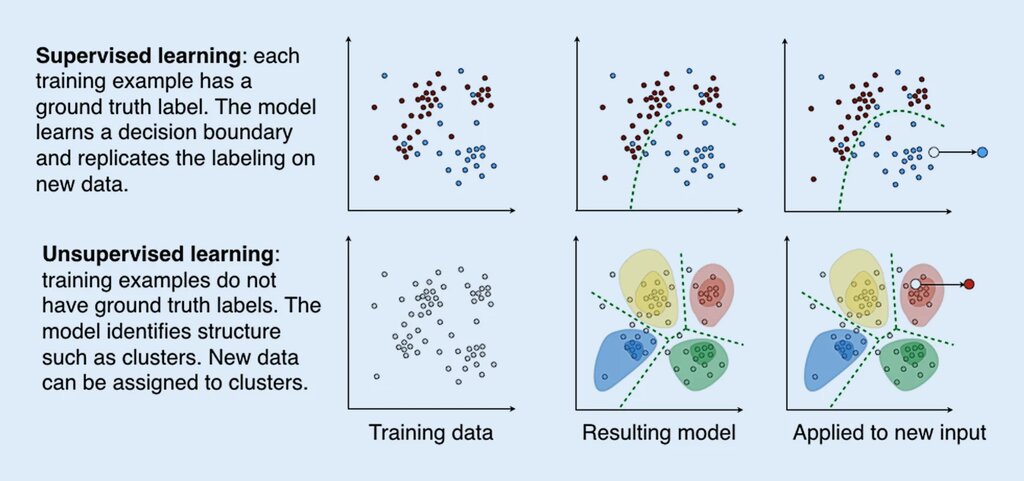
A type of machine learning where the model is trained on a dataset that is well-labeled, meaning each piece of data is tagged with the correct output or answer. The model's goal is to learn the mapping function that turns inputs into the correct outputs.
In supervised learning, the computer acts like a student with a detailed answer key. It's given a set of questions (the data) and the corresponding correct answers (the labels). For example, to train a model to identify spam, we would feed it thousands of emails already labeled as either 'spam' or 'not spam'. The model learns the features of spam emails and uses that knowledge to classify new, incoming emails.
Common uses for supervised learning include predicting house prices based on features like size and location, or identifying fraudulent credit card transactions.
Unsupervised Learning
other
A type of machine learning where the model is trained on a dataset that has no labels or predefined groups. The model's goal is to discover hidden patterns, structures, or relationships within the data on its own.
Unsupervised learning is like being given a box of jumbled puzzle pieces with no picture on the box to guide you. The data is unlabeled. The goal is to find interesting structures or groupings within the data itself. A common application is customer segmentation, where a model might group customers into different categories based on their purchasing habits, without being told what those categories should be. This helps businesses tailor their marketing efforts.
Another example is anomaly detection, like identifying unusual network activity that could signal a security threat.
Then there's a middle ground, which combines the other two approaches.
Semi-supervised learning uses a small amount of labeled data along with a large amount of unlabeled data. This is useful when labeling data is expensive or time-consuming.
Imagine you want to tag all your photos. You might label a few pictures of your best friend, and the algorithm then uses that information, plus all your other unlabeled photos, to find and tag your friend in the rest of the collection. This is the essence of semi-supervised learning.
Machine Learning in Action
You likely interact with machine learning every day, even if you don't realize it. It's the engine behind many of the services we use.
- Recommendation Engines: When Netflix suggests a movie or Spotify creates a custom playlist for you, it's using machine learning to predict what you'll enjoy based on your viewing or listening history.
- Voice Assistants: Tools like Siri, Alexa, and Google Assistant use machine learning to understand your spoken commands and respond appropriately.
- Medical Diagnosis: In healthcare, machine learning models analyze medical images like X-rays and MRIs to help doctors detect diseases like cancer earlier and more accurately.
- Transportation: From predicting traffic patterns in Google Maps to the complex systems that guide self-driving cars, machine learning is making transportation safer and more efficient.
Now that you understand the basic types of machine learning, let's test your knowledge.
What is the primary way a machine learning model learns?
A developer is building a system to predict whether a credit card transaction is fraudulent. They have a large dataset of past transactions, each marked as either 'fraudulent' or 'not fraudulent'. Which type of machine learning approach is this?
These fundamental concepts are the building blocks of more complex systems. By understanding the difference between supervised, unsupervised, and semi-supervised learning, you can start to see how machines are taught to solve a vast range of problems.