Self-RAG Architecture Explained
Introduction to Retrieval-Augmented Generation
What is Retrieval-Augmented Generation?
Large Language Models (LLMs) are incredibly powerful, but they have two key limitations. First, their knowledge is frozen at the point their training data ends. Second, they can sometimes confidently make up incorrect information, a phenomenon known as hallucination.
Imagine an expert taking a closed-book exam. They can only rely on what they've memorized. Now, imagine that same expert taking an open-book exam. They can look up specific, current facts to ensure their answers are accurate and detailed. Retrieval-Augmented Generation, or RAG, gives an LLM that
Retrieval-Augmented Generation (RAG) is an AI framework that connects a language model to an external knowledge repository, allowing the model to fetch and include relevant information when generating an answer.
Instead of just relying on its internal, memorized data, a RAG system first retrieves relevant information from an outside source—like a company's internal documents, a specific database, or the live internet. It then uses this fresh information to generate a much better, more accurate response.
The Two Core Components
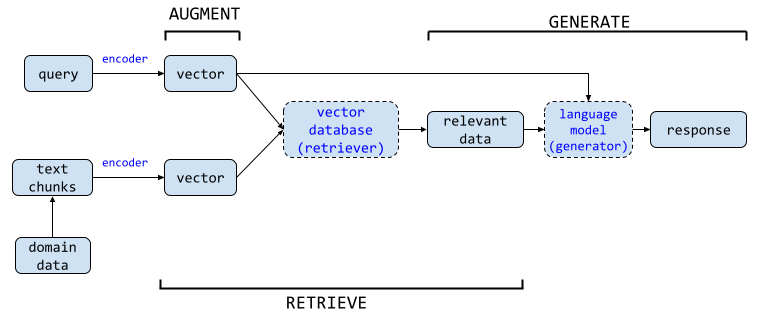
A RAG system is built on a simple but powerful two-step process. It combines a retriever with a generator to produce its final output.
-
The Retriever: Think of the retriever as a super-fast research assistant. When you ask a question, its job is to search through a vast library of information (the external knowledge source) and find the most relevant snippets of text. It doesn't understand the text in a human sense, but it's brilliant at matching your query to documents that contain the information needed to answer it.
-
The Generator: The generator is the LLM itself. It takes your original question and the relevant information provided by the retriever. Its job is to synthesize all of this into a single, coherent, and human-sounding answer. It's the expert who reads the researcher's notes and writes the final report.
First, retrieve the facts. Then, generate the answer. This simple sequence makes LLMs dramatically more reliable.
Why RAG Matters
Integrating retrieval with generation solves several of the biggest problems with standalone LLMs.
- Improved Accuracy: By grounding the model's response in real, verifiable information, RAG significantly reduces the risk of hallucinations. The model is encouraged to stick to the facts provided.
- Access to Current Information: An LLM's training data might be months or even years old. RAG connects it to live data sources, allowing it to answer questions about recent events with up-to-date information.
- Domain-Specific Expertise: A company can create a RAG system that points to its own private knowledge base, like technical manuals or internal wikis. This effectively turns a general-purpose LLM into a specialized expert on that company's specific domain, without the massive cost of retraining the entire model.
- Increased Trust and Transparency: Because the system first retrieves information, it can often cite its sources. This allows users to verify the information for themselves, building trust in the AI's answers.
RAG in the Real World
The development of RAG has unlocked new possibilities for AI applications. It started as a research concept to make language models more factual and has quickly evolved into a standard architecture for building reliable AI tools.
You can see RAG in action in many modern AI systems:
- Customer Support Chatbots: A bot can use a company's product documentation as its knowledge source to answer highly specific customer questions accurately.
- Research Assistants: A financial analyst could use a RAG system connected to market data and earnings reports to get instant summaries and insights.
- Educational Tools: An AI tutor could pull from the latest scientific papers or historical archives to provide students with detailed, sourced explanations on complex topics.
Now that you understand the fundamentals of RAG, let's test your knowledge.
What are the two main components of a Retrieval-Augmented Generation (RAG) system?
What is the primary role of the "Retriever" in a RAG system?
By adding a retrieval step, RAG makes language models more powerful and trustworthy, paving the way for more sophisticated and useful AI applications.