Self-Attention in Large Language Models
Introduction to Self-Attention
The Heart of the Transformer
How do we understand sentences? When you read the words on this screen, you're not just processing them one by one. You're constantly making connections. In the sentence "The cat sat on the mat, tired after a long day," your brain links "tired" back to "the cat," not "the mat."
This ability to weigh the importance of different words in a sentence is crucial for understanding context. Early AI models struggled with this. They would read a sentence sequentially, like someone reading through a long tube, and often forget what happened at the beginning by the time they reached the end. This made understanding long-range relationships in text very difficult.
The Transformer architecture, which powers most modern Large Language Models (LLMs), solved this problem with a clever mechanism called self-attention.
The self-attention mechanism is the core innovation of the Transformer.
Self-attention allows a model to look at all the words in a sentence at the same time and figure out which ones are most important to the meaning of every other word. It creates a network of connections, a web of relevance, within the text itself.
Instead of a single stream of information, the model calculates how much attention each word should pay to every other word in the sequence. It's like having a conversation in a group where you can instantly gauge who is referring to whom and which parts of the conversation are most relevant to each other.
How It Works
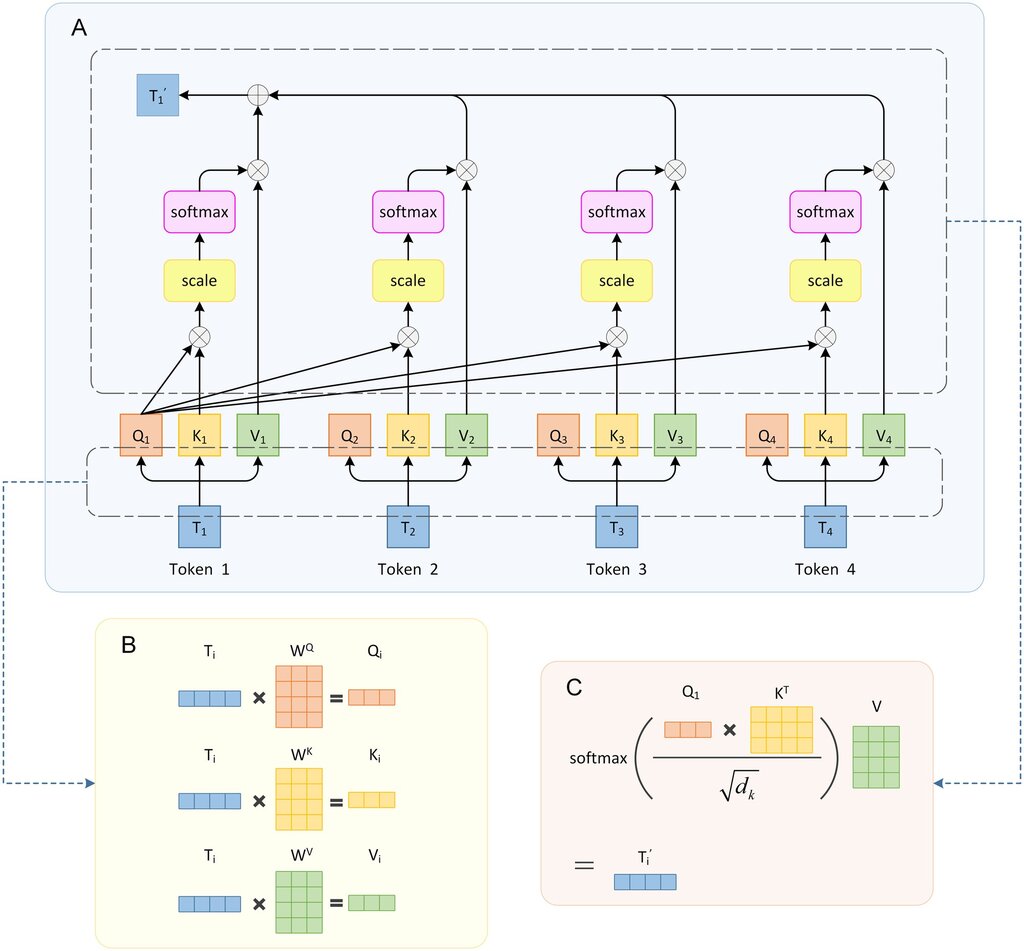
So, how does a machine do this? For every word (or token) in an input sentence, the model creates three different vectors:
- Query (Q): This represents the current word that is looking for context. It's like a question: "Who or what is relevant to me?"
- Key (K): This is like a label for all the words in the sentence. It's what the Query vector is compared against.
- Value (V): This contains the actual information or substance of each word.
The process is a bit like searching for a video online. Your search term is the Query. The titles and descriptions of all the videos are the Keys. When your Query matches a Key well, the system shows you that video, which is the Value.
Self-attention works similarly. The model compares the Query vector of one word with the Key vector of every other word in the sentence. This comparison produces a score. A high score means the words are highly relevant to each other. These scores are then used to create a weighted sum of all the Value vectors. Words with higher scores contribute more to the final representation of the current word.
This allows the model to build a new representation for each word that is infused with context from the entire sentence.
Advantages Over Older Methods
Before Transformers, models like Recurrent Neural Networks (RNNs) were state-of-the-art. RNNs process sequences one word at a time, maintaining a "memory" or hidden state that gets updated at each step. This sequential nature created two major problems.
First, it was slow. You couldn't process the tenth word until you had processed the first nine. Second, information was often lost over long distances. The model's memory of the first word would fade by the time it reached the fiftieth word, a problem known as the vanishing gradient problem.
Self-attention solves both issues. Since it looks at all words simultaneously, it can be massively parallelized, making training much faster. More importantly, the path between any two words in the sentence is direct. The model can link the first word to the last word just as easily as it can link two adjacent words, enabling it to capture long-range dependencies effectively.
| Feature | Recurrent Neural Networks (RNNs) | Self-Attention (Transformers) |
|---|---|---|
| Processing | Sequential (one word at a time) | Parallel (all words at once) |
| Speed | Slow due to sequential nature | Fast and highly parallelizable |
| Context | Struggles with long-range dependencies | Excellently captures long-range dependencies |
| Connections | Indirect, through a hidden state | Direct between any two words |
This ability to directly model relationships between any two positions in a sequence, regardless of their distance, is the key advantage of self-attention. It's what allows LLMs to understand the intricate nuances of language, from grammatical structure to subtle contextual clues scattered across a document.
What was a primary limitation of models like Recurrent Neural Networks (RNNs) for understanding long sentences?
In the analogy of searching for a video online, what does the 'Key' vector in self-attention correspond to?
By focusing on the relationships between words, self-attention provides the foundation for the deep contextual understanding that makes modern AI so powerful.