Secure Your Accounts with Two-Factor Authentication
Understanding Two-Factor Authentication
More Than a Password
Think of your password as the key to your digital front door. Anyone who gets that key can walk right in. But what if you had a second lock, one that required something only you have? That’s the basic idea behind two-factor authentication, or 2FA.
Two-factor authentication (2FA) adds an essential second layer of security by requiring something you know (password) and something you have (typically your phone).
Instead of relying on just a password, 2FA asks you to prove your identity in two different ways. This makes it much harder for someone to gain unauthorized access to your accounts. Even if a thief steals your password, they're stopped at the second step because they don't have your phone or your fingerprint.
The Three Factors of Authentication
Every method used to verify your identity falls into one of three categories, known as authentication factors. Two-factor authentication works by combining any two of these.
| Factor | What it Is | Common Examples |
|---|---|---|
| Knowledge | Something you know | Password, PIN, answer to a security question |
| Possession | Something you have | Your phone, a physical security key, a bank card |
| Inherence | Something you are | Fingerprint, face scan, voice recognition |
The key is that the two factors must be from different categories. Using a password and a PIN, for instance, is not 2FA because both are knowledge factors. But using a password (knowledge) and a one-time code sent to your phone (possession) is a classic example of 2FA.
This combination of factors creates a much stronger defense for your accounts.

Why It Matters
Passwords alone are surprisingly fragile. They can be stolen in data breaches, guessed by brute-force attacks, or tricked out of you through phishing scams. Phishing is when an attacker sends a deceptive email, like a fake bank alert, to trick you into revealing your login details.
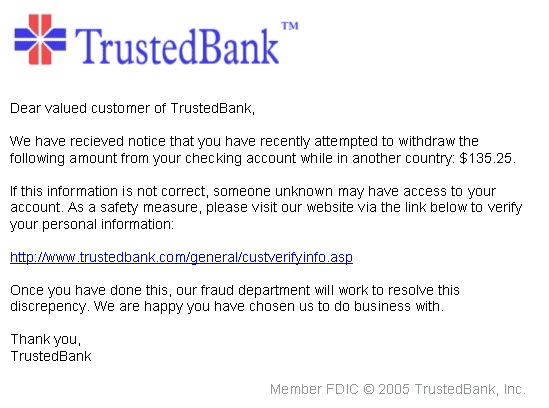
Two-factor authentication directly counters these threats. A criminal with your stolen password can't complete the login without the second factor. This makes 2FA one of the most effective steps you can take to secure your digital life.
By adding a second layer of verification, 2FA protects you even if your password is compromised.
It's a simple concept that dramatically boosts your security against the most common types of online attacks.
What is the main goal of using two-factor authentication (2FA)?
Which of the following scenarios is a correct example of two-factor authentication?