Secrets of the Atom and Matter Transformation
Atomic Theory Foundations
Dalton's Atomic Theory
While the idea that matter is made of tiny particles has existed for millennia, it wasn't until the early 1800s that it was placed on a firm scientific footing. English chemist John Dalton developed the first comprehensive atomic theory, shifting the conversation from philosophical speculation to scientific law. Through his experiments with gases, Dalton proposed a new way of seeing the world, one built from indestructible, fundamental units.
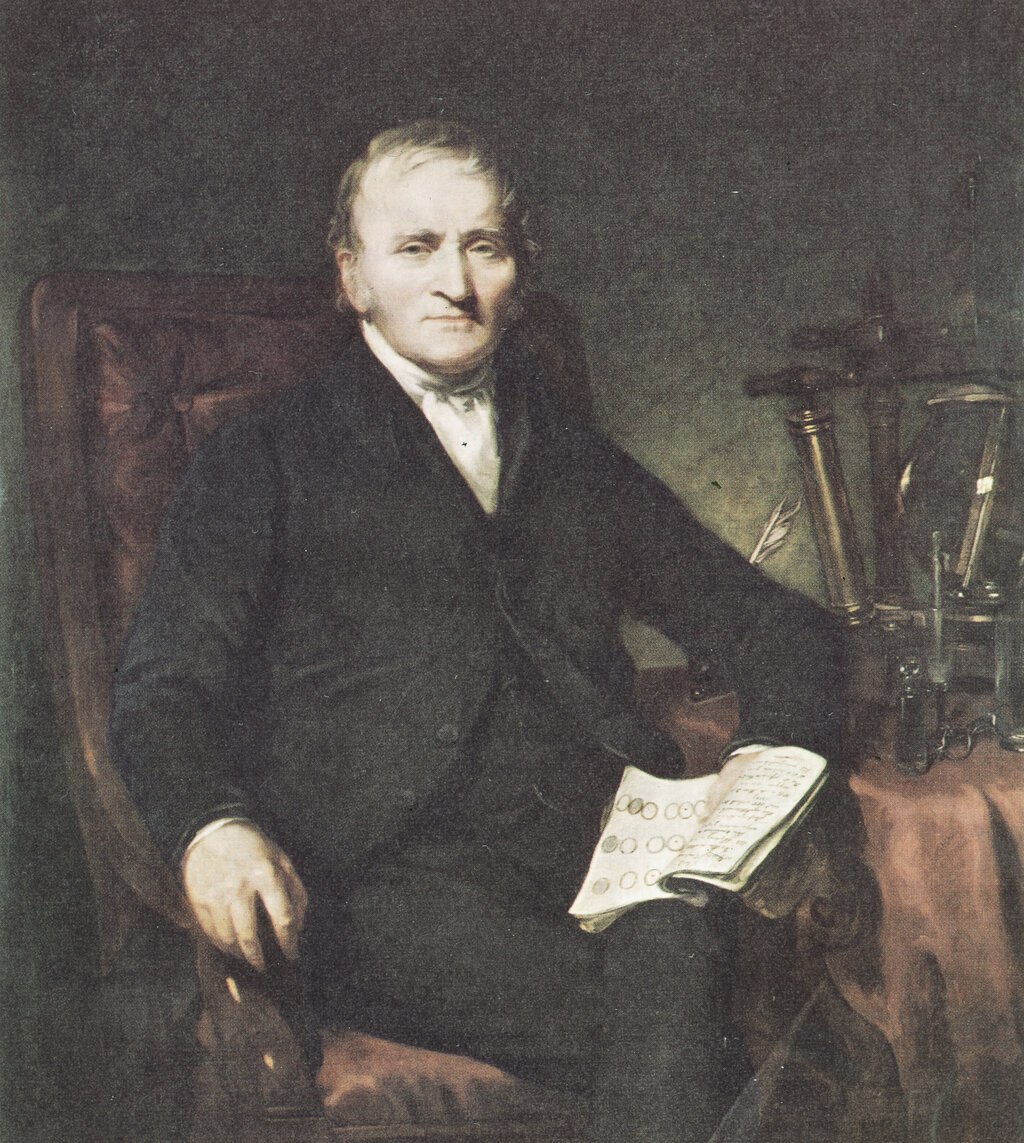
Dalton's theory was revolutionary because it wasn't just a single idea; it was a set of interconnected principles, or postulates, that explained several key observations in chemistry. These postulates provided the rules for how matter behaves and interacts.
At its core, Dalton's theory stated that all matter is composed of tiny, indivisible particles called atoms. He pictured them as solid, featureless spheres.
| Postulate | Description |
|---|---|
| 1. Tiny Particles | All matter is made of extremely small particles called atoms. |
| 2. Identical Atoms | Atoms of a given element are identical in size, mass, and other properties. |
| 3. Different Atoms | Atoms of different elements differ in size, mass, and other properties. |
| 4. Indivisible Atoms | Atoms cannot be subdivided, created, or destroyed. |
| 5. Chemical Reactions | Atoms of different elements combine in simple whole-number ratios to form chemical compounds. In chemical reactions, atoms are combined, separated, or rearranged. |
Elements and Compounds
Dalton's framework provides a clear distinction between an element and a compound. An element is a pure substance consisting of only one type of atom. For example, a block of pure iron contains only iron atoms. These atoms are all identical to each other in terms of their properties.
A compound, on the other hand, is a pure substance consisting of two or more different types of atoms chemically bonded together. Water is a classic example. Each water molecule is formed from two hydrogen atoms bonded to one oxygen atom. This ratio is always fixed. You can't have water with, say, three hydrogen atoms and one oxygen atom—that would be a different substance entirely.
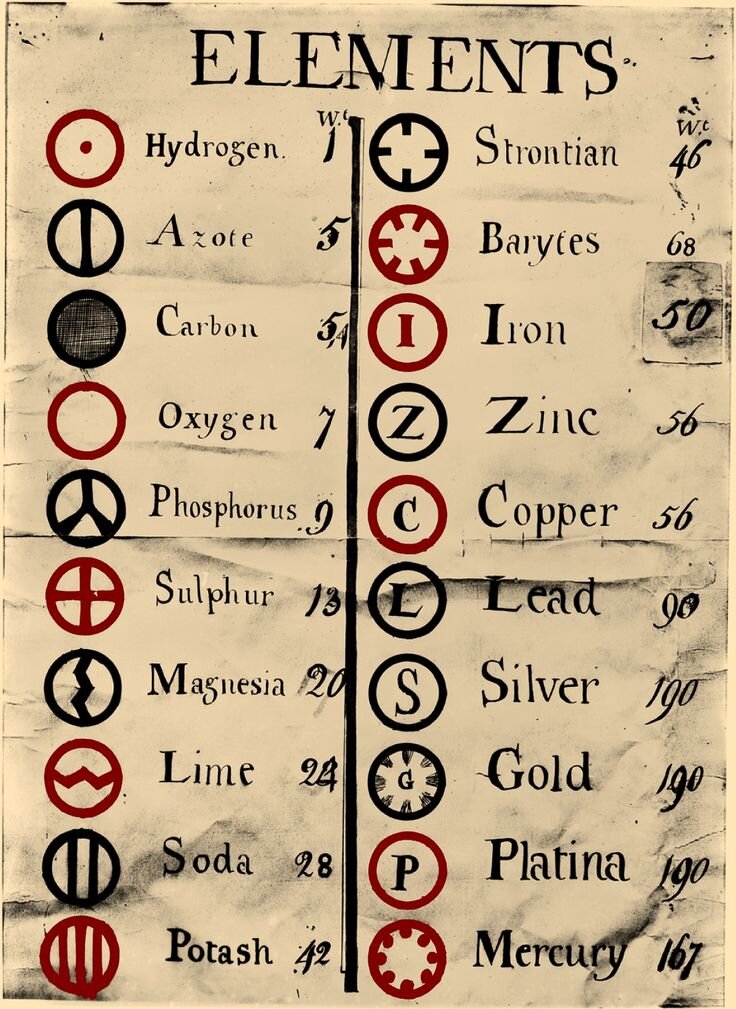
Dalton also proposed that each element has a unique atomic weight. He didn't know the exact weights, but he could determine their relative weights by analyzing compounds. For instance, by observing that water was composed of about 8 parts oxygen to 1 part hydrogen by mass, he inferred that an oxygen atom must be significantly heavier than a hydrogen atom. He created a system of symbols to represent the different atoms in his notes, a precursor to the modern chemical symbols we use today.
Atoms and Conservation of Mass
One of the most powerful consequences of Dalton's theory is its simple explanation for the Law of Conservation of Mass. This law, established by Antoine Lavoisier, states that mass is neither created nor destroyed in a chemical reaction.
If atoms are indestructible and reactions are merely rearrangements of these atoms, then the law makes perfect sense. The same atoms that you start with must be present at the end, just bonded to different partners. No atoms are lost, and no new atoms are created, so the total mass must remain constant.
Imagine you have a pile of red LEGO bricks and a pile of blue LEGO bricks. You can take them apart and reassemble them into new structures, but the total number of red and blue bricks will never change. Chemical reactions work the same way with atoms.
Dalton's theory was a monumental step forward, providing the foundational principles that chemists still use. Of course, science is always evolving. We now know that atoms are not the indivisible spheres Dalton imagined, but are themselves composed of even smaller subatomic particles. However, his core ideas—that elements are made of unique atoms and that reactions are rearrangements of those atoms—remain central to chemistry.
Ready to check your understanding of these foundational ideas?
What was the primary contribution of John Dalton to the concept of atoms?
According to Dalton's atomic theory, what is a compound?
By establishing these first principles, Dalton provided the essential grammar for the language of chemistry, allowing scientists to begin deciphering the composition of the world around us.