Second Grade Success in Thirty Days
Mastering Multi-digit Operations
Beyond Single Digits
When we look at a number like 345, we're not just seeing three separate digits. We're seeing a code that tells us about quantity. The position of each digit gives it a specific power. This is called place value.
The digit on the right is in the ones place. The next one to the left is in the tens place, and the one after that is in the hundreds place. So, 345 is really just a quick way of saying we have 3 hundreds, 4 tens, and 5 ones.
300 + 40 + 5 = 345
Understanding this structure is the key to working with bigger numbers. When we add or subtract, we're really just combining or taking away these groups of hundreds, tens, and ones. We always start with the smallest place value on the right and work our way left.
Regrouping in Addition
Sometimes, when you add the digits in a column, you get a number that's 10 or more. You can't fit a two-digit number in a single place value column. So, what do you do? You regroup, which is sometimes called carrying over.
Imagine you have 8 ones and someone gives you 4 more. You now have 12 ones. You can trade 10 of those ones for a single ten, leaving you with 2 ones. That new ten gets carried over to the tens column to be added with the other tens.
Let's try it with 158 + 64.
This process works the same way for any number of digits. By following these standard algorithms, you can solve any addition problem reliably. It's like having a recipe for getting the right answer every time.
Borrowing in Subtraction
Subtraction can get tricky when the top digit in a column is smaller than the bottom digit. For example, in 93 - 45, you can't take 5 away from 3. This is where borrowing comes in.
Think of it like making change. If you need to give someone $5 but only have three $1 bills, you'd break one of your $10 bills. That gives you ten more $1 bills. Now you have 13 ones and can easily give 5 away.
In subtraction, we borrow from the place value to the left. We take one ten from the tens column (reducing it by 1) and add it as 10 ones to the ones column. Let's look at 93 - 45.
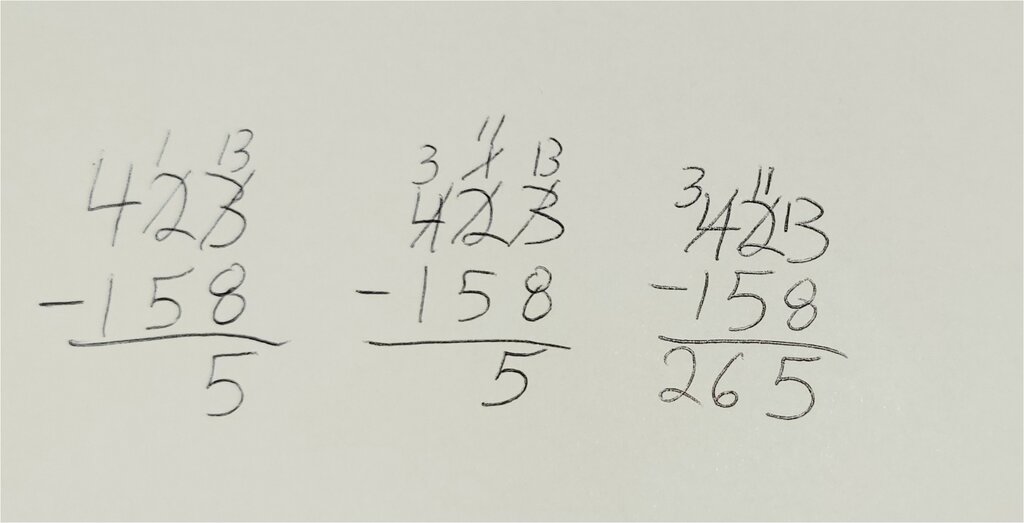
Here's the breakdown:
- Ones column: We can't do 3 - 5. We borrow 1 ten from the 9 in the tens place. The 9 becomes an 8, and the 3 becomes 13.
- Now we can solve the ones column: 13 - 5 = 8.
- Tens column: We have 8 - 4 = 4.
The answer is 48. This method involves decomposing numbers, or breaking them down, to make subtraction possible.
Mental Math Strategies
While writing things down is great, sometimes you need to solve problems in your head. A powerful trick is to break numbers apart to make them friendlier.
To solve 48 + 25, you could add 2 to 48 to get to an easy number, 50. Since you took that 2 from the 25, you now have 23 left to add. 50 + 23 is much easier to solve: 73.
For subtraction, like 71 - 19, you can think of 19 as being very close to 20. So, 71 - 20 = 51. But since you took away one too many, you add it back: 51 + 1 = 52.
These little tricks help you see numbers flexibly and build your confidence.
These skills become very useful in real-world situations, especially in problems that have more than one step.
You have 120 stickers. You give 25 to a friend and then get 15 more for your birthday. How many stickers do you have now?
First, subtract the stickers you gave away: 120 - 25 = 95. Then, add the new stickers: 95 + 15 = 110. You have 110 stickers.
Let's check what you've learned.
In the number 345, what does the digit '4' represent?
What is the sum of 158 + 64?
Working with multi-digit numbers is all about understanding place value and knowing when to regroup. With practice, these steps will become second nature.