Second Grade Math Essentials
Understanding Numbers
The Building Blocks of Numbers
Numbers are all around us. They tell us the time, how much things cost, and how many pages are in a book. At their core, numbers are just symbols we use to represent quantities.
Everything starts with ten simple digits: 0, 1, 2, 3, 4, 5, 6, 7, 8, and 9. Think of these as the alphabet for math. By combining them in different ways, we can write any number imaginable, from the number of fingers on your hand to the number of stars in the sky.
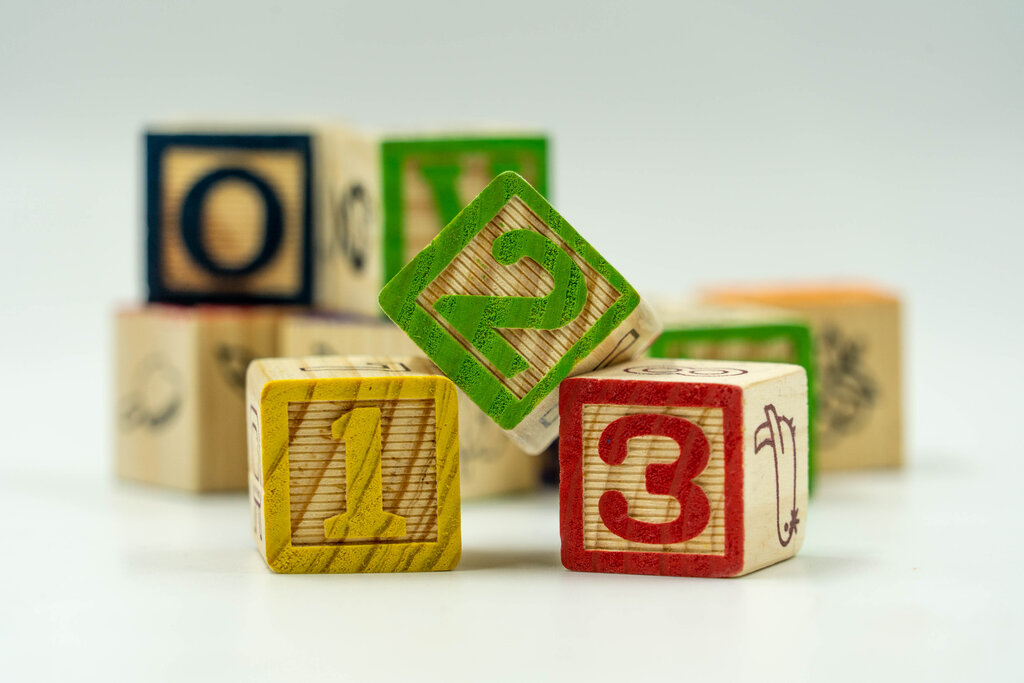
When we count past 9, we need more than one digit. The number 10 uses a 1 and a 0. The number 25 uses a 2 and a 5. But what do these digits actually mean when they're next to each other? The secret lies in their position, or what we call place value.
The Power of Place Value
Imagine you have a big pile of small, single blocks. Each block is a "one." If you stack ten of these blocks together, you get a rod. That's a "ten." If you line up ten of those rods side-by-side, you create a flat square. That's a "hundred."
Place value works the same way. The position of a digit in a number tells us if it represents ones, tens, or hundreds. The digit on the far right is always in the ones place. The digit to its left is in the tens place. And the digit to the left of that is in the hundreds place.
Let's break down the number 528. It's made of three digits: 5, 2, and 8.
- The 8 is in the ones place, so it just means 8 ones.
- The 2 is in the tens place, so it means 2 tens, or twenty.
- The 5 is in the hundreds place, so it means 5 hundreds.
When we put it all together, we have five hundred and twenty-eight. The position of each digit is what gives it its true value.
Even the number 1,000 follows this rule! It has a 1 in the thousands place and zeros in the hundreds, tens, and ones places.
Odd and Even Numbers
Numbers also have different properties. One of the first you'll learn is whether a number is odd or even. This is a simple way to sort numbers into two big groups.
An even number is any number that can be split into two equal whole parts. Think about the number 6. You can divide it into two groups of 3. That means 6 is an even number.
An odd number is one that can't be split perfectly in two. If you try to split 7 into two groups, you'll have one group of 3 and one group of 4. They aren't equal. So, 7 is an odd number.
Luckily, there's a quick trick to figure this out. You only need to look at the digit in the ones place!
If the digit in the ones place is a 0, 2, 4, 6, or 8, the whole number is even.
If the digit in the ones place is a 1, 3, 5, 7, or 9, the whole number is odd.
| Number | Digit in Ones Place | Type |
|---|---|---|
| 12 | 2 | Even |
| 39 | 9 | Odd |
| 154 | 4 | Even |
| 871 | 1 | Odd |
| 930 | 0 | Even |
It doesn't matter how big the number is. The number 987,654,321 is odd simply because its last digit is 1.
Ready to check your understanding?
In the number 347, what is the value of the digit 4?
Which of the following numbers is an even number?
Great work. Understanding digits and place value is the first major step in mastering math. It's the foundation for everything that comes next.