SCS Runoff Method and Unit Hydrograph
Introduction to Hydrology
The Water Cycle
Water is constantly on the move. It flows in rivers, sits in lakes, and makes up the vast oceans. It's also in the air as vapor and locked away in glaciers as ice. This continuous movement of water on, above, and below the surface of the Earth is called the hydrologic cycle, or the water cycle.
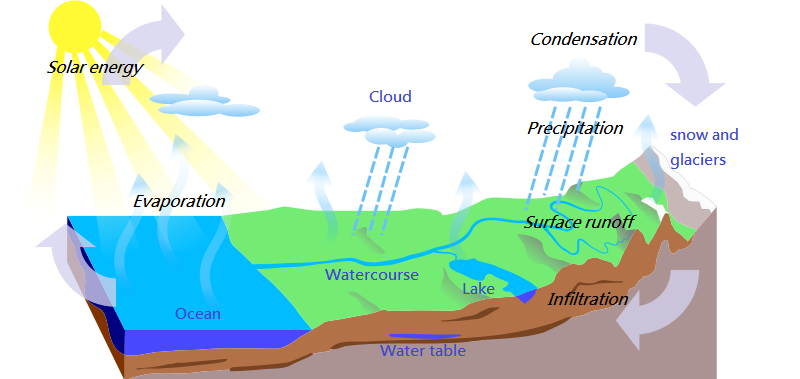
The sun is the engine of this cycle. It heats water in oceans and lakes, causing it to evaporate and rise into the atmosphere as water vapor. Plants also release water vapor through a process called transpiration. As this moist air rises, it cools, and the water vapor condenses to form clouds. When the water droplets in clouds become too heavy, they fall back to Earth. This is the part of the cycle we'll focus on: precipitation.
Precipitation
Precipitation is any form of water that falls from clouds and reaches Earth's surface. It can be liquid, like rain, or solid, like snow, sleet, or hail. For hydrologists, who study water, precipitation is the main input of water into a land area, like a watershed. How much water falls, how quickly it falls, and in what form, are all crucial factors that determine what happens next.
What Happens to the Rain?
Once precipitation hits the ground, it faces a fork in the road. It can either soak into the ground or flow over the surface. These two processes are called infiltration and runoff.
Infiltration
noun
The process by which water on the ground surface enters the soil.
Infiltration is like a sponge soaking up water. Several factors control how much water can infiltrate and how quickly. The type of soil plays a big role; sandy soils have large pores and can absorb water quickly, while clay soils have smaller pores and absorb water more slowly.
The ground cover also matters. A dense forest or a grassy field will have much higher infiltration rates than a paved parking lot or a rooftop. That's because vegetation and its root systems create pathways for water to enter the soil. Impervious surfaces, like concrete and asphalt, block infiltration almost completely.
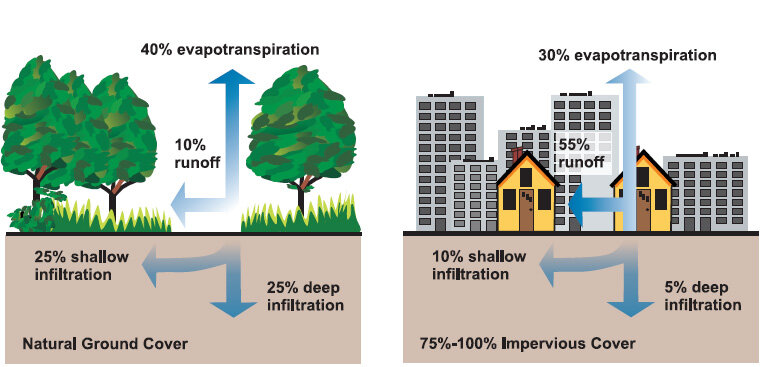
Another key factor is how much water is already in the soil. If the ground is already saturated from a previous storm, its capacity to absorb more water is low. In this case, most of the new rainfall will not infiltrate.
Runoff Processes
When water can't soak into the ground, it has to go somewhere else. This is where runoff comes in. Runoff is the water that flows over the land surface, eventually making its way to streams, rivers, lakes, and oceans.
Runoff is generated when the rate of precipitation is greater than the rate of infiltration.
Think of an empty bucket with a few holes in the bottom. If you pour water in slowly, it will all leak out through the holes (infiltration). But if you dump a large amount of water in quickly, the holes can't drain it fast enough, and the bucket overflows (runoff).
This overland flow is a powerful force. It can erode soil, carry pollutants, and cause flooding. It starts as a thin layer of water moving across the ground, called sheet flow. As the water continues downhill, it concentrates into small channels called rills, which then merge into larger gullies. Eventually, this water finds its way into the network of streams and rivers that drain the landscape.
Understanding the balance between infiltration and runoff is the foundation of hydrology. It helps us manage water resources, predict floods, and design infrastructure like storm drains and reservoirs.