SCM IT for Japanese Home Improvement Retailers
Supply Chain Management Basics
What Is Supply Chain Management?
Think about the smartphone in your pocket. It didn't just appear in the store. Its journey involved dozens of companies across multiple countries. Miners extracted rare metals, factories assembled tiny components, and logistics companies shipped parts and finished products around the globe. This entire network of organizations, people, activities, information, and resources is a supply chain.
Supply Chain Management, or SCM, is the art and science of coordinating this complex flow. It's about getting the right product to the right place, at the right time, in the right quantity, and at the right cost.
Supply Chain Management spans all movement and storage of raw materials, work-in-process inventory, and finished goods from point of origin to point of consumption.
The main goals of SCM are straightforward. First, to be efficient and reduce costs by eliminating waste and unnecessary steps. Second, to keep customers happy by ensuring products are available when they want them. A well-managed supply chain gives a business a significant competitive edge.
The Core Components
A supply chain is made up of several key functions that work together. Understanding these core components helps clarify how the entire system operates.
| Component | Description |
|---|---|
| Procurement | The process of sourcing and acquiring the raw materials and parts needed for production. This involves finding suppliers, negotiating prices, and managing relationships. |
| Production | Also known as manufacturing or operations, this is the stage where raw materials are transformed into finished goods. The focus is on quality and efficiency. |
| Distribution | This involves managing the storage of finished products in warehouses and moving them to the next point in the chain, such as a retailer or directly to a customer. |
| Logistics | The overarching process of managing how resources are acquired, stored, and transported to their final destination. It includes transportation, warehousing, and inventory management. |
Let's trace the journey of a simple wooden table. Procurement involves buying wood from a lumber company. In production, a factory cuts, assembles, and finishes the wood into a table. The finished tables are then sent to a distribution center (a warehouse). Finally, logistics handles the transportation of that table from the warehouse to the furniture store where you buy it.
The Role of Technology
Coordinating all these moving parts across potentially hundreds of partners would be impossible with just pen and paper. This is where information technology (IT) becomes essential. IT systems act as the nervous system of the supply chain, allowing all the different components to communicate and stay in sync.
Technology provides visibility. A manager can track a shipment of materials from a supplier in real-time. It enables data analysis. A company can analyze sales data to forecast how many products they need to make next month. It automates processes. When inventory at a warehouse runs low, the system can automatically place an order with the factory.
Essentially, IT helps replace guesswork and delays with data-driven decisions and real-time information, making the entire supply chain faster, more reliable, and more efficient.
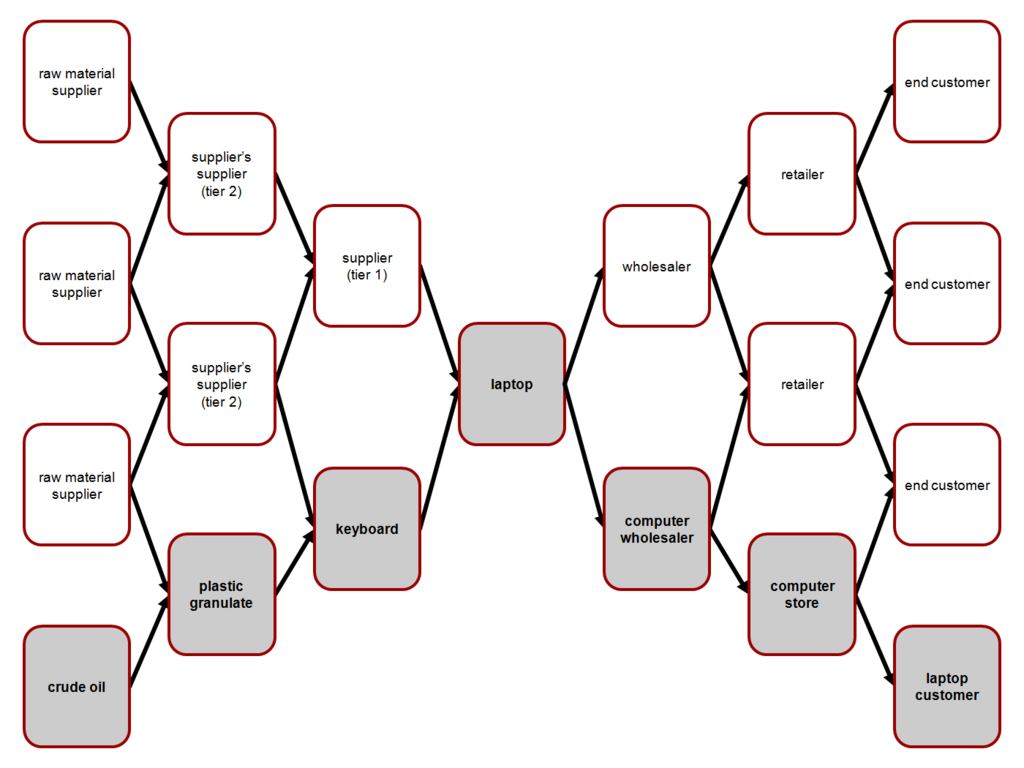
By connecting procurement, production, and logistics with a shared flow of information, businesses can respond more quickly to changes in customer demand and potential disruptions.
Which of the following best describes a supply chain?
A furniture company buys lumber to build tables. This activity is part of which key supply chain function?