Science Olympiad Water Quality Essentials
Water Cycle
The Endless Journey of Water
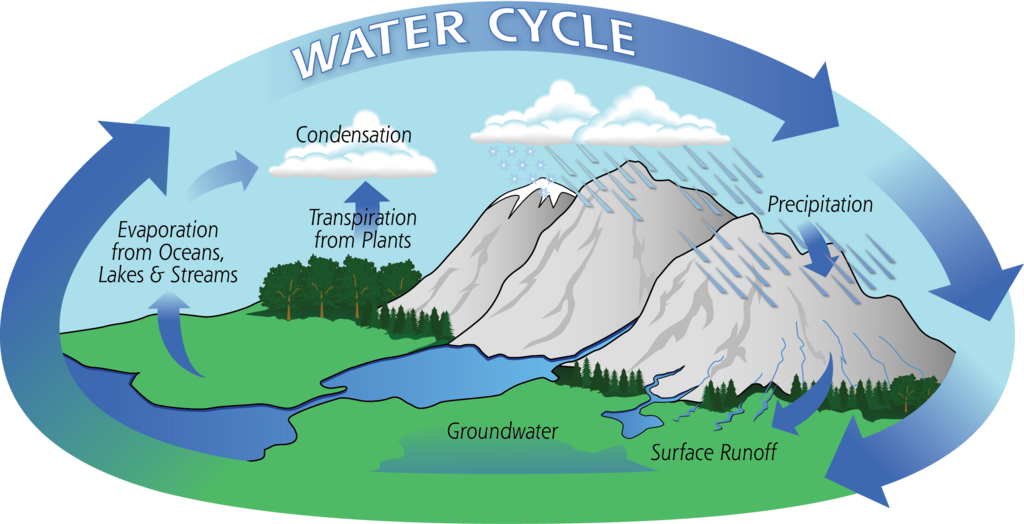
Water is constantly on the move. It travels from the ground to the atmosphere and back again in a continuous process called the water cycle, or the hydrologic cycle. This cycle is essential for all life on Earth, distributing water and heat across the globe.
The water cycle describes how Earth's water is not only always changing forms, between liquid (rain), solid (ice), and gas (vapor), but also moving on, above, and in the Earth.
This journey has several key stages. Let's trace the path a water molecule might take.
From Surface to Sky
The sun is the engine that drives the water cycle. It provides the energy that lifts water from the Earth's surface into the atmosphere through a process called evaporation. When water in oceans, lakes, or rivers heats up, it changes from a liquid to a gas called water vapor. This vapor then rises into the air.
Oceans are the primary source of atmospheric water. About 90% of the moisture in the atmosphere comes from the evaporation of water from oceans, seas, lakes, and rivers.
Plants also release water vapor into the air from their leaves in a process called transpiration. It's like the plants are breathing out water. Together, evaporation and transpiration send a huge amount of water into the atmosphere every day.
From Sky to Surface
As water vapor rises, it cools down. This cooling causes the vapor to turn back into tiny liquid water droplets, a process known as condensation. These droplets, along with ice crystals, gather together to form clouds.
precipitation
noun
Any form of water—liquid or solid—that falls from clouds and reaches the ground.
When these droplets or crystals become too heavy to stay suspended in the air, they fall to Earth as precipitation. This can take the form of rain, snow, sleet, or hail, depending on the temperature.
Water's Return Trip
Once water reaches the ground, it can take a few different paths. Some of it soaks into the soil in a process called infiltration. This water can be taken up by plants or can seep deeper to become groundwater, which is water stored in underground layers of rock and soil.
Water that doesn't soak into the ground flows over the land as runoff. It travels across the surface, collecting in streams, rivers, and lakes, and eventually makes its way back to the ocean, where the cycle can begin all over again.
This movement of water is crucial. It replenishes freshwater sources that we depend on for drinking, agriculture, and industry.
Earth's Water Supply
While it seems like water is everywhere, the amount available for us to use is surprisingly limited. About 97% of Earth's water is saltwater found in oceans. It's too salty for drinking or farming without expensive treatment.
That leaves only about 3% as freshwater. And most of that isn't easy to get to. Over two-thirds of all freshwater is locked up in glaciers and ice caps. The rest is mostly found underground as groundwater or in lakes and rivers.
| Water Source | Percentage of Total Water |
|---|---|
| Oceans (saltwater) | 97% |
| Freshwater | 3% |
This small fraction of accessible freshwater is what supports most life on land, including us. The water cycle continuously purifies and distributes this vital, limited resource.