Science and the Making of Modern European Culture
Cosmological Paradigm Shifts
A Universe Built for Humanity
For centuries, the universe was an orderly, intuitive place. At its center was Earth, stationary and unique. Around it, nested in a series of perfect, transparent spheres, spun the Moon, Mercury, Venus, the Sun, Mars, Jupiter, and Saturn. Beyond them all lay the sphere of fixed stars, and finally, the realm of God.
This was the Aristotelian-Ptolemaic model, a synthesis of Greek philosophy and later astronomical calculations. It was more than a scientific theory; it was a complete cosmology that affirmed humanity's central role in creation. The universe was literally built around us. This model divided the cosmos into two distinct regions: the terrestrial and the celestial. Everything below the Moon's orbit—the sublunar realm—was a place of change, decay, and imperfection. It was composed of the four elements: earth, water, air, and fire. In contrast, the heavens were perfect, eternal, and unchanging, made of a fifth element called aether.
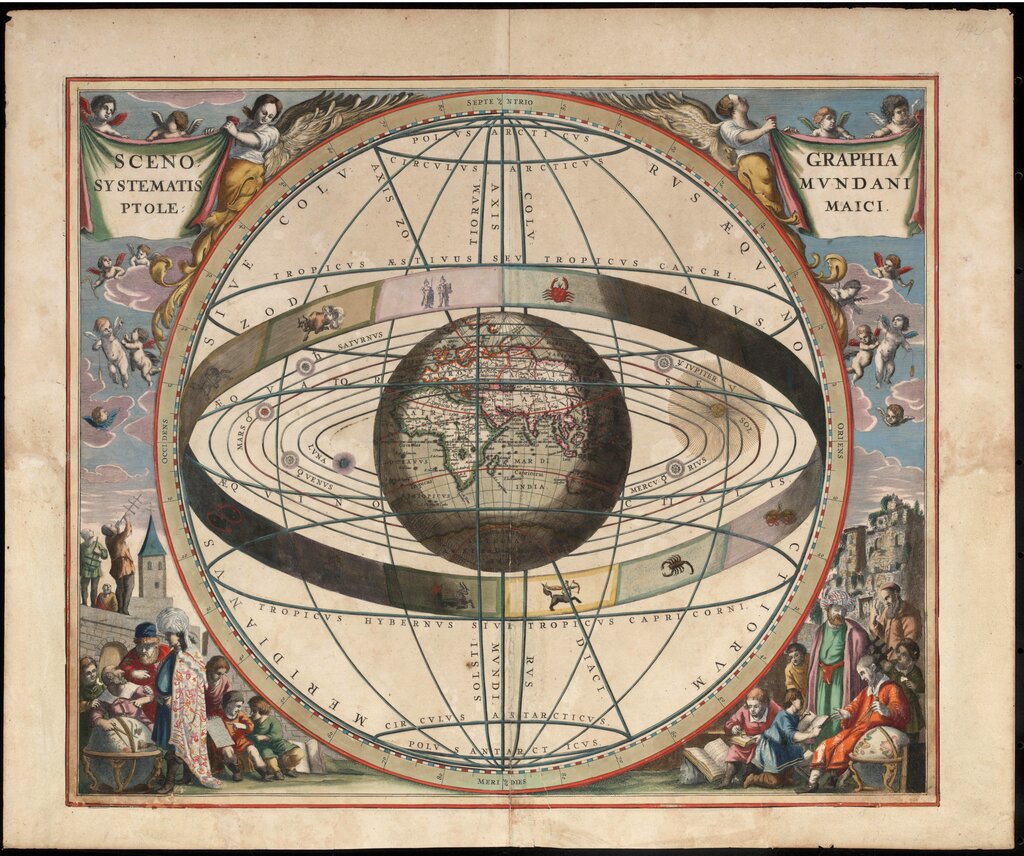
This physical hierarchy mirrored a spiritual and social one known as the Great Chain of Being. This concept organized all of existence into a strict pecking order, from God at the very top, down through angels, humans, animals, plants, and finally inanimate matter like rocks. Every being had its designated place.
In this system, humanity occupied a crucial middle rung. We were the bridge between the spiritual and the material, possessing both a soul and a physical body. This cosmic structure reinforced the social order on Earth. The king ruled the state just as God ruled the universe. The father ruled the family. Each person had a defined role and station, and to challenge that was to challenge the very fabric of reality.
A Crack in the Crystal Spheres
Nicolaus Copernicus's heliocentric model, placing the Sun at the center of the universe, was not just an astronomical adjustment. It was a metaphysical earthquake. By demoting Earth to just another planet orbiting the Sun, Copernicus inadvertently tore a hole in the Great Chain of Being.
If Earth was no longer the unique center of creation, what did that imply about humanity's special status? If our world, a place of sin and imperfection, was now located among the perfect celestial spheres, the clear distinction between the terrestrial and the divine collapsed. This was profoundly unsettling. The theological objections from both Catholic and Protestant authorities were not simply about contradicting a few lines of scripture. They were about defending an entire worldview that underpinned social and religious stability.
To move the Earth was to move the foundations of society itself. If humanity was no longer the focal point of the physical universe, perhaps human authority—whether of popes or kings—was not as absolute as it seemed.
This resistance wasn't just dogmatic; it was a defense of a cohesive, ordered reality. The Copernican model created paradoxes. It implied a universe of incomprehensible size, with the stars scattered at immense distances. It also failed to immediately provide better predictions than the Ptolemaic system, which had been refined for over a thousand years. For a time, it was easier to dismiss the new model as a mathematical fantasy than to grapple with its terrifying implications.
The New Mechanics of Heaven
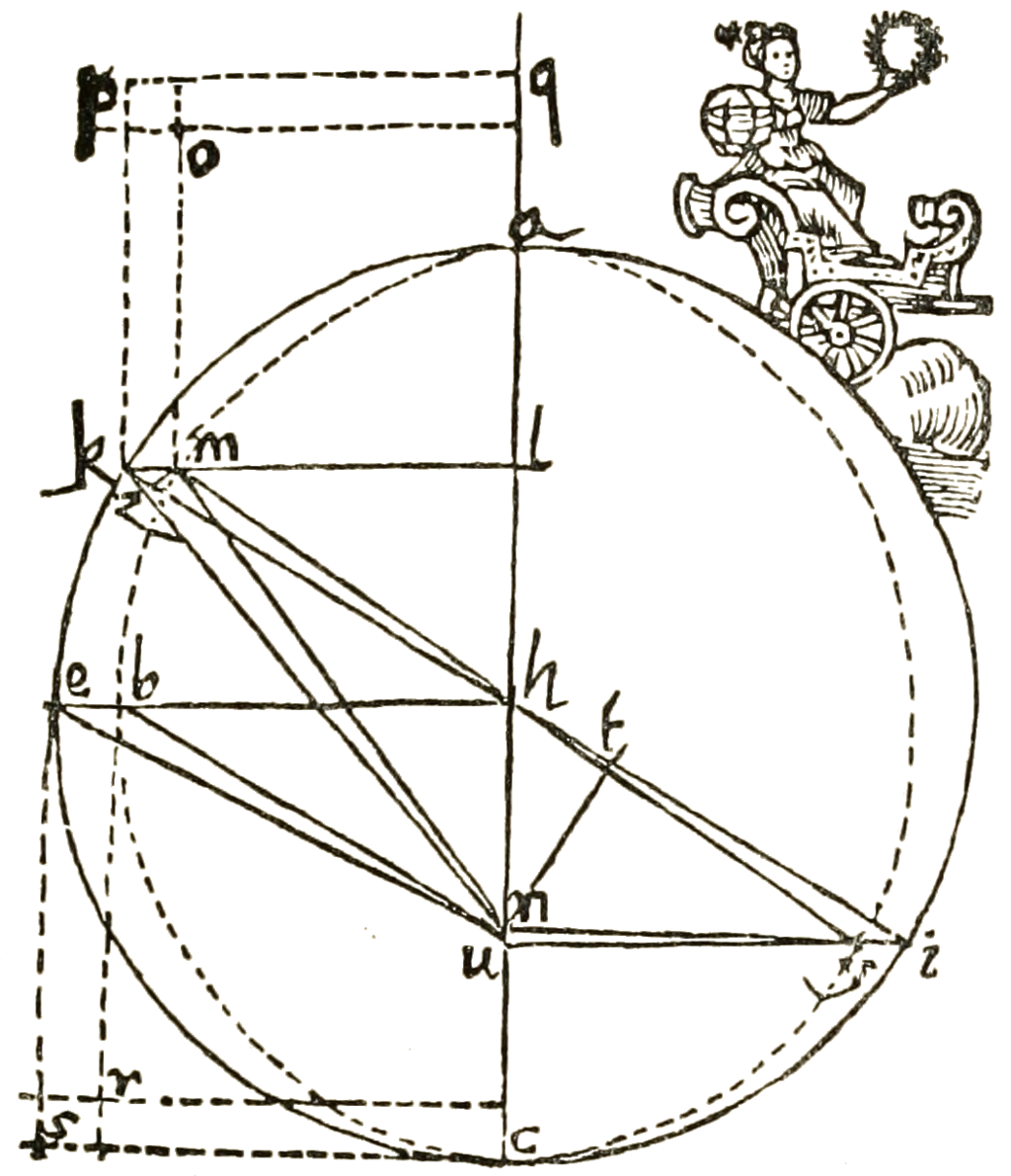
While Copernicus moved the Earth, he kept one foot firmly in the ancient world by retaining the idea of perfect circular orbits. It was Johannes Kepler who truly broke from this tradition. Using the meticulous observational data of Tycho Brahe, Kepler discovered that planets do not move in circles, but in ellipses.
Kepler's laws of planetary motion transformed astronomy into a true physical science. The planets were no longer guided by angelic beings or fixed to crystalline spheres. Instead, they moved according to forces that could be described with mathematics. The universe began to look less like a divinely ordained hierarchy and more like a giant, intricate machine.
This shift necessitated a change in the perception of God. The deity of the Great Chain of Being was intimately involved in every level of creation. The new 'mechanical' cosmos suggested a more distant creator—a divine clockmaker who had designed the universal machine, wound it up, and let it run according to its own physical laws.
A Sideways Glance
If Kepler provided the mathematical framework, Galileo Galilei provided the empirical proof that shattered the old cosmos. In 1610, he published Sidereus Nuncius (The Starry Messenger), a short pamphlet describing the shocking discoveries he had made with his newly constructed telescope.
| Observation | What Galileo Saw | Old Belief Challenged |
|---|---|---|
| The Moon | A cratered, mountainous surface, much like Earth's. | The heavens are perfect, smooth, and utterly different from the corruptible Earth. |
| Jupiter | Four small 'stars' orbiting the planet. | All heavenly bodies must orbit the Earth. |
| Venus | A full set of phases, just like the Moon. | Venus orbits the Earth. (This was impossible in the Ptolemaic model). |
| The Stars | Millions of previously unseen stars. | The universe is small and contained; the stars are fixed to a single sphere. |
Galileo’s observations were direct, observable evidence that the Aristotelian-Ptolemaic model was wrong. The Moon was not a perfect orb. Celestial bodies orbited planets other than Earth. The universe was vastly larger than anyone had imagined.
The Starry Messenger was a bestseller. It was written in a clear, accessible style, and its impact went far beyond academia. It forced people to confront a new reality. The heavens were not a realm of divine perfection but a physical space filled with worlds. This realization didn't just change astronomy; it changed what it meant to be human. We were no longer at the center of everything, but inhabitants of a small planet in an immense and indifferent cosmos. The paradigm had shifted, and the modern world had begun.
According to the Aristotelian-Ptolemaic model, what was the fundamental difference between the sublunar (terrestrial) realm and the celestial realm?
The primary reason Copernicus's heliocentric model was so unsettling was that it provided less accurate predictions of planetary positions than the established Ptolemaic model.
The journey from a geocentric to a heliocentric universe was more than a scientific update. It was a fundamental reordering of humanity's place in the cosmos, one that reshaped religion, society, and our own self-perception.