Schopenhauer's Philosophy of Will
Introduction to Schopenhauer
The Philosopher of Pessimism
Arthur Schopenhauer was a 19th-century German philosopher who built his reputation on being thoroughly unimpressed with existence. Born in 1788 in Danzig (modern-day Gdańsk), he came from a wealthy merchant family. This financial independence allowed him to pursue philosophy without needing a university position for most of his life.
He had a famously difficult relationship with his mother, Johanna, a novelist and salon hostess. After his father's death, their conflicts grew, and they eventually became estranged. Schopenhauer spent his life as a solitary, often cantankerous figure, convinced of his own genius even when the world ignored him.
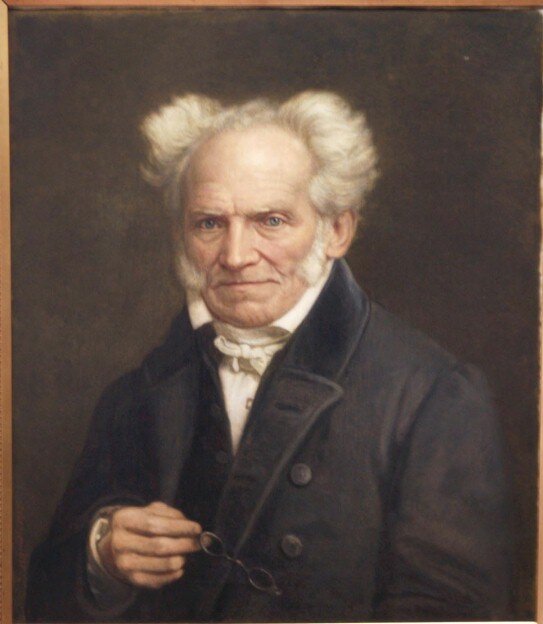
The philosophical world Schopenhauer entered was dominated by German Idealism. Thinkers like G.W.F. Hegel were the superstars of the day, building complex systems that often saw history as a rational process moving toward a positive goal. Schopenhauer found this absurd. He saw the world not as rational and orderly, but as fundamentally irrational, chaotic, and filled with suffering. He was a staunch contrarian, deliberately publishing his main work at the same time as Hegel's to compete for attention. It didn't work; Hegel remained far more famous during their lifetimes.
The World as Will
Schopenhauer’s masterpiece is The World as Will and Representation, published in 1818. The title lays out his entire philosophy. The "Representation" is the world as we experience it through our senses and intellect. It's the world of objects in space and time, governed by cause and effect. This part of his thinking was heavily influenced by Immanuel Kant, who argued that we can only know the world as it appears to us (the phenomenal world), not as it is in itself (the noumenal world).
Schopenhauer agreed with Kant but took a radical step further. He claimed we can get a glimpse of the world-in-itself. He called this underlying reality the "Will." This isn't a personal, conscious will, like our decision to have coffee. It's a blind, endless, striving force that drives everything in the universe, from the orbit of planets to the growth of a plant to our own deepest desires.
The world we see is just the surface. Underneath, a relentless, irrational force called the Will drives everything, causing endless striving and suffering.
This concept of the Will is the source of Schopenhauer's pessimism. Because the Will is a constant, insatiable force, life is an endless cycle of desire, temporary satisfaction, and new desire. We are puppets of this cosmic striving. Fulfilling one want only leads to another, or worse, to the emptiness of boredom. For Schopenhauer, suffering is the default state of existence.
Eastern Echoes
Unusually for a European philosopher of his time, Schopenhauer looked beyond the Western tradition. He was one of the first major thinkers to seriously incorporate Eastern philosophy into his work. He read Latin translations of Hindu texts like the Upanishads and was deeply interested in Buddhism.
He found striking parallels between his ideas and Eastern thought. He saw his concept of the "Representation" as similar to the Hindu concept of Maya, the veil of illusion that hides true reality. He also connected the relentless striving of the Will to the Buddhist concept of Dukkha, the fundamental suffering and unsatisfactoriness of life caused by craving and attachment.
Schopenhauer offered a stark and challenging alternative to the dominant philosophies of the 19th century. By combining Kant's framework with the idea of a blind, irrational Will and drawing inspiration from Eastern traditions, he created a worldview that, while deeply pessimistic, continues to resonate with those who question the inherent goodness or rationality of the world.