Scale Your Digital Agency
Understanding Systems Thinking
Seeing the Whole Picture
Imagine your business is a complex machine. You could spend all your time examining one gear, polishing it, and making sure it's perfect. But if you don't understand how that gear connects to all the others, the machine might still break down. Systems thinking is the practice of stepping back to see the entire machine, not just its individual parts.
It's a way of understanding how things influence one another within a whole. Instead of focusing on isolated events or departments, you look for connections, patterns, and relationships. In a digital agency, this means you stop seeing 'sales,' 'design,' and 'client support' as separate silos. You start seeing them as interconnected parts of a single system that delivers value to your clients.
Connections and Consequences
The core of systems thinking lies in two key concepts: interdependencies and feedback loops. Interdependencies mean that different parts of a system rely on each other. A decision in one area will always have ripple effects elsewhere.
For example, when your sales team lands a new client by promising a tight deadline, it doesn't just affect them. That promise immediately impacts the project management team's schedule, the design team's creative process, and the development team's workload. These connections are the pathways through which actions travel in an organization.
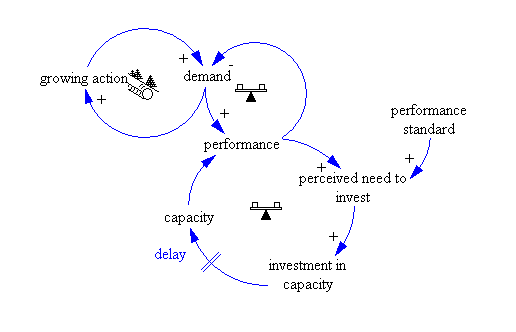
These interdependencies create feedback loops, which are circular chains of cause and effect. There are two main types.
Reinforcing Loops: These amplify change, creating exponential growth or decline. Think of a snowball rolling downhill. More successful projects lead to more client referrals, which brings in more projects. The effect compounds over time.
Balancing Loops: These resist change and try to maintain stability. If your team gets overloaded with too many projects (from a reinforcing loop!), quality might drop. This leads to fewer referrals, which slows down new business until the team catches up. The system self-corrects.
More Than the Sum of its Parts
When parts of a system interact, they can create outcomes that you wouldn't expect by looking at the parts in isolation. These are called emergent properties. A classic example is a flock of birds. No single bird is in charge, and there's no master plan. Yet, the flock moves as a single, coordinated entity. That coordinated movement is an emergent property.
In your agency, the company culture is an emergent property. You can't find 'culture' in a single employee or a mission statement on the wall. It emerges from the thousands of daily interactions, shared values, communication styles, and leadership behaviors. The agency's reputation in the market is another one. It's not the result of one successful project, but the cumulative effect of all your work, client relationships, and marketing efforts over time.
Understanding this helps you realize you can't directly command a great culture into existence. Instead, you have to influence the underlying interactions and conditions that allow a great culture to emerge.
By applying systems thinking, you shift from reacting to individual problems to designing a healthier, more resilient organization. You start asking different questions: not just "How do we fix this one late project?" but "What is in our system that makes late projects happen, and where can we intervene to change that pattern?" This perspective is key to making lasting improvements and scaling effectively.
What is the primary focus of systems thinking?
A sales team promising a tight deadline to a new client directly impacts the workload of the design and development teams. This is a clear example of...