Scalable Kubernetes Microservices
Microservices Architecture
Breaking Down the Monolith
For a long time, the standard way to build software was to create a single, unified application. Think of it like a giant, self-contained unit where every feature—user authentication, payment processing, product catalog—is woven together into one massive codebase. This is called a monolithic architecture.
Monoliths are simple to build and deploy at first. Everything is in one place. But as the application grows, this simplicity becomes a problem. Making a small change to one feature requires testing and redeploying the entire application. If one part fails, the whole system can crash. Scaling becomes an all-or-nothing game; you have to scale the entire application, even if only one small feature is getting all the traffic.
Microservices architecture offers a different approach. Instead of one big application, you build a collection of small, independent services.
Each service is built around a specific business capability, like handling user profiles or managing the shopping cart. These services are developed, deployed, and scaled independently. If the user profile service needs an update, you only touch that service. If it fails, it doesn't necessarily bring down the shopping cart or payment services.
Core Principles of Microservices
This architectural style is guided by a few key ideas that make it powerful.
Autonomy
noun
Each microservice is a self-contained unit. The team responsible for it has full ownership, from development to deployment and maintenance. They can choose the best technology for their specific service without being constrained by the choices made for other services. This independence allows teams to move faster.
Services are also loosely coupled. This means they have minimal dependency on each other. They communicate through well-defined APIs (Application Programming Interfaces), which act as stable contracts. As long as the contract isn't broken, a team can change the inner workings of their service without forcing other teams to make changes. This prevents a ripple effect of changes across the system.
Finally, microservices are built for scalability. With a monolith, if your payment processing gets heavy traffic, you have to scale the entire application. With microservices, you can scale just the payment service. This is far more efficient, saving on resources and cost. You can allocate computing power precisely where it's needed.
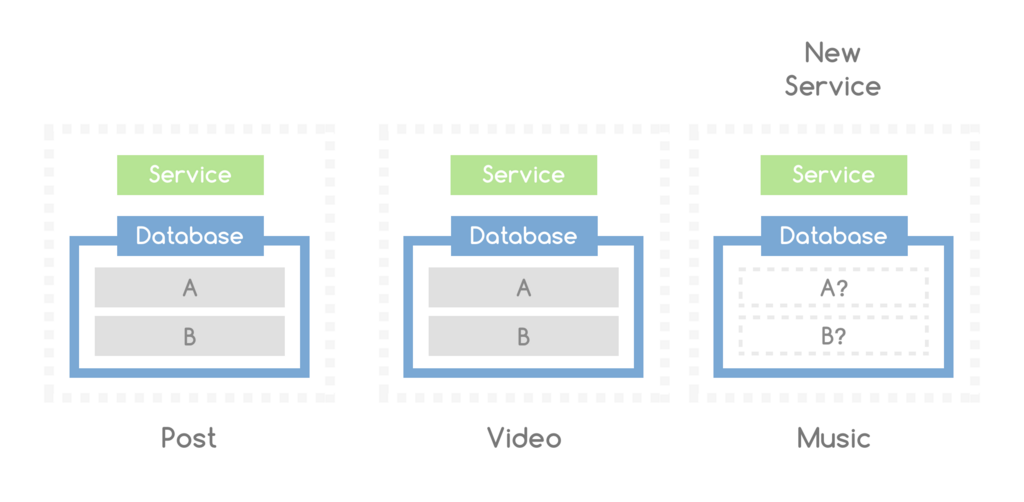
Finding the Right Boundaries
One of the biggest challenges in designing a microservices architecture is deciding how to split the application. How small is a "microservice"? What functions should be grouped together?
If you make services too small, you can end up with a complex web of communication that's hard to manage. If they're too large, you start creeping back toward a monolithic design.
This is where Domain-Driven Design (DDD) comes in. DDD is an approach that focuses on the core business domain. Instead of thinking about technical layers (like "data access" or "user interface"), you model your software around the real-world business concepts.
You identify different parts of the business, called "bounded contexts." A bounded context is a specific area with its own vocabulary and logic. For an e-commerce site, 'Sales', 'Shipping', and 'Customer Support' could be separate bounded contexts. Each of these is a strong candidate to become a microservice or a set of related microservices.
By aligning service boundaries with business domains, you create services that are more logical, cohesive, and easier to maintain.
This approach ensures that each service has a clear, well-defined purpose that makes sense to everyone, from developers to business stakeholders. Getting these boundaries right is crucial for building a system that is resilient, scalable, and adaptable to change.
What is the primary disadvantage of a monolithic architecture as an application grows larger and more complex?
An e-commerce platform sees a massive surge in traffic to its payment processing service, while other services like the product catalog remain stable. In a well-designed microservices architecture, what is the most efficient response?