Saturn Spacecraft Program
Introduction to Saturn Exploration
A Voyage to the Ringed Planet
The Cassini-Huygens mission represents one of humanity's most ambitious journeys to the outer solar system. It wasn't just about taking pictures; it was a comprehensive effort to understand the entire Saturn system, from the planet's stormy atmosphere to its magnificent rings and dozens of moons. This massive undertaking wasn't the work of a single country. It was a joint project between NASA, the European Space Agency (ESA), and the Italian Space Agency (ASI), combining resources and expertise to explore a distant world.
Mission Goals
The mission had a long list of scientific goals. Researchers wanted to study the structure and behavior of Saturn's atmosphere and rings. They aimed to map the planet's powerful magnetic field, or magnetosphere. A major focus was also on Saturn's moons, particularly the enigmatic Titan, which is shrouded in a thick, nitrogen-rich atmosphere, and the icy Enceladus, which was later found to have geysers erupting from its surface.
An Epic Journey
The Cassini-Huygens spacecraft launched from Earth in October 1997. To get to Saturn, it didn't take a direct path. Instead, it used gravity assists, swinging by Venus twice, then Earth, and finally Jupiter, to build up enough speed for its long trip. After a journey of nearly seven years, the spacecraft finally arrived and entered orbit around Saturn in July 2004. Its mission, originally planned for four years, was extended multiple times, ultimately lasting for 13 years of exploration within the Saturn system. The entire mission, from launch to finish, spanned two decades.
The Cassini-Huygens mission spent 20 years in space, with 13 of those years spent orbiting and studying Saturn up close.
Two Spacecraft in One
The mission was composed of two main parts. The first was the Cassini orbiter, a sophisticated spacecraft about the size of a school bus. It was built by NASA and carried a dozen scientific instruments to study Saturn and its system from orbit. Attached to Cassini was the second component: the Huygens probe. Built by the ESA, this saucer-shaped probe had one specific, high-stakes job: to descend through the thick atmosphere of Saturn's largest moon, Titan, and land on its surface.
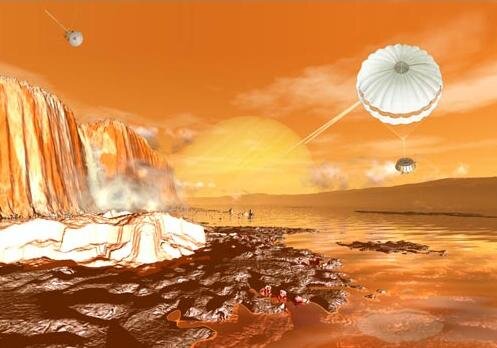
In January 2005, the Huygens probe detached from Cassini and successfully made its descent, giving us our first and only landing in the outer solar system. It sent back incredible data about Titan's atmosphere and images from its mysterious, frigid surface before its batteries died a few hours later. Meanwhile, the Cassini orbiter continued its long, fruitful tour of the Saturn system, revolutionizing our understanding of gas giants and their moons until its mission ended in 2017.
The Cassini-Huygens mission was a collaborative effort between which three space agencies?
What was the specific, primary objective of the Huygens probe?
The international collaboration and dual-spacecraft design of Cassini-Huygens set a new standard for robotic exploration.