Satellite Fundamentals
Introduction to Satellite Technology
What Is a Satellite?
In the simplest terms, a satellite is any object that orbits another, larger object in space. The Moon is a natural satellite of Earth. Humans, however, have been launching artificial satellites since the mid-20th century. These are complex machines sent into space to perform specific jobs.
Think of an artificial satellite as a very tall tower. From its high vantage point, it can see a large portion of the Earth's surface at once. This unique position allows it to do things that would be impossible from the ground, like relaying communication signals over vast distances or taking wide-angle pictures of weather patterns.
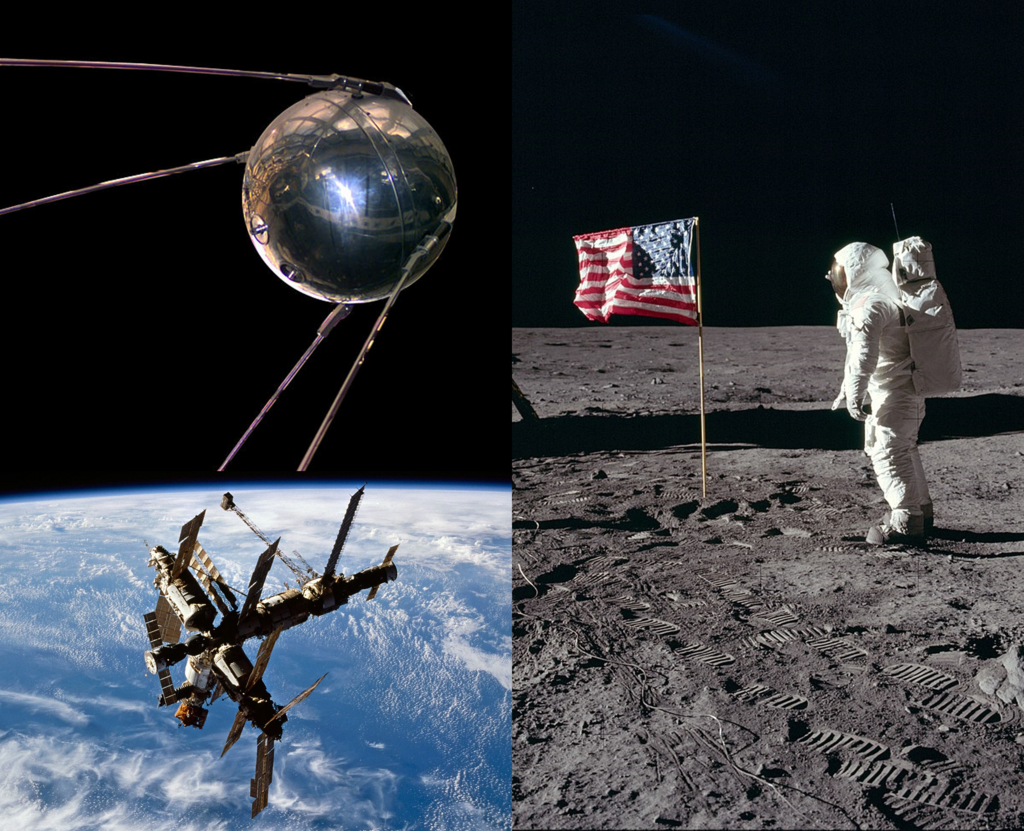
A Quick History
The story of artificial satellites begins on October 4, 1957. On that day, the Soviet Union launched Sputnik 1, a polished metal sphere just 58 centimeters in diameter. It did little more than orbit Earth and transmit a simple, repeating radio beep, but its impact was enormous. It kicked off the Space Race between the United States and the Soviet Union.
The United States responded a few months later, launching its first satellite, Explorer 1, on January 31, 1958. Explorer 1 was more than just a competitor; it carried scientific instruments that led to the discovery of the Van Allen radiation belts, a zone of charged particles held in place by Earth’s magnetic field. These early missions paved the way for the thousands of satellites that orbit our planet today.
Anatomy of a Satellite
While satellites come in many shapes and sizes, they are all built from a common set of parts, each with a crucial role. A satellite has two main sections: the bus and the payload.
The bus is the satellite's main body and includes everything needed to keep it running. The payload is the equipment that performs the satellite's specific mission.
Let's break down the key subsystems, which are mostly part of the bus.
Bus
noun
The main structural body of the satellite that houses the essential systems.
- Structure: This is the physical frame of the satellite, holding everything together. It's often called the bus.
- Power System: Most satellites are solar-powered. They have large solar panels that convert sunlight into electricity. This power is stored in rechargeable batteries to keep the satellite running when it's in Earth's shadow.
- Propulsion System: Small rockets or thrusters allow the satellite to make adjustments to its orbit or orientation. This is crucial for keeping it in the correct position over its lifetime.
- Attitude Control: This system keeps the satellite pointed in the right direction. It uses sensors like star trackers and gyroscopes to know its orientation and small devices like reaction wheels or thrusters to adjust it.
- Communication System: Antennas and radios, known as transceivers, send and receive signals from Earth. This is how ground controllers command the satellite and how the satellite sends its data back.
- Payload: This is the whole reason for the mission. For an Earth observation satellite, the payload might be a powerful camera. For a communication satellite, it's the set of transponders that relay signals.
How Satellites Communicate
Satellite communication is a two-way street. A signal must travel from a ground station on Earth up to the satellite, and then from the satellite back down to a receiver on Earth.
The signal sent from the ground up to the satellite is called the uplink. The signal sent from the satellite back down to the ground is the downlink.
A key component in this process is the transponder. It’s a unit on the satellite that receives the uplink signal, amplifies it to make it stronger, changes its frequency to avoid interference with the uplink, and then transmits it as the downlink. Satellites often have many transponders to handle multiple communication channels at once.
Satellite communication is a technology that uses orbiting satellites to send and receive signals for various applications like television broadcast, internet services, and global positioning systems.
Classifying Satellites
Satellites can be categorized by their job. While there are many specialized missions, most fall into one of four main groups.
| Satellite Type | Primary Function |
|---|---|
| Communication | Relay television, phone, and internet signals around the world. |
| Navigation | Provide precise location and timing information (e.g., GPS). |
| Earth Observation | Monitor weather, climate, land use, and natural disasters. |
| Scientific | Explore space, study stars and planets, and conduct experiments. |
From enabling a phone call across an ocean to tracking a hurricane's path, these different types of satellites play a fundamental role in our modern world.
Now that you understand the basics, let's test your knowledge.
What was the primary significance of the Sputnik 1 satellite launch in 1957?
The two main sections of a satellite are the payload and the ______.
Understanding these core concepts is the first step. Next, we'll explore the paths these satellites take as they circle the Earth.