SAT Trigonometry Essentials
Right Triangle Basics
What Makes a Triangle Right?
A right triangle is a triangle with one angle that measures exactly 90 degrees. This special angle is called a right angle, and it's usually marked with a small square in the corner.
The two sides that form the right angle are called the legs. The third side, which is always the longest and sits opposite the right angle, is called the hypotenuse.
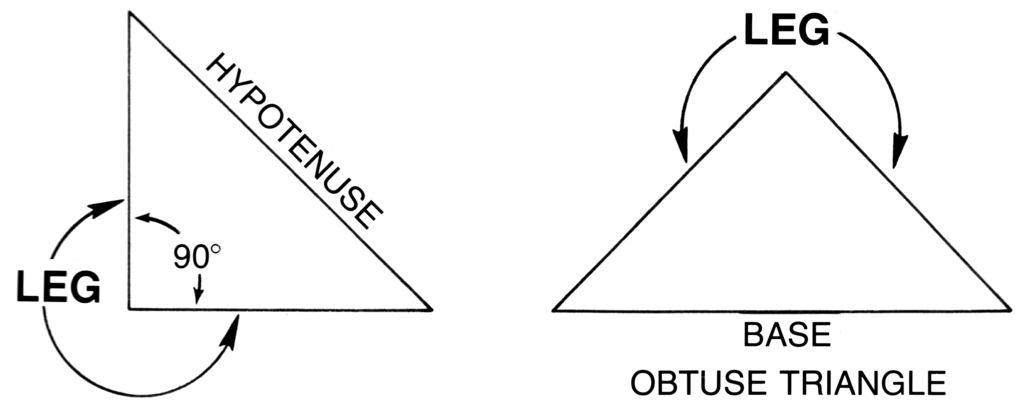
One key property of any triangle is that its three interior angles always add up to 180 degrees. Since a right triangle already uses up 90 of those degrees, the other two angles must be acute (less than 90 degrees) and add up to 90 degrees themselves.
The Pythagorean Theorem
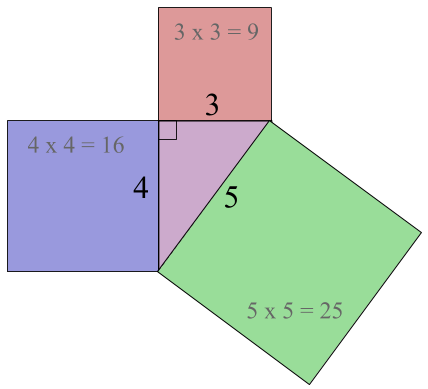
Right triangles have a unique and powerful relationship between their sides, described by the Pythagorean theorem. It’s a formula that connects the lengths of the two legs to the length of the hypotenuse.
The theorem states that for any right triangle with legs of length a and b and a hypotenuse of length c, the following equation is true:
In simple terms, if you square the lengths of the two legs and add them together, you get the square of the length of the hypotenuse.
Let's see it in action. Imagine a right triangle with legs that are 6 inches and 8 inches long. To find the length of the hypotenuse (c), we can use the theorem:
- Square the lengths of the legs: and .
- Add them together: .
- This sum is equal to , so .
- Find the square root of 100 to get the length of c: .
The hypotenuse is 10 inches long.
You can also use the theorem to find a missing leg if you know one leg and the hypotenuse. Say a right triangle has a hypotenuse of 13 cm and one leg of 5 cm. Let's call the missing leg b.
- Start with the formula: .
- Plug in the values we know: .
- Calculate the squares: .
- Subtract 25 from both sides to isolate : , which gives .
- Take the square root: .
The missing leg is 12 cm long.
Pythagorean Triples
Some right triangles have side lengths that are all whole numbers. These sets of three integers are called Pythagorean triples. The triangles we just worked with, 6-8-10 and 5-12-13, are examples.
Knowing the most common triples can be a huge time-saver, especially on standardized tests. If you see a right triangle with legs of 3 and 4, you can instantly know the hypotenuse is 5 without doing any calculations.
| Leg (a) | Leg (b) | Hypotenuse (c) |
|---|---|---|
| 3 | 4 | 5 |
| 5 | 12 | 13 |
| 8 | 15 | 17 |
| 7 | 24 | 25 |
Also, any multiple of a Pythagorean triple is also a triple. For example, since 3-4-5 is a triple, so are 6-8-10 (multiplied by 2) and 9-12-15 (multiplied by 3). Recognizing these patterns is a great shortcut for solving problems involving right triangles.
In a right triangle, the two sides that form the 90-degree angle are called the legs. What is the name of the side opposite the right angle?
The three interior angles of any triangle add up to 180 degrees. If a right triangle has one angle that measures 40 degrees, what is the measure of the third angle?
Mastering these basics will give you a solid foundation for tackling more advanced geometry and trigonometry problems.