Saraswati Veena Foundations and Technique
Instrument Anatomy
The Body of the Veena
The Saraswati Veena is a marvel of acoustic engineering, with each part serving a distinct purpose. The instrument's main body is dominated by the Kudam, a large, bowl-shaped resonator typically carved from a single block of jackfruit wood. This hollow chamber is responsible for the instrument's deep, resonant tone. Attached to the Kudam is a long, hollow neck called the Dandi. The Dandi not only supports the frets and strings but also acts as a secondary resonating chamber.
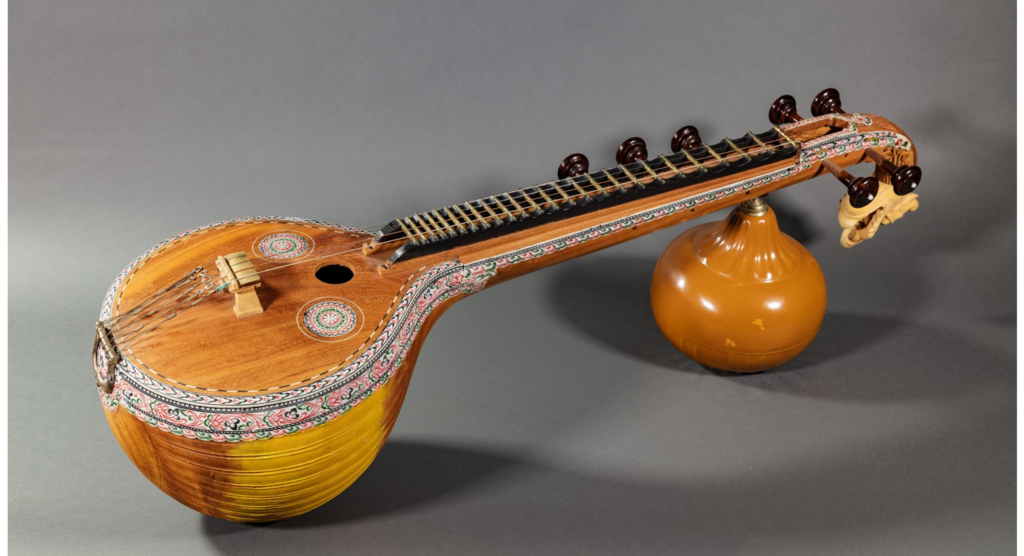
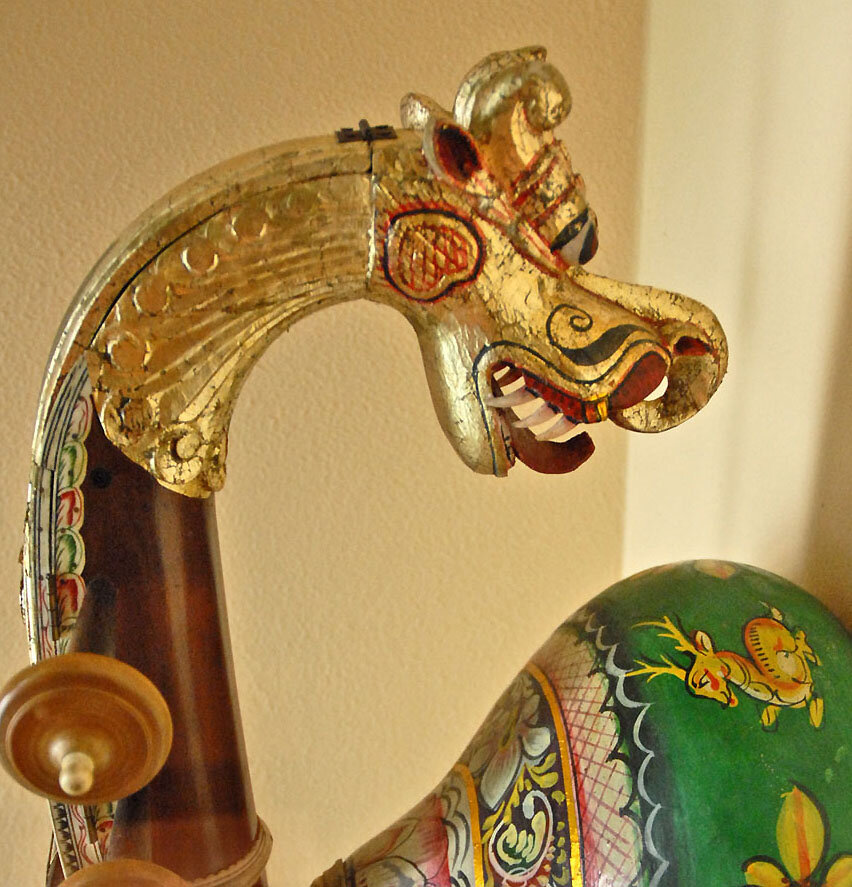
At the end of the Dandi, you'll find an ornate, downward-curving scroll. This is not just decoration; it's a carved figure called the Yali, a mythical creature from Hindu mythology. While it adds to the instrument's beauty, it also serves a practical purpose, acting as a counterweight to the large Kudam and helping the instrument balance when played. Sometimes, a smaller, secondary resonator made from a gourd is attached beneath the Dandi near the Yali to provide further support and balance.
Strings and Frets
The Veena has two distinct sets of strings. Four main playing strings run over the top of the Dandi. These are used to play the melody. To the side of the Dandi, running parallel to the main strings, are three auxiliary strings known as the Tala strings. These are used to provide rhythmic accompaniment and a drone, much like the sympathetic strings on a sitar. They are not fretted but are plucked with the little finger to keep time.
The main strings pass over a wide, flat-topped bridge called the Kudurai. This bridge is typically made of brass and wood. Its broad, slightly curved surface is crucial for producing the instrument's characteristic buzzing timbre, known as 'jivari'. The vibrations of the string against this surface create the rich overtones that give the Veena its unique voice.
Unlike a guitar's embedded metal frets, the Veena has 24 movable brass frets set on two parallel ledges of hardened beeswax mixed with charcoal powder. This ledge is called the Melam. The beeswax allows the frets to be precisely positioned and adjusted. This is vital for the performance of Carnatic music, which relies heavily on microtonal inflections and slides (gamakas) between notes. The height and curve of the Melam must be perfect to allow the player to pull the string across the fret, bending the pitch by several semitones without the string buzzing against lower frets.
Tuning and Tension
All seven strings are attached to large wooden tuning pegs, or Biradai, at the neck of the instrument. The four main playing strings are attached to pegs on the side of the Dandi, while the three Tala strings are attached to pegs on the top. These pegs hold the strings under tension. At the other end, the strings pass over the Kudurai and are secured to metal posts or hooks called Langars, which are anchored to the body of the Kudam. Fine-tuners, small beads near the bridge, allow for subtle adjustments to the pitch without having to turn the large wooden pegs.
Understanding these parts is the first step to appreciating the Veena's complex voice and its role in Carnatic music. Each component, from the wood of the Kudam to the curve of the Kudurai, is designed to work in harmony.
What is the primary function of the Kudam, the large, bowl-shaped part of the Saraswati Veena?
The characteristic buzzing timbre of the Veena, known as 'jivari', is produced by the string's vibration against which component?