Sanskrit and Surya Siddhanta for Vedic Sciences
Sanskrit Alphabet
The Devanagari Script
Sanskrit is written in a script called Devanagari. It might look complex at first, but it's incredibly systematic. Devanagari is an abugida, which means that each consonant character has an inherent vowel sound, typically 'a' (like the 'u' in 'but'). Vowel signs, called mātrās, are then added to change this sound. This makes the script highly phonetic; for the most part, you read exactly what you see written.
Devanagari is phonetic: what’s written is what’s read.
The script is written from left to right. A unique feature is the horizontal line, called a shirorekhā, that runs along the top of the letters, connecting them into words. The alphabet is divided into two main categories: vowels and consonants.
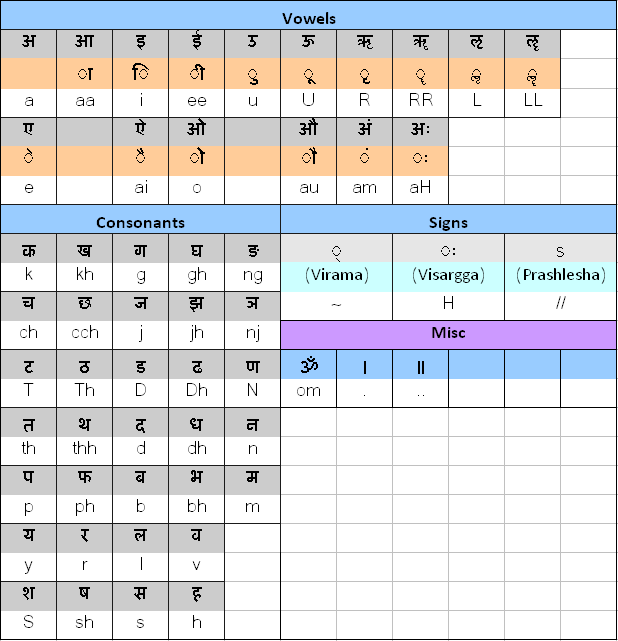
Vowels (Svarāḥ)
Sanskrit has 13 primary vowels, known as svarāḥ (स्वरः). They are categorized as short (hrasva) or long (dīrgha). The distinction is important, as vowel length can change the meaning of a word. A long vowel is held for about twice as long as a short one.
Here are the basic vowels. When a vowel starts a word, it's written with its full, independent character. When it follows a consonant, it's written as a modifying mark (mātrā).
| Devanagari | Transliteration | Pronunciation Guide |
|---|---|---|
| अ | a | Like the 'u' in 'cut' |
| आ | ā | Like the 'a' in 'father' |
| इ | i | Like the 'i' in 'pin' |
| ई | ī | Like the 'ee' in 'see' |
| उ | u | Like the 'u' in 'put' |
| ऊ | ū | Like the 'oo' in 'moon' |
| ऋ | ṛ | A syllabic 'r', like 'ri' in 'river' |
| ॠ | ṝ | The long version of ऋ, very rare |
| ऌ | ḷ | A syllabic 'l', like 'li' in 'linden', also rare |
| ए | e | Like the 'a' in 'say' |
| ऐ | ai | Like the 'ai' in 'aisle' |
| ओ | o | Like the 'o' in 'go' |
| औ | au | Like the 'ow' in 'cow' |
Two additional sounds, the anusvāra and visarga, act like vowel modifiers. The anusvāra (अं) adds a nasal sound (like 'm' or 'n'), while the visarga (अः) adds a soft, voiceless echo of the preceding vowel, like a puff of air.
Consonants (Vyañjanāni)
The consonants, or vyañjanāni (व्यञ्जनानि), are organized in a brilliantly logical way: by the point of articulation in the mouth, moving from the back to the front. There are 33 in total.
Each row in the table below represents a place of articulation (e.g., gutturals are produced at the back of the throat), and each column represents the manner of articulation (e.g., unaspirated, aspirated, nasal).
| Category | Unaspirated | Aspirated | Voiced Unaspirated | Voiced Aspirated | Nasal |
|---|---|---|---|---|---|
| Gutturals (back of throat) | क (ka) | ख (kha) | ग (ga) | घ (gha) | ङ (ṅa) |
| Palatals (palate) | च (ca) | छ (cha) | ज (ja) | झ (jha) | ञ (ña) |
| Retroflex (roof of mouth) | ट (ṭa) | ठ (ṭha) | ड (ḍa) | ढ (ḍha) | ण (ṇa) |
| Dentals (teeth) | त (ta) | थ (tha) | द (da) | ध (dha) | न (na) |
| Labials (lips) | प (pa) | फ (pha) | ब (ba) | भ (bha) | म (ma) |
Aspirated consonants (like ख, kha) are pronounced with a noticeable puff of air, similar to the 'p' in 'pot'. Unaspirated consonants (like क, ka) have no such puff, like the 'p' in 'spot'.
Beyond this main grid, there are the semi-vowels and the sibilants (hissing sounds).
| Type | Characters |
|---|---|
| Semi-vowels | य (ya), र (ra), ल (la), व (va) |
| Sibilants | श (śa), ष (ṣa), स (sa) |
| Aspirate | ह (ha) |
Learning this system is the first and most crucial step to reading Sanskrit. With these building blocks, you can begin to sound out any word written in Devanagari.
What type of writing system is Devanagari, where each consonant has an inherent vowel sound that can be modified by other marks?
What is the name of the horizontal line that runs along the top of Devanagari letters, connecting them into words?