Sampling Methods Explained
Introduction to Sampling
Why Sample?
Imagine you want to know the average height of every adult in a country. Measuring millions of people would be an enormous task—expensive, time-consuming, and practically impossible. Instead, you could measure a smaller group and use their average height to estimate the average for the whole country. This is the core idea behind sampling.
sampling
noun
The process of selecting a subset of individuals from within a statistical population to estimate characteristics of the whole population.
Sampling allows us to make well-informed conclusions about a large group by studying a small, manageable part of it. From political polls predicting election outcomes to quality control checks in a factory, sampling is a fundamental tool that makes large-scale research feasible.
Key Ingredients of Sampling
To understand sampling, we first need to get a few key terms straight. These concepts form the foundation of any sampling process.
population
noun
The entire group of individuals, items, or data that you are interested in studying.
The population is the
who
or
what
you want to draw conclusions about. It could be all the trees in a forest, all the emails sent by a company in a year, or all the patients with a specific medical condition.
sample
noun
A specific group of individuals that you will collect data from. The sample is a subset of the population.
The sample is the group you actually study. The characteristics of the sample are used to make inferences about the characteristics of the entire population.
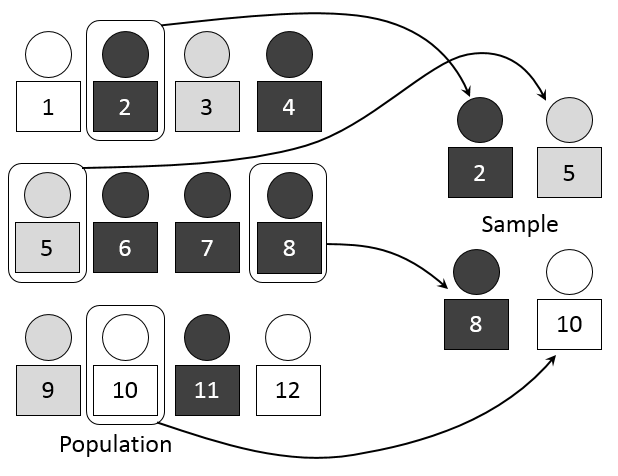
But how do you select individuals for your sample? You need a list to draw from. This list is called the sampling frame.
frame
noun
The list of all the individuals from which a sample is drawn. It should ideally include every member of the population.
A good sampling frame is crucial. If your list is incomplete or inaccurate, your sample won't be a good reflection of the population. For instance, if you use a phone book from 2005 as your sampling frame for a survey today, you'll miss everyone who has moved or only uses a cell phone. This leads to problems.
Avoiding Pitfalls
The goal of sampling is to get a snapshot that accurately reflects the bigger picture. But sometimes, the snapshot can be misleading. This happens when bias or errors creep into the process.
Sampling bias occurs when some members of a population are systematically more likely to be selected in a sample than others.
Imagine you're surveying people about their favorite park, but you only interview people at one specific park on a weekday morning. You're likely to overrepresent retirees and stay-at-home parents and completely miss the opinions of people who work full-time. Your results would be biased.
Another issue is sampling error. This isn't a mistake in the traditional sense. It's the natural difference between a sample and the population it represents. Because a sample is only a part of the whole, its characteristics will rarely match the population's characteristics perfectly.
For example, if the true average height of a population is 5'9", a random sample from that population might have an average height of 5'8" or 5'10". That difference is sampling error.
While you can never eliminate sampling error completely, you can reduce it by increasing your sample size. A larger sample is generally more likely to be a better reflection of the population, just as a larger photo gives you more detail than a tiny thumbnail. Getting sampling right is the first step toward trustworthy research.
A researcher studies the academic performance of 200 freshmen at a large university to understand the performance of all 15,000 freshmen at that university. In this scenario, what does the group of 200 freshmen represent?
What is the primary purpose of using sampling in research?