SaaS Financial Modeling for VC
SaaS Financial Statements
A Different Kind of Financial Story
Financial statements tell a company's story in numbers. For a traditional business, like a furniture store, the story is straightforward. A customer buys a sofa, the store gets paid, and it records the sale. It's a one-time event.
Software as a Service (SaaS) companies tell a different tale. Their story unfolds over time through subscriptions. Instead of a single large purchase, customers pay a recurring fee for access to software. This fundamental difference in the business model changes how their financial statements are structured and read.
For software providers, SaaS offers a recurring revenue model, providing more stability and predictable cash flow compared to one-time software sales.
This shift from one-time sales to ongoing relationships is the key to understanding SaaS financials. It introduces unique concepts, particularly around when a company can actually count the money it's received as revenue.
The Income Statement
The income statement shows a company's profitability over a period, like a quarter or a year. For a SaaS business, the top line, Revenue, is a measure of the service delivered during that time, not the cash collected.
Accounting principles require companies to recognize revenue only when it is earned. If a customer pays $1,200 upfront for a one-year subscription in January, the SaaS company cannot report $1,200 in revenue for January. The service is delivered over 12 months, so the revenue must be recognized over those 12 months.
In this case, the company would recognize $100 in revenue each month ($1200 / 12$). The income statement for January would show $100 in revenue from that customer, even though $1,200 in cash came in the door.
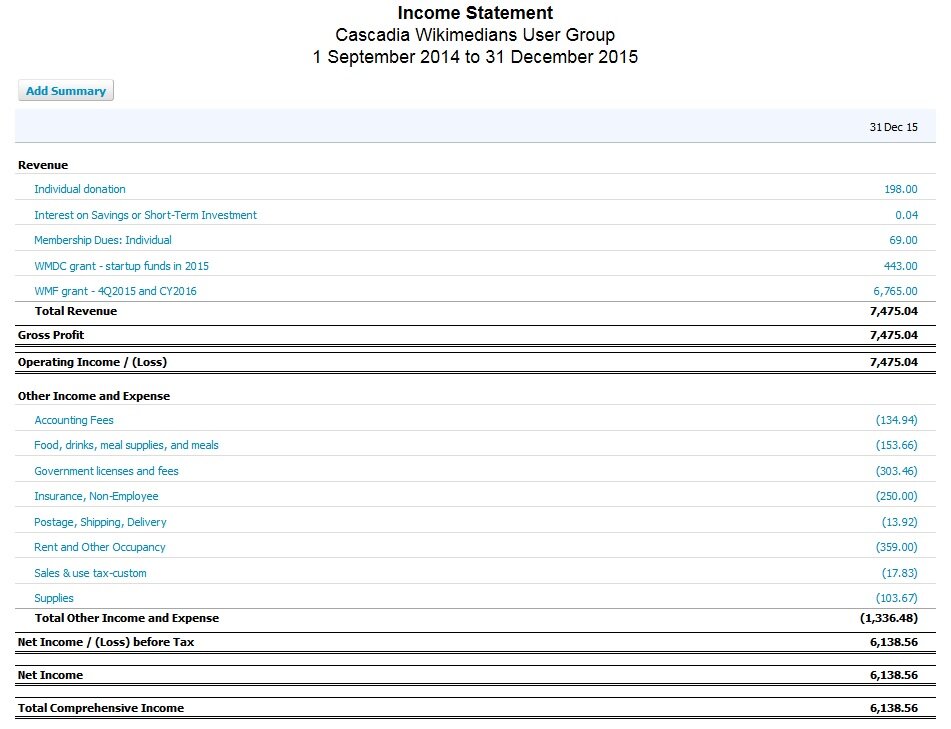
The rest of the SaaS income statement is similar to a traditional one, listing costs like research and development (R&D), sales and marketing, and general administrative expenses. But the way revenue is recorded is the most significant departure.
The Balance Sheet and Deferred Revenue
So, if a customer pays $1,200 in January but the company only recognizes $100 as revenue, where does the other $1,100 go? It appears on the balance sheet as a liability called deferred revenue.
Deferred Revenue
noun
A liability on a company's balance sheet representing payments received for products or services that have not yet been delivered or earned. It is also known as unearned revenue.
Think of deferred revenue as an IOU. The customer has paid, but the company still owes them a service. As the company delivers the service each month, it reduces the deferred revenue liability and recognizes the revenue on the income statement.
Let's follow the $1,200 annual subscription:
- January: Cash increases by $1,200. Deferred Revenue (a liability) increases by $1,200. At the end of the month, the company recognizes $100 of revenue and reduces the Deferred Revenue balance to $1,100.
- February: The company recognizes another $100 of revenue. The Deferred Revenue balance is now $1,000.
This process continues until the full $1,200 has been recognized as revenue and the deferred revenue balance from that customer is zero.
A growing deferred revenue balance is often a healthy sign for a SaaS company, indicating strong new bookings and future predictable revenue.
The Cash Flow Statement
The cash flow statement is where you can see the actual cash moving in and out of the business. For a SaaS company, this statement is crucial because profitability on the income statement can be very different from the company's cash position.
A young, fast-growing SaaS company might show a net loss on its income statement but have positive cash flow. How? It collects cash from annual subscriptions upfront while only recognizing a fraction of it as revenue. This cash can then be used to fund operations and growth.
The cash flow statement reconciles the net income from the income statement with the actual change in cash by accounting for non-cash items and changes in balance sheet accounts, like deferred revenue. It provides the clearest picture of a company's ability to generate and use cash.
Now, let's test your understanding of these core concepts.
A SaaS company receives a $3,600 payment in March for a one-year subscription. How much revenue should it recognize on its income statement for the month of March?
On a SaaS company's balance sheet, deferred revenue is classified as a(n) ________.
Understanding these three statements is the first step in analyzing a SaaS business. They provide a unique window into a company's health, revealing a story of growth and future potential that isn't always apparent at first glance.