Rutherford's Atomic Revolution
Early Atomic Models
The First Atomic Ideas
For thousands of years, people wondered what the world was made of. If you cut a piece of gold in half, and then in half again, and kept going, would you eventually reach a point where you couldn't cut it anymore? The ancient Greeks called this final, uncuttable particle an "atomos," which means "indivisible."
But this was just an idea. It wasn't until the early 1800s that an English chemist named John Dalton brought the concept of the atom into the realm of science. Based on his experiments with gases, Dalton proposed that all matter is made of tiny, solid spheres.
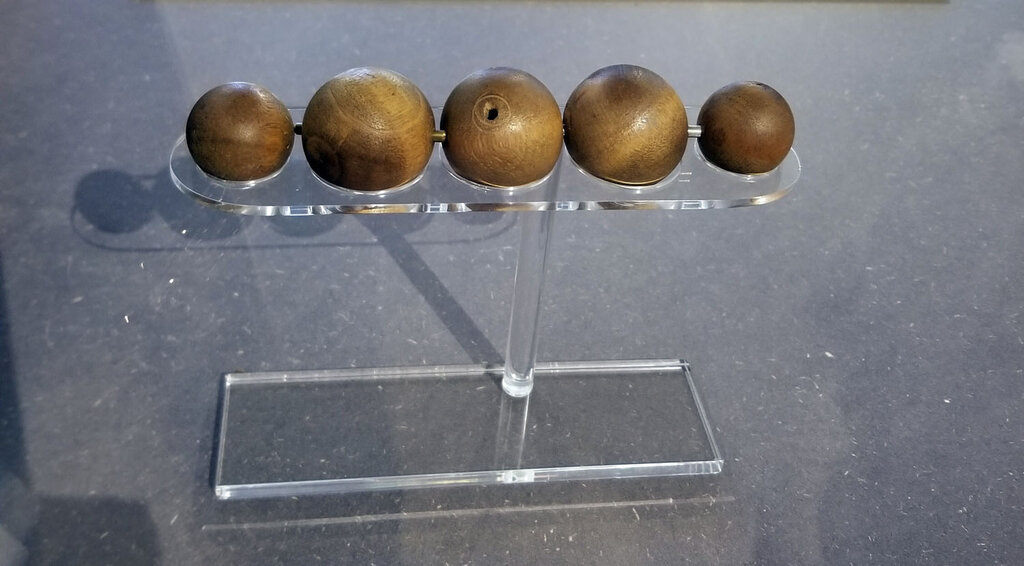
Dalton's model was simple but powerful. He imagined atoms as tiny, featureless billiard balls. According to his theory:
- All atoms of a specific element are identical. Every gold atom is the same as every other gold atom.
- Atoms of different elements are different. A gold atom is different from an iron atom.
- Atoms can't be created or destroyed, only rearranged. Chemical reactions are just atoms shuffling partners to form new substances.
Dalton's model pictured the atom as a solid, indivisible sphere, with no internal parts.
A Change in the Picture
Dalton's billiard ball model was the leading theory for nearly a century. But in 1897, a physicist named J.J. Thomson made a discovery that would change everything. While experimenting with electricity in a glass tube, he found that he could produce a beam of particles that were much, much smaller than atoms. Even more surprising, these particles had a negative electrical charge.
He had discovered the electron. This was a huge deal. If atoms contained these tiny negative particles, it meant that atoms were not solid and indivisible after all. They had smaller pieces inside them.
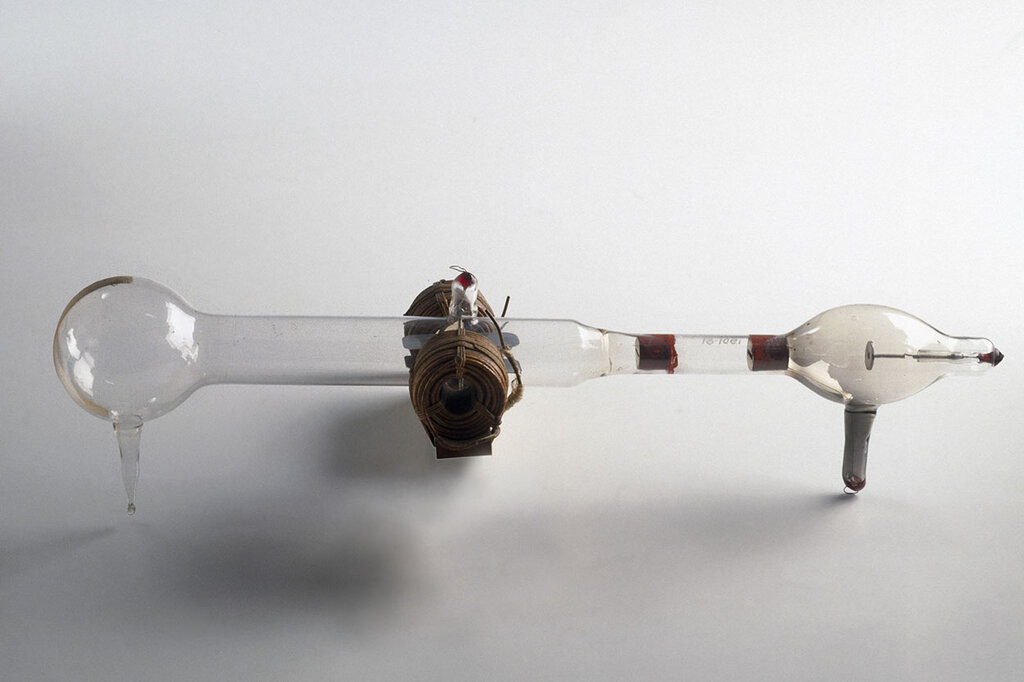
Thomson knew that atoms as a whole are electrically neutral, meaning they have no overall charge. So, if there was negative stuff inside, there had to be positive stuff to balance it out. This led him to propose a new model for the atom.
Cracks in the Models
Thomson's "plum pudding" model was an important step forward. It accounted for the existence of the electron and the atom's neutral charge. But it was still just a proposal, and it had its own problems. The model couldn't explain how the electrons and positive charge were held together, or why they didn't just collapse into each other.
Both Dalton's and Thomson's models were crucial milestones. They moved the atom from a philosophical idea to a scientific concept that could be tested and improved upon. But they were incomplete. The solid sphere couldn't explain electricity, and the plum pudding model was a vague picture of how the parts fit together. The stage was set for another groundbreaking experiment that would reveal a very different, and much stranger, picture of the atom's inner world.
According to John Dalton's atomic model, what happens to atoms during a chemical reaction?
What discovery directly led J.J. Thomson to propose that Dalton's 'billiard ball' model was incorrect?
These early ideas laid the groundwork for our modern understanding of the atom.