Rust and AI Database Construction
Introduction to Databases
Organizing Information
At its heart, a database is just an organized collection of data. Think of it like a digital filing cabinet. Instead of stuffing papers randomly into a drawer, you use folders, labels, and a system to make sure you can find what you need later. Databases do the same thing for information, but on a much larger and faster scale.
Whether you're building a simple to-do list app or a massive social network, you need a way to store, retrieve, and manage data. That's where databases come in. They provide the structure and tools to handle information efficiently. There are two main families of databases you'll encounter: relational and non-relational.
Relational Databases (SQL)
Relational databases are the traditional workhorses of the data world. They organize data into tables, which are a lot like spreadsheets. Each table has rows (representing individual records) and columns (representing attributes of those records). This structure is defined by a rigid blueprint called a schema.
Imagine a simple table for storing user information:
| user_id (Primary Key) | username | |
|---|---|---|
| 1 | alice | alice@example.com |
| 2 | bob | bob@example.com |
| 3 | charlie | charlie@example.com |
Each row is a unique user, and each column stores a specific piece of information. The user_id is a primary key—a unique identifier for each row in this table. This is crucial for creating relationships between tables. For example, we could have another table for orders that uses the user_id to link an order back to the user who placed it. This linking field in the orders table would be a foreign key.
These databases use a language called SQL (Structured Query Language) to interact with the data. You use SQL to create, read, update, and delete information. Because of their structured nature, relational databases are excellent when your data is predictable and consistency is critical. Think banking systems, e-commerce stores, and booking systems.
Non-Relational Databases (NoSQL)
Non-relational databases, often called NoSQL, emerged to handle the massive amounts of unstructured and semi-structured data common on the modern web. They don't rely on the rigid table-and-schema structure of their relational counterparts. Instead, they use a variety of data models, offering much more flexibility.
Common NoSQL database types include:
- Document stores: Data is stored in flexible, JSON-like documents. (e.g., MongoDB)
- Key-value stores: Data is stored as simple key-value pairs. (e.g., Redis)
- Column-family stores: Data is stored in columns rather than rows, great for analytics. (e.g., Cassandra)
- Graph databases: Data is stored as nodes and edges, perfect for representing complex relationships. (e.g., Neo4j)
For example, a user profile in a document database might look like a single, self-contained document:
{
  "_id": "1",
  "username": "alice",
  "email": "alice@example.com",
  "interests": ["rust", "databases", "hiking"],
  "orders": [
    { "order_id": "101", "product": "Laptop" },
    { "order_id": "102", "product": "Mouse" }
  ]
}
Notice how all of Alice's information, including her orders, is nested within one record. This flexibility makes NoSQL databases ideal for applications with rapidly changing requirements, large amounts of data, or data that doesn't fit neatly into tables. Think social media feeds, IoT sensor data, and real-time applications.
Database Architectures
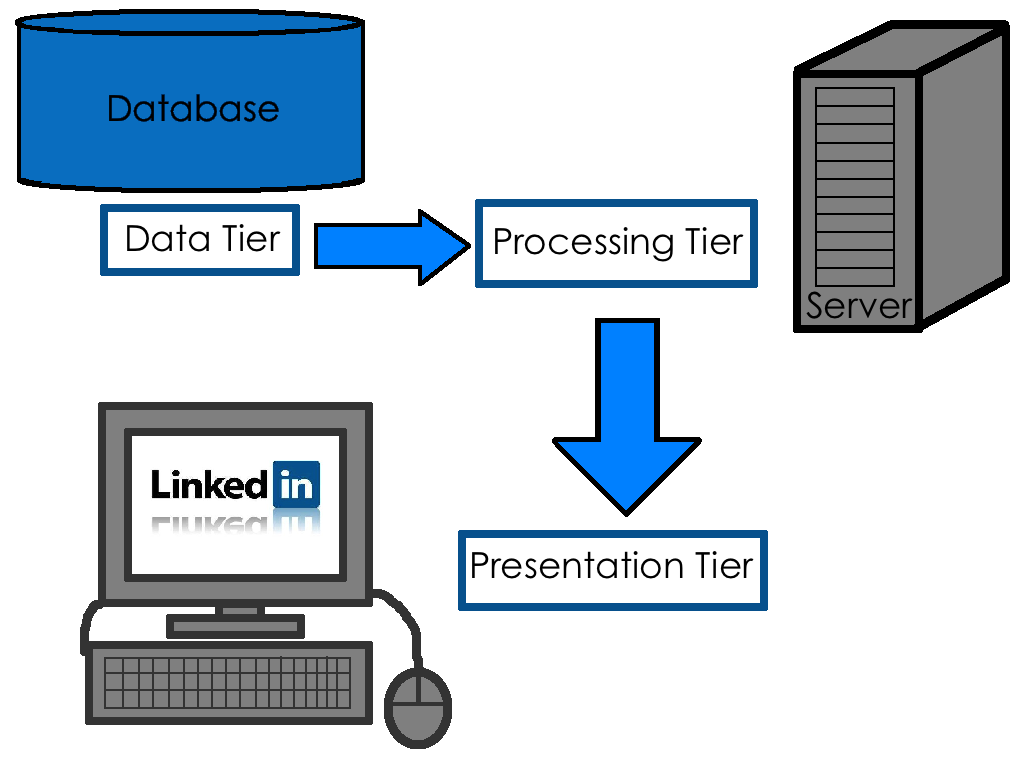
Beyond the data model, it's also important to understand how databases are structured. The most common architecture is the client-server model. In this setup, clients (your application, a user interface) send requests to a central database server, which processes the request and sends back the data. This is often part of a three-tier architecture, separating the user interface (presentation), application logic (processing), and data storage.
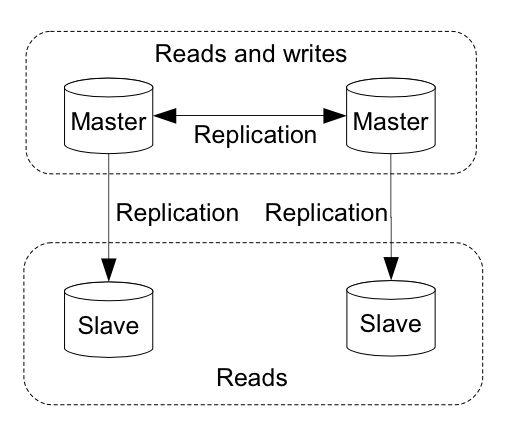
Another common architecture is a distributed database. Instead of living on a single powerful server, the database is spread across multiple machines. This approach improves scalability (you can add more machines to handle more traffic) and reliability (if one machine fails, the others can take over). Techniques like replication, where data is copied across multiple nodes, are fundamental to distributed systems.
Choosing the right database and architecture depends entirely on your project's needs. Do you need strict consistency and have well-structured data? A relational database might be best. Do you need high performance, massive scale, and flexibility? A NoSQL solution could be the right fit. Understanding these fundamentals is the first step toward designing an effective data storage system for your Rust application.
What is the primary purpose of a database?
In a relational database, what is the role of a foreign key?
Now that you have a high-level view of what databases are and the major types you'll encounter, you're ready to start thinking about how to design one yourself.