Rule of Thirds Photography Composition
Introduction to the Rule of Thirds
The Rule of Thirds
One of the first principles of composition you'll learn in photography, art, or design is the Rule of Thirds. It’s a simple guideline to help you place the subject of your image in a way that’s pleasing to the eye.
The rule of thirds is a composition guideline that divides a frame into nine parts using two equally spaced horizontal and vertical lines.
Imagine a tic-tac-toe grid drawn over your image. This grid creates four intersection points and divides your frame into nine equal segments.

The core idea is to place important elements of your composition along these lines or at the points where they intersect. Our eyes are naturally drawn to these intersection points, so placing your subject there can create a more balanced and dynamic image than simply centering it.
Why It Works
The Rule of Thirds works by creating a sense of balance and visual interest. Placing a subject dead center can sometimes feel static or boring. By moving the subject off-center, you give it room to breathe and create a more engaging narrative. The empty space, often called negative space, balances the visual weight of the subject and guides the viewer's eye through the entire frame, not just to the middle.
This technique dates back to 1797, when painter John Thomas Smith mentioned it in relation to landscape painting. He noted that by dividing a scene into thirds, an artist could achieve a more harmonious and less rigid composition. The principle has been a staple in the visual arts ever since.
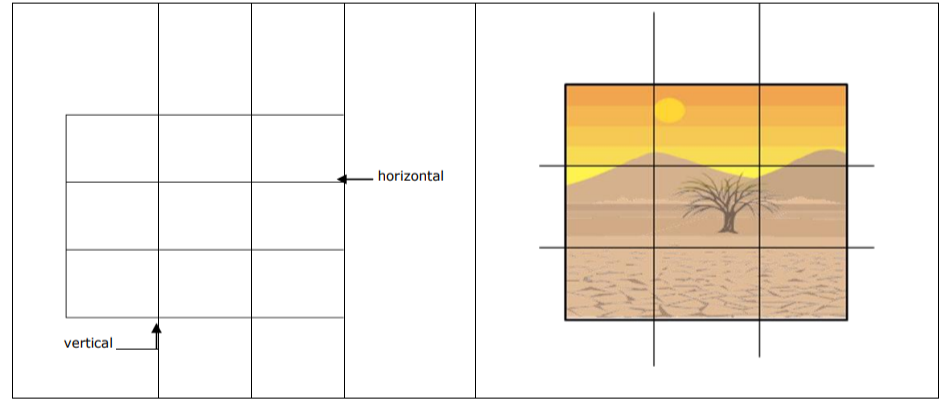
For example, when shooting a landscape, try placing the horizon on either the top or bottom horizontal line instead of in the middle. If the sky is interesting, give it two-thirds of the frame. If the foreground is more compelling, let it occupy the bottom two-thirds.
In a portrait, placing the subject's eyes on one of the upper intersection points can create a powerful connection with the viewer. In videography, this rule helps filmmakers frame shots to guide the audience's attention and create a more cinematic feel.
The Rule of Thirds isn't a strict rule, but a powerful guideline. Knowing when to use it, and when to break it, is part of developing your own visual style.
Now, let's test your understanding of this core concept.
According to the Rule of Thirds, where should you place the most important elements of your image?
When photographing a landscape with a particularly dramatic sky, where should you place the horizon line to emphasize it using the Rule of Thirds?
Mastering this simple guideline is the first step toward creating more compelling and professional-looking images and videos.