Rubik's Cube Mastery
Cube Notation
The Language of the Cube
To solve a Rubik's Cube, you don't just randomly twist it. You follow specific sequences of moves, called algorithms. But to share and learn these algorithms, everyone needs to speak the same language. That's where cube notation comes in. It's a simple shorthand to describe every possible turn.
Cube notation is what cubers use to describe algorithms, and algorithms are the memorized sequences of moves that they use to solve the cube quickly.
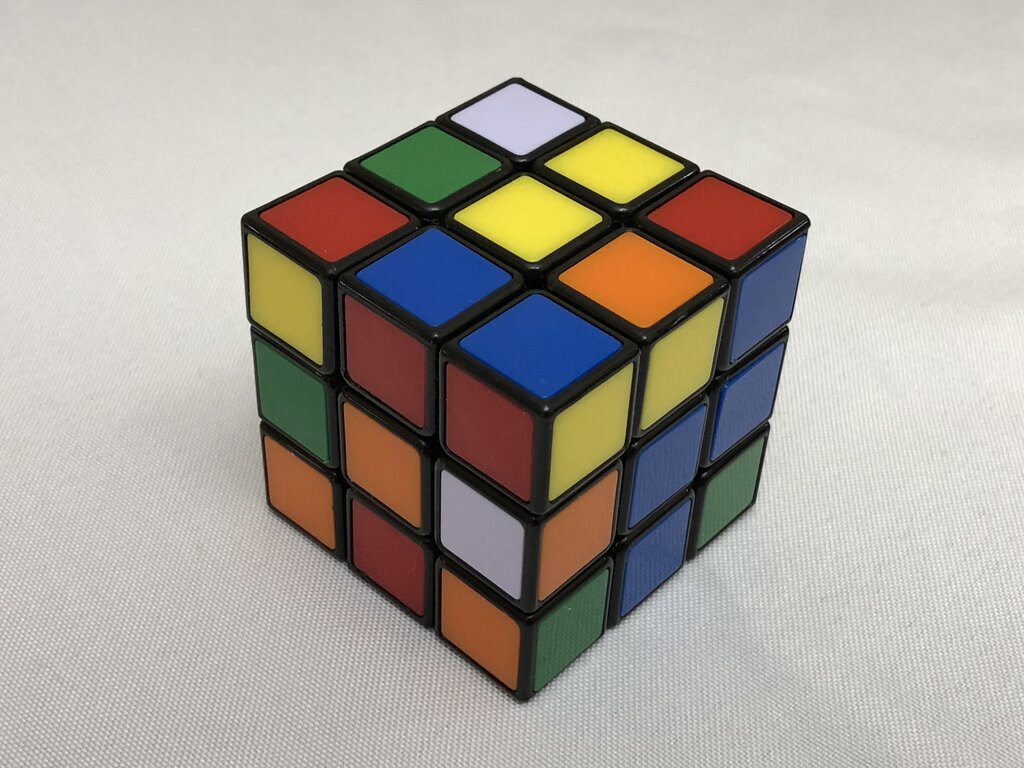
First, let's name the faces. Imagine holding the cube so one side is directly facing you. That's the Front face. The other faces are named relative to it.
Each of the six faces has a one-letter abbreviation:
- F (Front): The face looking at you.
- B (Back): The face opposite the front.
- U (Up): The top face.
- D (Down): The bottom face.
- R (Right): The right face.
- L (Left): The left face.
These letters form the basis of all cube notation.
Turning the Faces
A letter by itself means you turn that face 90 degrees clockwise, as if you were looking directly at it.
| Notation | Move |
|---|---|
| R | Turn the right face clockwise |
| L | Turn the left face clockwise |
| U | Turn the up (top) face clockwise |
| D | Turn the down (bottom) face clockwise |
| F | Turn the front face clockwise |
| B | Turn the back face clockwise |
To indicate a counter-clockwise turn, we add a prime symbol ('), which looks like an apostrophe. So, a counter-clockwise turn of the Right face is written as R'.
| Notation | Move |
|---|---|
| R' | Turn the right face counter-clockwise |
| L' | Turn the left face counter-clockwise |
| U' | Turn the up face counter-clockwise |
| D' | Turn the down face counter-clockwise |
| F' | Turn the front face counter-clockwise |
| B' | Turn the back face counter-clockwise |
Finally, for a 180-degree turn (a double turn), we add the number 2 after the letter. An R2 move is the same as making two R moves. The direction doesn't matter for a double turn, so R2 is the same as R'2.
Building Algorithms
Algorithms are just sequences of these moves written together. You perform the moves one after another, from left to right. For example, one of the most fundamental move sequences is a four-move pattern often called a "trigger".
R U R' U'
This sequence means: turn the right face clockwise, then the up face clockwise, then the right face counter-clockwise, and finally the up face counter-clockwise. Practicing short sequences like this helps build muscle memory and familiarity with the notation.
Mastering this notation is the first real step. Every solution guide and tutorial uses it, so getting comfortable now will make everything else much easier.
Time to check your understanding.
In Rubik's Cube notation, what does the letter 'B' stand for?
How would you notate a 90-degree counter-clockwise turn of the Right face?
With this language, you're now ready to start learning the actual steps to solving the cube.