Romanian 7th Grade Chemistry Olympiad Prep
Atomic Structure
The Building Blocks of Everything
Everything you see, from the chair you're sitting on to the air you're breathing, is made of atoms. For a long time, people thought atoms were the smallest possible things, like tiny, uncuttable spheres. But we now know they are made of even smaller pieces called subatomic particles.
There are three main types of subatomic particles you need to know:
- Protons: These have a positive (+) electrical charge.
- Neutrons: These have no charge at all. They are neutral.
- Electrons: These have a negative (-) electrical charge.
Protons and neutrons are packed together in the center of the atom, in a dense region called the nucleus. Electrons are much smaller and lighter, and they move around the nucleus in a large area called the electron cloud. Because opposite charges attract, the negative electrons are held in orbit around the positive nucleus.
An Atom's Identity
How do we tell one type of atom from another? A carbon atom is different from an oxygen atom, but why? The secret is the number of protons.
The number of protons in an atom's nucleus is its atomic number (Z). This number is unique to each element and defines what it is. Every atom with 6 protons is a carbon atom. Every atom with 8 protons is an oxygen atom. It's like an ID card for the element.
The nucleus contains both protons and neutrons, and together they make up most of the atom's mass. The total number of protons and neutrons in an atom is its mass number (A).
Mass Number (A) = (Number of Protons) + (Number of Neutrons)
To find the number of neutrons, you just rearrange the formula: Number of Neutrons = A - Z.
Chemists use a standard notation to show this information quickly:
Here, X is the element's symbol, A is the mass number, and Z is the atomic number. For example, a common form of carbon has 6 protons and 6 neutrons. Its atomic number (Z) is 6, and its mass number (A) is 6 + 6 = 12. We write it as .
But what if an atom had a different number of neutrons? It would still be the same element, because the number of protons hasn't changed. Atoms of the same element with different numbers of neutrons are called isotopes.
| Isotope | Protons (Z) | Neutrons | Mass Number (A) | Notation |
|---|---|---|---|---|
| Carbon-12 | 6 | 6 | 12 | |
| Carbon-13 | 6 | 7 | 13 | |
| Carbon-14 | 6 | 8 | 14 |
All three are carbon atoms, but they have different masses. Some isotopes are unstable, or radioactive, like Carbon-14. Scientists use the predictable decay of Carbon-14 to figure out the age of ancient artifacts, a process called radiocarbon dating.
Where the Electrons Live
Electrons don't just zoom around the nucleus randomly. They are organized into specific energy levels, or electron shells. Think of these shells like floors in a building or lanes on a racetrack. Electrons in the shells closest to the nucleus have the lowest energy, and those farther away have higher energy.
Each shell can only hold a certain number of electrons. The rule for the maximum number of electrons in a shell (n) is $2n^2$.
- Shell 1 (n=1): Holds up to $2(1^2) = 2$ electrons.
- Shell 2 (n=2): Holds up to $2(2^2) = 8$ electrons.
- Shell 3 (n=3): Holds up to $2(3^2) = 18$ electrons.
Electrons fill the lowest energy shells first. A neutral atom has the same number of electrons as protons. So, for sodium (Na), which has an atomic number of 11, it has 11 protons and 11 electrons. Here's how they're arranged:
Shell 1 gets 2 electrons. Shell 2 gets 8 electrons. That's 10 so far. The last electron goes into Shell 3. So, Sodium's electron configuration is 2-8-1.
The electrons in the outermost shell are called valence electrons. These are the most important electrons in chemistry because they are the ones involved in forming bonds with other atoms. For sodium, there is 1 valence electron.
The Periodic Table
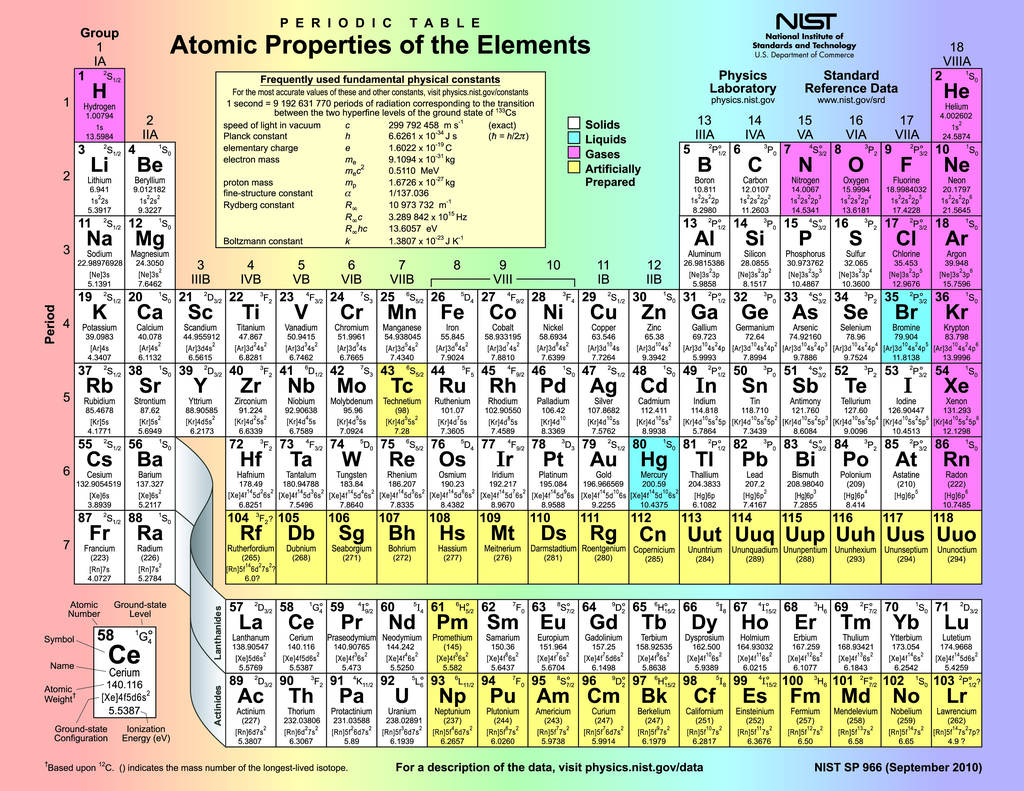
The periodic table isn't just a random chart of elements. It's a masterpiece of organization based on atomic structure. Elements are arranged in order of increasing atomic number.
Periods and Groups The horizontal rows are called periods. Elements in the same period have the same number of electron shells.
The vertical columns are called groups. Elements in the same group have the same number of valence electrons, which means they have similar chemical properties. For example, all elements in Group 1 (like Lithium, Sodium, Potassium) have 1 valence electron and are highly reactive metals.
Periodic Trends Because the table is so well organized, we can predict certain properties of elements just by looking at their position. These patterns are called periodic trends.
- Atomic Radius: This is the size of the atom. It generally decreases as you move from left to right across a period (because more protons pull the electrons in tighter) and increases as you move down a group (because you're adding more electron shells).
- Electronegativity: This is a measure of how strongly an atom attracts electrons. It increases from left to right across a period and decreases down a group. Fluorine (F) is the most electronegative element.
Understanding these fundamental ideas of atomic structure is the key to unlocking the rest of chemistry. Now, let's test what you've learned.
Which of the following correctly describes the electrical charges of the three main subatomic particles?
An atom of Uranium is represented as . How many neutrons does it have?
With these concepts in hand, you're well on your way to thinking like a chemist.