Rocket Engineering Fundamentals
Rocket Propulsion
Action and Reaction
At its heart, a rocket is a simple device that follows a fundamental law of physics. It doesn't push against the air or the ground. It pushes against itself.
This is all thanks to Newton's Third Law of Motion. You've probably heard it before: for every action, there is an equal and opposite reaction. If you stand on a skateboard and throw a heavy ball forward, you and the skateboard will roll backward. The ball going one way is the "action." You moving the other way is the "reaction."
A rocket does the exact same thing, but on a much grander scale. Instead of throwing a ball, it throws hot gas out of its back end at incredible speed. This massive, continuous action of expelling gas creates an equal and opposite reaction that pushes the rocket forward.
Newton's Third Law of Motion states that for every action, there is an equal and opposite reaction, which is the fundamental principle behind propulsion
This principle works anywhere, which is why rockets function perfectly in the vacuum of space where there's nothing to push against.
Generating Thrust
To create that powerful blast of gas, a rocket engine needs a few key ingredients. The whole process is essentially a controlled, continuous explosion. The force generated by this process is called thrust.
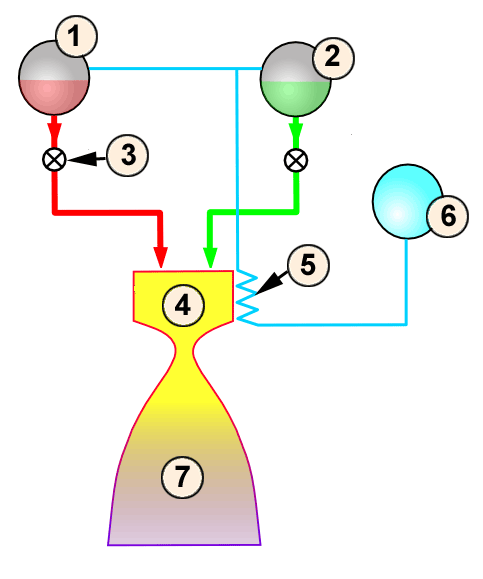
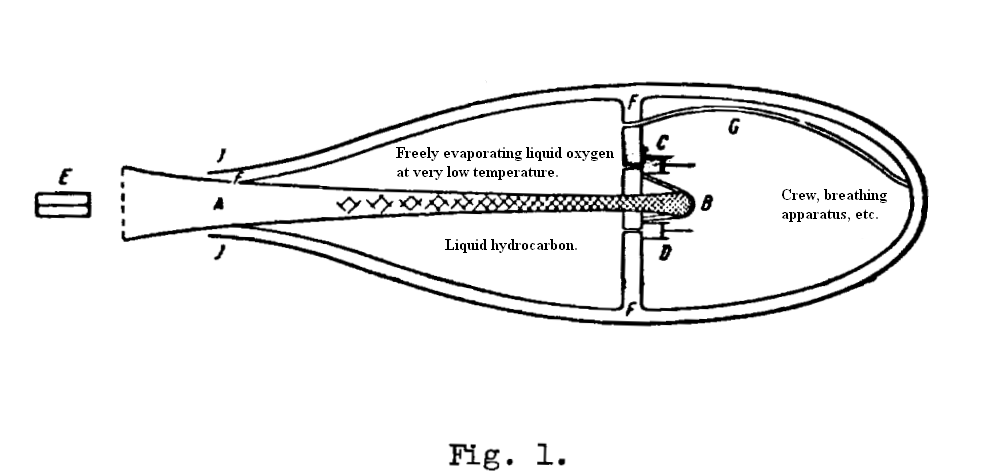
The fundamental components of a liquid rocket engine are straightforward. You need propellants, which consist of a fuel and an oxidizer. The oxidizer is a chemical that allows the fuel to burn, which is crucial in space where there is no oxygen. These are stored in separate tanks.
When it's time to launch, these propellants are fed into a combustion chamber, where they mix and ignite. This creates incredibly hot, high-pressure gas. The gas expands in all directions, pushing on the chamber walls. The only way out is through an opening at the back called a nozzle.
As the gas escapes through the nozzle, it accelerates to tremendous speeds. While the gas shoots backward, it pushes the rocket forward. The shape of the nozzle is specially designed to maximize the speed of this escaping gas, which in turn maximizes the rocket's thrust.
thrust
noun
The reactive force that propels a rocket forward, produced by expelling high-velocity exhaust gas from its engine.
The Rocket Equation
Getting a rocket to space is incredibly difficult because of a fundamental challenge: a rocket must carry its own fuel. The more fuel you add, the heavier the rocket gets. And the heavier the rocket gets, the more fuel you need to lift it. This tricky relationship is captured in a formula known as the Tsiolkovsky rocket equation.
Developed by Russian scientist Konstantin Tsiolkovsky in 1903, this equation is the foundation of rocket science. It tells us how much a rocket's velocity can change based on how much propellant it uses and how fast it shoots that propellant out.
The crucial part of the equation is the ratio of initial mass to final mass (). This is called the mass ratio. To get a large delta-v, you need a very high mass ratio. This means that a huge portion of the rocket's initial weight must be propellant.
For example, over 90% of the Saturn V rocket's weight at launch was just propellant. The structure and the Apollo spacecraft on top were a tiny fraction of the total. This is why rockets are built in stages, shedding empty fuel tanks as they fly to reduce their final mass and get the most delta-v possible.
Which fundamental principle of physics explains how a rocket generates thrust?
Why must a rocket carry its own oxidizer in addition to fuel?
Understanding these principles—from Newton's simple law to the demanding rocket equation—reveals why sending anything to space is such a monumental feat of engineering.