Rocket Engine Fundamentals
Rocket Propulsion Basics
The Action-Reaction Principle
How does a rocket move, especially in the vacuum of space where there’s nothing to push against? It's a common question, and the answer lies in a fundamental law of physics.
Newton's Third Law of Motion states that for every action, there is an equal and opposite reaction, which is the fundamental principle behind propulsion
Imagine you're standing on a skateboard holding a heavy bowling ball. If you throw the ball forward, what happens? You and the skateboard roll backward. The force you used to push the ball forward (the action) creates an equal and opposite force that pushes you backward (the reaction).
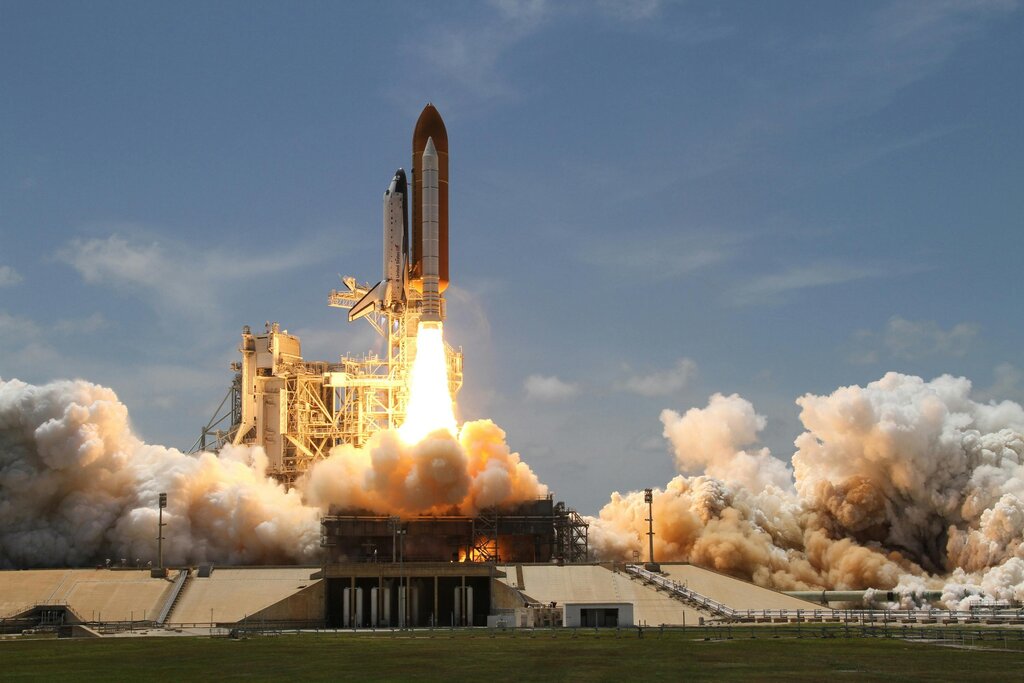
A rocket works the exact same way. Instead of a bowling ball, it throws hot gas out of its engine at very high speed. This powerful stream of gas shooting downward is the action. The resulting push that sends the rocket upward is the reaction.
Generating Thrust
This pushing force is called thrust. It’s what lifts a rocket off the launch pad and propels it through space. The amount of thrust a rocket engine generates depends on two key factors: how much mass it ejects and how fast it ejects that mass.
To get more thrust, a rocket must either eject more mass per second or eject that mass at a higher speed.
Measuring Efficiency
Not all rocket engines are created equal. Some are designed for raw power to overcome Earth's gravity, while others are built for long-term, efficient cruising in space. To compare their performance, engineers use a measure called specific impulse.
specific impulse
noun
A measure of how efficiently a rocket uses propellant to produce thrust.
Often abbreviated as , specific impulse tells you how much thrust you get from a certain amount of propellant over time. A higher specific impulse means the engine is more efficient—it can change the rocket's velocity more with less fuel. It's like a car's fuel economy, but for rockets.
Specific impulse is measured in seconds. You can think of it as how long one pound (or kilogram) of propellant can produce one pound (or newton) of thrust. For example, the powerful engines on the Saturn V's first stage had an of about 263 seconds at sea level. In contrast, some highly efficient ion thrusters used for deep space probes can have an of over 3,000 seconds. They produce very little thrust, but they can keep firing for years, using their fuel very slowly.
Think you've got the basics down? Let's test your knowledge.
What is the fundamental principle that explains how a rocket moves in the vacuum of space?
The pushing force that propels a rocket is called __________.
By understanding these core concepts—action-reaction, thrust, and efficiency—you have the foundation for how all rockets, from small models to giant interplanetary vehicles, take flight.