Robot Radio Communications
Radio Communication Basics
How Radio Waves Travel
Radio communication is the backbone of controlling unmanned vehicles. It allows us to send commands and receive data from a distance, all without wires. This is possible thanks to electromagnetic waves, a form of energy that travels through the air, and even the vacuum of space, at the speed of light.
Think of it like dropping a pebble into a still pond. Ripples spread out from the center, carrying energy across the water's surface. Radio waves work similarly, but instead of water, they travel through the electromagnetic field. A transmitter creates these waves, and a receiver picks them up.
These waves have distinct properties. The wavelength is the distance between two consecutive peaks, or crests, of the wave. The frequency is the number of waves that pass a point in one second, measured in Hertz (Hz). The amplitude is the wave's height, representing its strength.
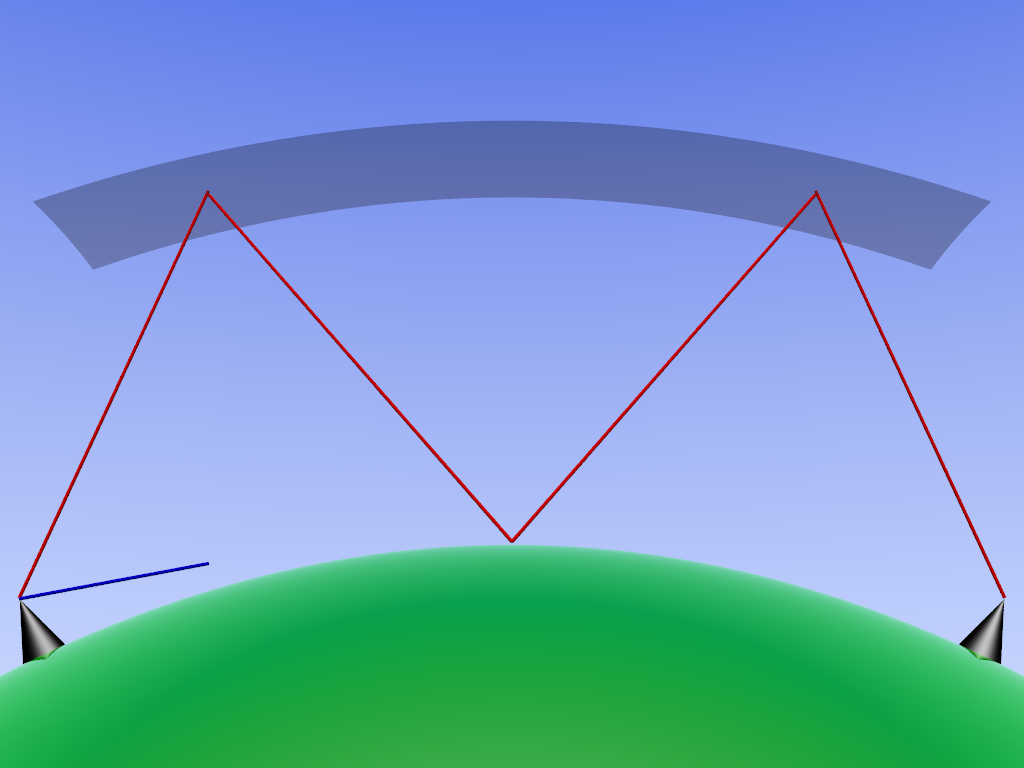
For communication to work over long distances, these waves sometimes need a little help. Lower frequency waves can bounce off the ionosphere, a layer of Earth's atmosphere, allowing them to travel over the horizon, far beyond the line of sight.
Finding the Right Channel
The electromagnetic spectrum is a vast range of frequencies, from very low to incredibly high. Radio waves occupy a specific portion of this spectrum, which is divided into different frequency bands. Each band has unique characteristics that make it suitable for certain applications.
Think of it like lanes on a highway. Some lanes are for slow-moving trucks (low frequencies), while others are for fast-moving cars (high frequencies). To avoid chaos, regulators like the FCC in the United States assign specific frequency bands for different uses, such as AM/FM radio, television broadcasts, cell phones, and of course, robotics.
Frequency
noun
The rate at which a wave's cycle repeats, measured in Hertz (Hz). One Hz is one cycle per second.
Generally, lower frequencies can travel farther and penetrate obstacles like walls better, but they can't carry as much data. Higher frequencies can carry massive amounts of data—perfect for streaming video from a UGV—but their range is shorter and they're more easily blocked by obstacles. Choosing the right frequency is a trade-off between range, data rate, and reliability.
| Band | Frequency Range | Common Applications |
|---|---|---|
| High Frequency (HF) | 3 - 30 MHz | Long-distance (shortwave) radio, aviation communication |
| Very High Frequency (VHF) | 30 - 300 MHz | FM radio, two-way radios, marine communications |
| Ultra High Frequency (UHF) | 300 MHz - 3 GHz | TV broadcast, GPS, Wi-Fi, Bluetooth, most UGVs/drones |
| Super High Frequency (SHF) | 3 - 30 GHz | Satellite communication, radar, 5G mobile networks |
Encoding the Message
A plain radio wave, called a carrier wave, doesn't carry any information by itself. To send a useful signal, we need to modify, or modulate, this wave. Modulation is the process of embedding our data—whether it's voice, video, or UGV control commands—onto the carrier wave.
There are two classic ways to do this: Amplitude Modulation (AM) and Frequency Modulation (FM).
-
Amplitude Modulation (AM): This technique varies the amplitude (the height or strength) of the carrier wave in sync with the information signal. The frequency remains constant.
-
Frequency Modulation (FM): Here, the amplitude of the carrier wave stays constant, but its frequency is varied. The wave cycles become closer together or farther apart to represent the data.
Modern digital systems, including those used in UGVs, use more advanced digital modulation. These methods change the wave's properties—like its phase (its starting point in the cycle)—to represent data as a stream of 1s and 0s. This is more robust and efficient for sending complex data.