Road Construction Essentials
Introduction to Road Construction
From Roman Roads to Modern Highways
Roads are one of humanity's oldest and most essential inventions. The first major road builders were the Romans, who created an incredible network of straight, durable roads across their empire. Their secret was a deep, layered foundation. They dug a trench, filled it with large stones, then added smaller stones, gravel, and sand, and finally topped it with fitted paving stones.
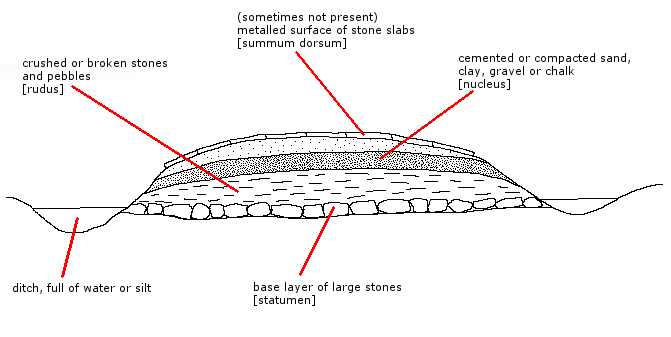
This basic idea of using layers for strength and drainage has stuck around. In the 18th and 19th centuries, engineers like Thomas Telford and John McAdam refined the process. They emphasized the importance of a solid, raised foundation and proper drainage to keep the roadbed dry and stable. McAdam's method, using compacted layers of broken stone, was particularly revolutionary and became the basis for modern road construction.
Two Types of Pavement
Today's roads are far more advanced, designed to handle heavy, fast-moving traffic. They generally fall into two categories: flexible and rigid pavements.
Flexible pavements use asphalt, a sticky black substance derived from petroleum. They are called "flexible" because the pavement structure bends slightly under the load of a vehicle.
Think of a flexible pavement like a stack of thick blankets. When you press down on the top blanket, the pressure spreads out through each layer underneath. The load is distributed from the surface down through several layers to the soil below. Most of the roads you drive on are flexible pavements.
Rigid pavements use Portland cement concrete. These pavements are much stiffer and don't bend like asphalt roads.
A rigid pavement acts more like a stiff board placed on the ground. The concrete slab distributes the vehicle's weight over a very wide area of the soil beneath it. Because of this, they often require fewer underlying layers. You'll typically find rigid pavements on major highways and airport runways where the traffic is extremely heavy.
The Layers of a Road
Whether flexible or rigid, modern roads are built as a system of carefully engineered layers. Each layer has a specific job, and together they create a durable surface that can withstand traffic and weather for years. Let's look at a typical flexible pavement structure from the bottom up.
1. Subgrade: This is the foundation of the road—the natural soil that's already there. Before anything else is built, the subgrade must be prepared by clearing, grading, and compacting it to make it dense and stable. A weak subgrade will lead to a failed road.
2. Subbase Course: This is the first layer of new material placed on top of the subgrade. It's usually made of lower-quality crushed stone or gravel. Its main jobs are to provide drainage, prevent water from weakening the subgrade, and add structural support.
3. Base Course: This is the primary load-bearing layer. It consists of higher-quality, specifically-sized crushed stone or gravel that is tightly compacted. It distributes the load from the surface above, spreading it over the wider subbase and subgrade.
4. Surface Course: Also called the wearing course, this is the top layer that vehicles drive on. It must be smooth, tough enough to resist wear from tires, and waterproof to protect the layers below. For a flexible pavement, this is hot-mix asphalt.
Each of these components works together. A failure in one layer can compromise the entire road structure, leading to potholes, cracks, and other problems.
Now, let's test your knowledge on the basics of road construction.
What was the key to the durability of ancient Roman roads?
Which layer of a flexible pavement is considered the primary load-bearing layer?
Understanding these fundamental principles—from historical precedents to the modern, layered approach—is the first step in appreciating the complex engineering that goes into the roads we use every day.