RNA Polymerase: The Transcription Maestro
RNA Polymerase Basics
The Cell’s Master Scribe
Inside every living cell, DNA holds the master blueprint for life. But this precious blueprint is kept safe in the nucleus (in eukaryotes) and isn't used directly for day-to-day tasks. To get the instructions out to the cellular machinery, the cell makes temporary copies. The enzyme responsible for this vital job is called RNA polymerase.
Think of RNA polymerase as a molecular scribe. It carefully reads a gene on a DNA strand and transcribes it into a portable, single-stranded message called messenger RNA (mRNA).
This process, known as transcription, is the first step in expressing a gene. The RNA message then travels to the ribosomes, the cell's protein-building factories, where it directs the creation of a specific protein. Without RNA polymerase, the genetic code would remain locked away, and the cell couldn't function.
An Overview of Transcription
How does this molecular machine work? Transcription happens in three basic stages: initiation, elongation, and termination. For now, we'll focus on the big picture.
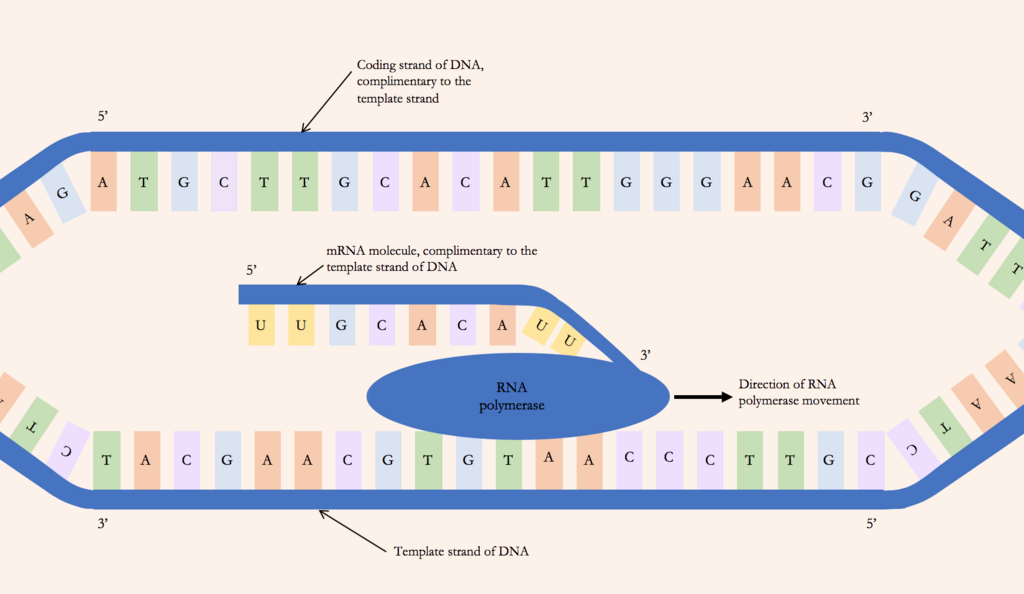
First, RNA polymerase binds to a specific region of DNA called a promoter, which signals the start of a gene. Once attached, the enzyme unwinds a small section of the DNA double helix, creating a “transcription bubble.” This exposes the nucleotide bases on each strand.
Next, the polymerase moves along the DNA, reading one strand—the template strand. For each DNA nucleotide it reads, it adds a matching RNA nucleotide to the growing RNA chain. The matching rules are slightly different than in DNA: adenine (A) in DNA pairs with uracil (U) in RNA, and cytosine (C) pairs with guanine (G).
This continues until the polymerase reaches a 'stop' signal on the DNA, at which point it releases the newly made RNA molecule and detaches from the DNA.
One Scribe or a Team
While RNA polymerase performs the same fundamental job in all life, its structure varies between the major domains of life: prokaryotes (like bacteria) and eukaryotes (like plants and animals).
Prokaryotic cells keep things simple. They have just one type of RNA polymerase that is responsible for transcribing all types of RNA, including mRNA, tRNA, and rRNA.
Eukaryotic cells, with their more complex genomes and cellular structures, have specialized polymerases for different jobs. There are three main types:
- RNA Polymerase I transcribes most of the ribosomal RNA (rRNA) genes, which are essential components of ribosomes.
- RNA Polymerase II is the star of the show for protein-coding genes. It transcribes all the genes that will become messenger RNA (mRNA).
- RNA Polymerase III transcribes genes for smaller RNA molecules, such as transfer RNA (tRNA) and some small rRNAs.
This division of labor in eukaryotes allows for more intricate control over gene expression, a key feature of complex organisms.
Understanding this fundamental enzyme is the first step to seeing how the genetic information in DNA is brought to life.
Let's review the key concepts.
What is the primary function of RNA polymerase?
In a eukaryotic cell, which type of RNA polymerase is responsible for transcribing the genes that code for proteins (mRNA)?