Risk Management Essentials
Introduction to Risk Management
What Is Risk Management?
Things go wrong. It’s a simple fact of life and business. A key supplier might miss a deadline, a new competitor could enter your market, or a critical piece of equipment might break down. You can’t prevent every problem, but you can prepare for them. That’s the core idea behind risk management.
Risk management is the systematic process of identifying, assessing, and controlling threats and deviations from the expected, which can impact an organization’s ability to reach their objectives.
It's a proactive process. Instead of reacting to problems as they happen, you look ahead, spot potential issues, and decide how to handle them before they cause serious damage. The goal isn't to eliminate all risk—that's impossible. Taking calculated risks is often necessary for growth. The real objective is to understand the risks you face so you can make smarter decisions.
The Building Blocks of Risk
To manage risk effectively, we first need to agree on what we're talking about. Three terms are crucial: hazard, vulnerability, and risk. They might sound similar, but they have distinct meanings.
Hazard
noun
A potential source of harm or an adverse effect on something or someone.
A hazard is something that could cause a problem. Think of a patch of ice on a road, a flaw in a piece of software, or a volatile chemical stored in a lab. By itself, a hazard is just a condition.
Vulnerability
noun
A weakness or gap in protection that could be exploited by a hazard.
Vulnerability is what makes a hazard dangerous. If the car on the icy road has brand-new snow tires and an expert driver, the vulnerability is low. If it has worn-out tires and a distracted driver, the vulnerability is high. Vulnerability is the exposure to the hazard.
Risk
noun
The probability that a hazard will cause harm, combined with the severity of that harm.
Risk combines the first two concepts. It’s the likelihood of a hazard actually causing trouble because of a vulnerability, and how bad that trouble would be. A wet floor (hazard) in an empty, locked room presents a very low risk. That same wet floor (hazard) in the main entrance of a hospital (high vulnerability) presents a very high risk of someone slipping and getting injured.
The Risk Management Process
Managing risk isn't a one-time event; it's a continuous cycle that helps an organization stay on track. While specific methods vary, the overall process generally follows a few key steps.
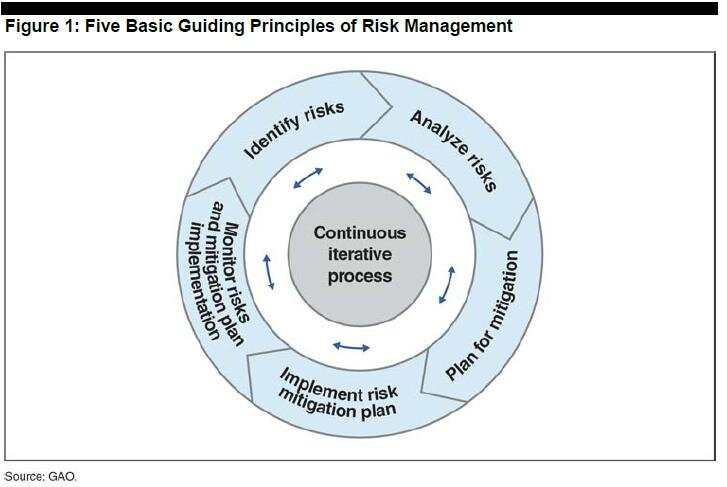
Here’s a simple breakdown of the stages:
-
Risk Identification: This is the brainstorming phase. You identify all potential risks that could affect your project or organization. What could go wrong? This includes everything from financial and operational risks to reputational and strategic ones.
-
Risk Assessment: Once you have a list of risks, you analyze them. How likely is each risk to occur? And if it does, what would the impact be? This step helps you understand which risks are minor annoyances and which are major threats.
-
Risk Evaluation: Here, you prioritize. Based on your assessment, you rank the risks to decide which ones need immediate attention. You might use a simple matrix, labeling risks as high, medium, or low priority.
-
Risk Treatment: Now it's time to act. For each significant risk, you decide how to handle it. You might try to avoid the risk, reduce its likelihood or impact, transfer it (like through insurance), or simply accept it and have a contingency plan ready.
These steps create a loop. After you've treated the risks, you monitor the situation. New risks can emerge, and old ones can change. Continuous monitoring ensures your risk management plan stays relevant and effective.
The main benefit of this process is simple: fewer surprises. By anticipating problems, you can reduce their impact or even prevent them entirely, saving time, money, and stress.
Ready to check your understanding?
What is the primary goal of risk management?
In a busy hospital corridor, a recently mopped, wet floor would be best described as a...