Rise and Evolution of the Roman World
Republican Power Struggles
Patricians vs. Plebeians
In the early Roman Republic, society was sharply divided into two classes: the Patricians and the Plebeians. Patricians were the aristocracy, a small group of wealthy landowning families who traced their ancestry to the earliest days of Rome. They held all political, religious, and military power. Everyone else was a Plebeian. This group included everyone from small farmers and merchants to laborers, representing the vast majority of Roman citizens.
Plebeians were citizens with basic rights, but they were shut out from holding public office or priesthoods. The laws were unwritten, interpreted and applied solely by patrician magistrates. This created a system ripe for abuse, where plebeians often found themselves in debt bondage or subject to arbitrary legal rulings with no recourse.
Frustrated by their lack of power and systemic exploitation, the plebeians discovered a powerful, non-violent weapon: collective action.
In 494 BCE, they staged the first 'Secession of the Plebs.' The plebeian soldiers, who formed the backbone of the Roman army, refused to fight an impending battle. Instead, they packed up and left Rome, setting up camp on a nearby hill. The city was left defenseless. The patricians, facing both an external enemy and an internal crisis, had no choice but to negotiate. This dramatic walkout demonstrated the plebeians' essential role in the state and forced the patrician elite to the bargaining table.
Forging a New Balance
The first secession resulted in a groundbreaking political innovation: the creation of the Tribunes of the Plebs. These were officials elected by the plebeians themselves. Their primary job was to protect plebeians from the arbitrary power of patrician magistrates. To do this, they were given an extraordinary power: the veto.
Veto
noun
The power or right vested in one branch of a government to cancel or postpone the decisions, enactments, etc., of another branch. From the Latin for 'I forbid.'
A tribune could physically step in to protect a plebeian from arrest or use their veto to block any act or law proposed by a magistrate or even the Senate. Their person was declared sacrosanct, meaning anyone who harmed a tribune could be killed without penalty. This gave the common people a direct check on the power of the ruling class.
But the plebeians wanted more than just protection; they wanted predictable and transparent laws. This led to another major demand: codifying the law in writing.
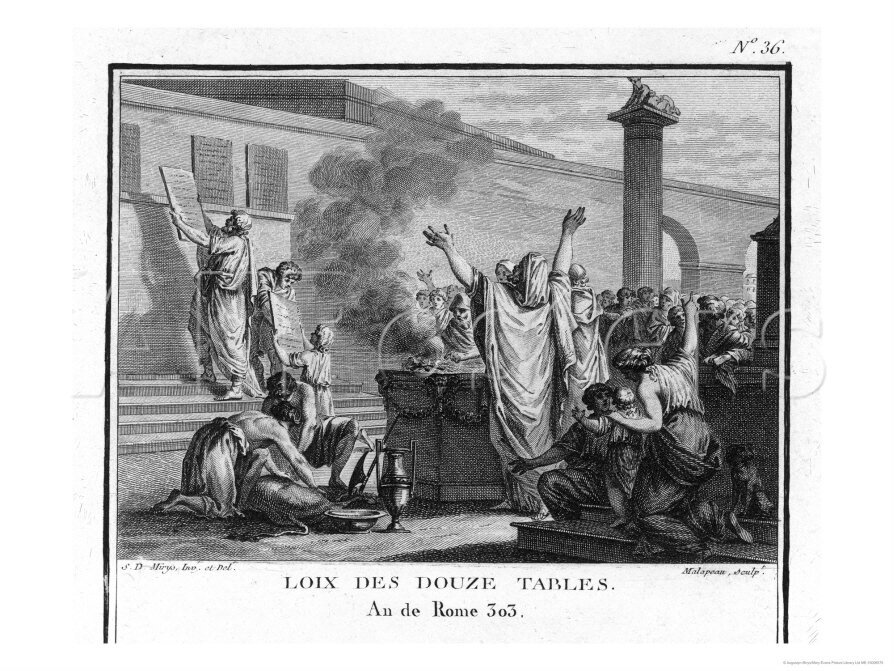
Around 450 BCE, a commission was appointed to write down Rome's laws. The result was the Twelve Tables, a set of laws inscribed on bronze tablets and displayed publicly in the Roman Forum. For the first time, law was no longer a secret known only to patrician priests and magistrates. It was accessible to all citizens, establishing a foundation for legal procedure and basic rights. While many of the laws were harsh by modern standards, their publication was a monumental step toward legal equality.
The Twelve Tables represent the earliest attempt to establish a standardized and publicly accessible legal code in Ancient Rome.
The Path to Legislative Power
The creation of tribunes and the Twelve Tables were major victories, but the struggle wasn't over. The plebeians had their own assembly, the Plebeian Council (Concilium Plebis), which passed laws called plebiscites (plebiscita). Initially, these laws only applied to plebeians. The ultimate goal was to make these resolutions binding on the entire Roman state, including the patricians.
After centuries of continued political pressure, this was finally achieved in 287 BCE with the passage of the Lex Hortensia. This law stipulated that all plebiscites passed by the Plebeian Council had the force of law for all Roman citizens. The assembly of the common people could now legislate for the entire Republic.
Interestingly, the Conflict of the Orders did not result in a democracy of the poor masses. Instead, it created a new, combined ruling class. Wealthy and influential plebeian families, known as the nobiles, joined the patricians to form a new aristocracy that dominated Roman politics for centuries. The fundamental achievement was not the elimination of an elite, but the creation of a system where power was shared and checked. This long struggle embedded principles of representation, legal transparency, and checks and balances deep within the Roman political DNA, concepts that would influence Western governance for millennia.
In the early Roman Republic, what were the two main social classes involved in the Conflict of the Orders?
What was the primary tactic used by the plebeians in 494 BCE to force the patricians to negotiate?
The Conflict of the Orders fundamentally reshaped the Republic, establishing a complex system of shared power born from protest and compromise.