Rigorous Real Analysis
Real Number Axioms
The Rules of the Game
We use real numbers every day, but what are they? Beyond just points on a line, the real numbers are a system governed by a precise set of rules, or axioms. These axioms are the foundational truths we accept without proof, from which all other properties are built.
The first set of rules are the Field Axioms. They define the basic arithmetic of addition, subtraction, multiplication, and division. They guarantee that for any two real numbers and , the results of , , and are also unique real numbers. Division by any non-zero real number is also a unique real number. These axioms are why algebra works the way it does, ensuring operations are commutative (), associative (), and distributive ().
An axiomatic system forms the foundation of many areas of mathematics.
Both the real numbers, denoted , and the rational numbers (fractions), denoted , satisfy the Field Axioms. So, what makes them different?
Putting Numbers in Order
The next layer of rules are the Order Axioms. These introduce the concept of positivity and allow us to compare numbers using inequalities like and . They state that for any two distinct real numbers and , either or . They also ensure that inequalities behave predictably with arithmetic. For instance, if , then for any . And if , then . A system that satisfies both the Field and Order axioms is called an ordered field.
Again, both the real numbers and the rational numbers are ordered fields. We still haven't found the rule that separates them. The real power of comes from one final, crucial axiom.
The Missing Piece
To understand the final axiom, we first need a few definitions. A set of numbers is bounded above if there's a number greater than or equal to every element in the set. That number is called an upper bound. A set can have many upper bounds. For example, the set is bounded above by 3, 4, 10, or any number greater than or equal to 3.
The smallest of all possible upper bounds has a special name: the supremum, or least upper bound. For our set , the supremum is 3. Similarly, a set is bounded below if there's a number less than or equal to all its elements. The greatest of these lower bounds is called the infimum.
Supremum
noun
The least upper bound of a set S, denoted sup(S). It is the smallest number that is greater than or equal to every element in S.
This brings us to the rule that defines the real numbers: the (also called the Least Upper Bound Property). It states that every non-empty subset of that is bounded above has a supremum that is also a real number. This sounds obvious, but it's a profound statement. It guarantees that the real number line has no gaps.
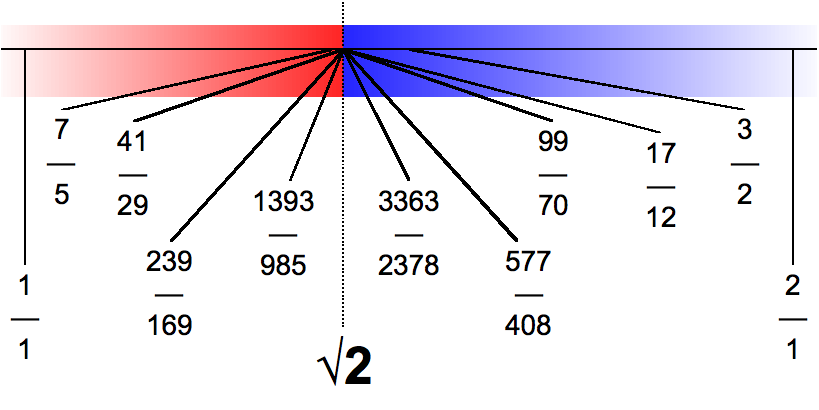
Let's see why the rational numbers fail this test. Consider the set . This set contains all rational numbers whose square is less than 2. It's certainly bounded above (by 1.5, for instance). But what is its supremum? The least upper bound is , which is not a rational number. So, the set is a bounded set of rational numbers whose least upper bound is not in the set of rational numbers. The rational number line has a hole where should be. The Completeness Axiom ensures that the real number line has no such holes.
Consequences of Completeness
The Completeness Axiom has two important consequences that are worth knowing. The first is the which, simply put, states that for any positive real number , you can always find a natural number that is larger than . No matter how large a number you pick, there's always a bigger integer. This prevents infinitely large and infinitely small numbers from existing within the real number system.
The second consequence is the Density of Rationals in Reals. This property states that between any two distinct real numbers, you can always find a rational number. This is why we can approximate any real number, like or , with a fraction to any degree of accuracy we want. Despite the fact that the rational numbers are full of 'holes', they are also sprinkled so densely throughout the real number line that you're never far from one.
With these axioms in place, we have a solid, logical foundation for the real numbers. This rigor allows us to move beyond intuitive ideas about calculus and begin building proofs about limits, continuity, and derivatives with full confidence.
Time to check your understanding of these foundational concepts.
Which axiom guarantees that for any two real numbers, and , the equation is always true?
Both the set of rational numbers () and the set of real numbers () are ordered fields. Which axiom distinguishes from ?