Rigorous Measure Theory
Introduction to Measure Theory
Beyond Simple Length
How long is the interval of numbers from 0 to 1? The answer is simple: its length is 1. What about the length of the numbers from 0 to 1 combined with the numbers from 2 to 4? We can just add their lengths: . Our intuition works well for simple intervals.
But what if we try to measure more complicated sets? Consider the set of all rational numbers between 0 and 1. A rational number is any number that can be written as a fraction, like 1/2, 3/4, or 22/7. Between any two rational numbers, you can always find another one. They are densely packed. And yet, there are infinitely more irrational numbers, like or , in that same interval.
So, what is the 'length' of all the rational numbers in [0, 1]? Our everyday idea of length starts to break down. We need a more powerful and precise toolkit to assign a notion of 'size'—like length, area, or volume—to a much wider variety of sets. This is the core idea behind measure theory.
The Rules for Measurable Sets
It turns out we can't consistently assign a 'length' to every possible subset of the real number line. Some sets are just too strange and paradoxical. So, mathematicians decided to first identify a collection of 'well-behaved' sets that we can measure. This collection is called a -algebra (pronounced sigma-algebra).
A -algebra on a set is a collection of subsets of that acts as a rulebook, telling us which sets are 'measurable'.
For a collection of sets to be a -algebra, it must satisfy three rules:
- The whole set is included. The entire space must be in the collection. If we're measuring subsets of the real line, the set of all real numbers must be measurable.
- It's closed under complements. If a set is in the collection, then its complement (everything in that is not in ) must also be in the collection. If you can measure a field, you can also measure everything that isn't the field.
- It's closed under countable unions. If you take a countable number of sets (finitely many, or infinitely many that you can list out) that are all in the collection, their union (everything that is in at least one of them) must also be in the collection.
Any set that belongs to a given -algebra is called a measurable set. These are the sets we're allowed to work with.
Defining a Measure
Once we have our collection of measurable sets (the -algebra), we can define a function that assigns a size to each of them. This function is called a measure.
A measure, often denoted by the Greek letter (mu), takes a measurable set as input and returns a non-negative number, which we think of as its size. It must follow two key properties:
| Property | Description |
|---|---|
| Non-negativity | The measure of any set is greater than or equal to zero. The measure of the empty set, , is exactly zero. |
| Countable Additivity | For any countable collection of disjoint measurable sets (sets that don't overlap), the measure of their union is the sum of their individual measures. |
This second property, countable additivity, is incredibly important. It lets us measure a complex set by breaking it down into an infinite number of simpler, non-overlapping pieces and then just summing up their sizes. This is where measure theory gets its power.
The Lebesgue Measure
One of the most important measures is the Lebesgue measure, which formalizes the concept of length on the real number line. It's constructed to satisfy our intuition. The Lebesgue measure of an interval is simply .
But it goes much further. Using the properties of measures and -algebras, it allows us to determine the 'length' of much more complex sets, like the set of irrational numbers between 0 and 1. The construction is clever. It starts by defining an 'outer measure' for any set by covering it with a countable collection of open intervals and finding the minimum possible sum of their lengths.
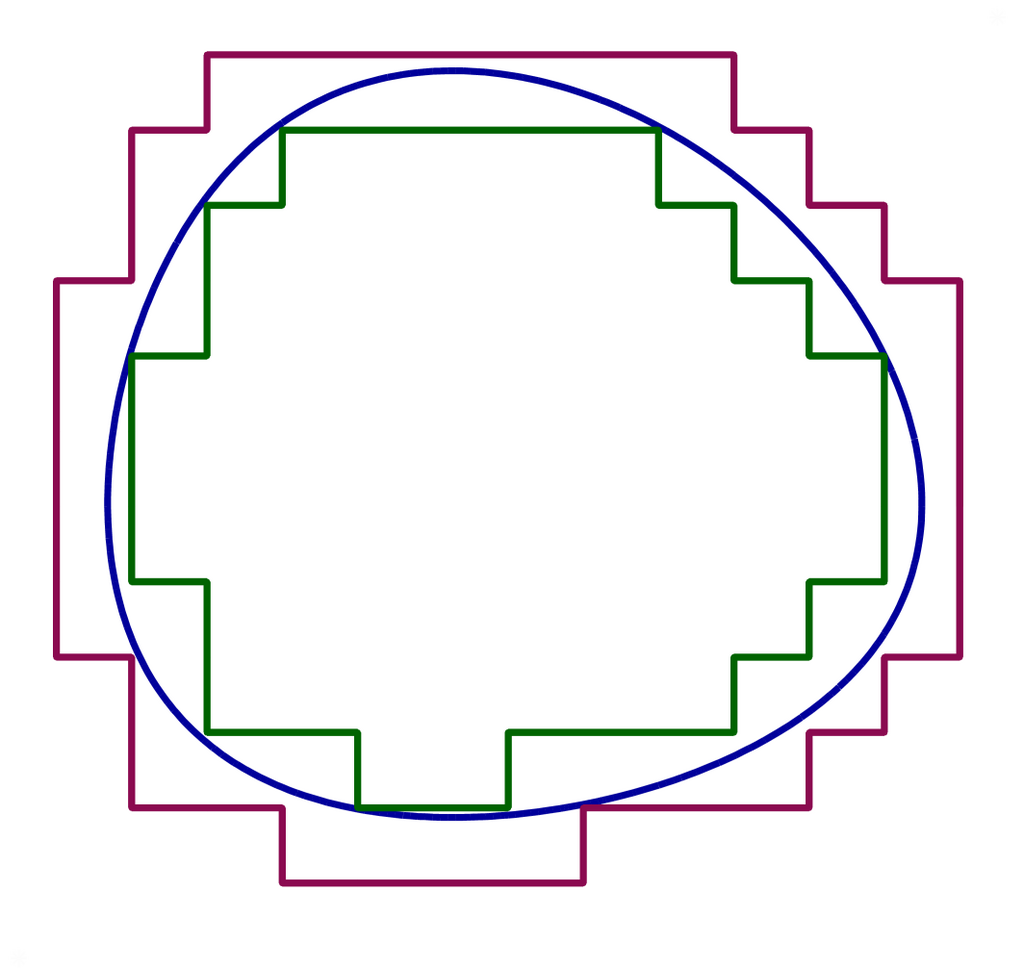
Then, it uses this outer measure to identify which sets are truly 'measurable'—those that neatly split other sets without causing contradictions. The sets that pass this test form a -algebra, and for them, the outer measure becomes the Lebesgue measure. This powerful construction is the foundation of modern integration theory.
With the Lebesgue measure, we can finally answer our earlier question. The set of all rational numbers between 0 and 1 has a Lebesgue measure of 0. Even though they are infinitely many and densely packed, they take up no 'length' at all. Consequently, the set of irrational numbers between 0 and 1 has a Lebesgue measure of 1.
When Measurement Fails
So, can we measure every set? As mentioned before, the answer is no. There are sets so bizarre that no consistent notion of 'length' can be assigned to them that also satisfies the property of countable additivity.
The most famous example is the Vitali set. Constructing it is a bit abstract. You start with all the real numbers in the interval . You then group them into collections where two numbers are in the same collection if their difference is a rational number. Finally, you create the Vitali set by picking exactly one number from each of these infinitely many collections.
The Vitali set is a subset of the real numbers that is not Lebesgue measurable.
If we were to assume the Vitali set has a measure, we could create a countable number of shifted, non-overlapping copies of it that perfectly fill up the interval .
If its measure were 0, then the sum of the measures of all its copies would also be 0, not 1. If its measure were a positive number, the sum would be infinite, also not 1. This contradiction shows that the Vitali set cannot have a well-defined Lebesgue measure. It's a 'non-measurable' set.
The existence of sets like this shows why we need the careful framework of -algebras. We have to restrict our attention to the sets that behave well, and for those, measure theory provides a solid and consistent foundation for ideas of size, length, and ultimately, probability and integration.
What is the primary motivation for developing measure theory?
A collection of subsets of a space X is a σ-algebra if it includes the whole space, is closed under complements, and is closed under __________.
This groundwork of measures and measurable sets is the first step into a larger world. It provides the language needed to build more advanced concepts in analysis and probability.