RF Microwave Processing of Polymer-Derived Ceramics
Electromagnetic Theory
The Rules of Electromagnetism
Electricity and magnetism were once thought of as separate forces. We knew electric charges could attract or repel each other. We also knew magnets had north and south poles. But in the 19th century, scientists began to uncover deep connections between them. A moving electric charge, for instance, could create a magnetic field. A changing magnetic field could create an electric current.
It was Scottish physicist James Clerk Maxwell who put all the pieces together. He formulated a set of four elegant equations that describe how electric and magnetic fields are generated and how they relate to each other. These equations are the foundation of everything we know about electromagnetism.
Maxwell's equations are to electromagnetism what Newton's laws are to motion. They are the fundamental rules of the game.
Let's look at each one without getting lost in the complex math. The first is Gauss's Law for electricity. It states that electric fields originate from electric charges.
Think of an electric charge as a tiny sprinkler. It sprays an electric field outward in all directions. If you have more charge (a bigger sprinkler), you get a stronger field. This equation simply formalizes that idea.
Next is Gauss's Law for magnetism.
This one is a bit different. It says there are no magnetic 'charges' or monopoles. You can't have an isolated north pole or south pole. If you cut a bar magnet in half, you don’t get a separate north and south piece. You get two new, smaller magnets, each with its own north and south pole. Magnetic field lines always form closed loops.
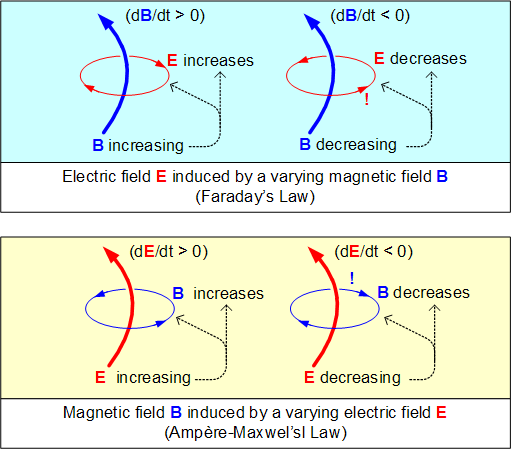
The third equation is Faraday's Law of Induction. This is the principle behind electric generators. It says that a changing magnetic field creates a circulating electric field.
Finally, we have the Ampère-Maxwell Law. This law states that a magnetic field can be created in two ways: by an electric current, or by a changing electric field.
Maxwell's crucial addition was the 'changing electric field' part. This insight revealed something extraordinary: electric and magnetic fields can create each other, leading to a new kind of phenomenon.
Waves from Fields
That final piece of the puzzle, Maxwell's addition to Ampère's law, unlocked a profound discovery. It meant that a changing electric field creates a magnetic field, which then changes and creates a new electric field, and so on. This creates a self-sustaining disturbance that ripples through space: an electromagnetic wave.
Maxwell calculated the speed of these waves using his equations and found it to be a very familiar number: the speed of light. He had discovered that light itself is an electromagnetic wave. This unified electricity, magnetism, and optics into a single, cohesive theory.
These waves are transverse, meaning the oscillations of the electric and magnetic fields are perpendicular to the direction the wave is traveling. They are also perpendicular to each other.
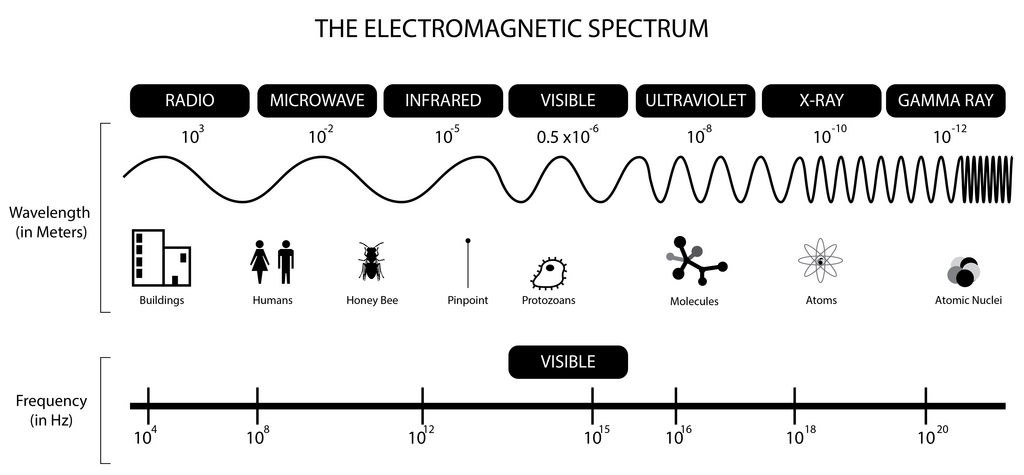
Radio waves, microwaves, X-rays, and visible light are all just different forms of electromagnetic radiation. They differ only in their frequency and wavelength, but they all travel at the same ultimate speed in a vacuum and obey the same fundamental laws.
When Waves Meet Matter
So what happens when one of these waves hits a material? The outcome depends on the properties of the material and the frequency of the wave. The wave's oscillating electric field exerts a force on the charged particles within the material, primarily the electrons.
There are three main possibilities: transmission, reflection, and absorption.
Transmission occurs when the wave passes through the material largely unaffected. This is what happens when visible light passes through a clean pane of glass. The material is transparent to that specific wave frequency.
Reflection is common in conductive materials like metals. The free electrons in the metal are easily able to move in response to the wave's electric field. As they slosh back and forth, they re-radiate their own electromagnetic wave, which travels back in the opposite direction. This is why metals are shiny and why they block radio signals.
Absorption is perhaps the most interesting interaction for many applications. If the material's electrons are not free to move but can vibrate or be excited to higher energy levels, they can absorb energy from the wave. This absorbed energy is typically converted into heat, causing the material's temperature to rise. This is the principle that allows a microwave oven to heat food. The microwave radiation is tuned to a frequency that is readily absorbed by water molecules.
The way a material responds to an electromagnetic field is determined by its electrical properties, such as its conductivity and permittivity. These properties dictate whether a wave will pass through, bounce off, or be absorbed and converted to heat.
Understanding these fundamental interactions is the key to harnessing electromagnetic energy for countless technologies, from wireless communication to advanced materials processing.
What was James Clerk Maxwell's key insight that completed the Ampère-Maxwell Law and led to the discovery of electromagnetic waves?
According to Gauss's Law for magnetism, what happens if you break a bar magnet in half?