Retirement Portfolio Construction
Investment Basics
The Golden Rule of Investing
You’ve probably heard the old saying, “Don’t put all your eggs in one basket.” It’s simple advice for carrying groceries, but it’s also the most important rule in investing. This core idea is called diversification.
Diversification is the practice of spreading your investments across various financial instruments, industries, and other categories to reduce risk.
Imagine you own an umbrella company. When it rains, you make a lot of money. But during a long, sunny spell, sales might dry up completely. Now, what if you also owned a sunglasses company? When it’s sunny, your sunglasses sell well, making up for the lack of umbrella sales. By owning both, you’ve made your overall income more stable, regardless of the weather.
Investing works the same way. Some investments do well when the economy is booming, while others might hold their value or even go up when things are slow. By holding a mix of different types of investments, you reduce the chance that a single event will have a disastrous impact on your entire portfolio. One part of your portfolio might be down, but another part could be up, helping to balance things out.
Diversification is a cornerstone of investment risk management, embodying the timeless wisdom of “don’t put all your eggs in one basket”.
Risk and Return: The Great Trade-Off
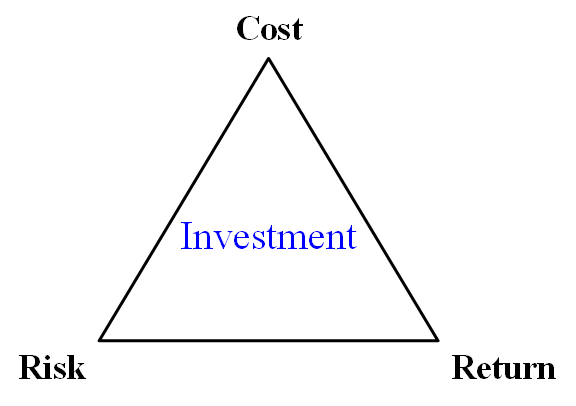
Every investment comes with a trade-off between risk and return. In simple terms, risk is the chance that you could lose some or all of the money you've invested. Return is the money you make on your investment. The two are fundamentally linked.
Generally, investments with the potential for higher returns also come with higher risk.
Think of it like this: a savings account at a bank is very low-risk. The chance of the bank losing your money is extremely small. Because the risk is so low, the return—the interest you earn—is also very modest.
On the other hand, investing in a brand-new tech startup is very high-risk. The company could fail, and you could lose everything. But if the company succeeds and becomes the next big thing, your potential return could be enormous.
There's no such thing as a high-return, no-risk investment. Understanding your own comfort level with risk is key to building a portfolio that lets you sleep at night.
Your Time Horizon
The third crucial concept is your time horizon. This is simply the length of time you expect to hold an investment before you need to cash it out. For retirement planning, your time horizon is often decades long.
Time Horizon
noun
The period of time one expects to hold an investment until they need to sell it.
Why does this matter so much? Because a longer time horizon gives you more time to ride out the ups and downs of the market. If you’re in your 20s and saving for retirement in your 60s, a market downturn in the next few years isn’t a catastrophe. You have 40 years for your investments to recover and grow.
This means that investors with longer time horizons can generally afford to take on more risk in pursuit of higher returns. As you get closer to your goal—in this case, retirement—your time horizon shrinks. At that point, you have less time to recover from losses. Most people shift to lower-risk investments as they near retirement to protect the money they’ve accumulated.
One of the keys to successful investing is learning how to balance your comfort level with risk against your time horizon.
Now, let's test your understanding of these core principles.
What is the primary goal of diversification in an investment portfolio?
Which of the following statements best describes the relationship between risk and return?
These three ideas—diversification, the risk-return trade-off, and your time horizon—are the bedrock of a sound investment strategy. They work together to help you make smart decisions for your long-term goals.