Resonance Stabilization in Chemistry
Introduction to Resonance
When One Structure Isn't Enough
Lewis structures are a great tool for visualizing molecules, but they have a limitation. Sometimes, a single drawing can't fully capture the reality of where the electrons are. Take the ozone molecule, , for example. We can draw two valid Lewis structures for it.
In the first structure, the double bond is on the left. In the second, it's on the right. Experiments show that both oxygen-oxygen bonds in ozone are identical in length and strength. They are shorter than a typical single bond but longer than a typical double bond.
So, which Lewis structure is correct? Neither is, entirely. The true structure is an average of the two. This concept is called resonance.
Resonance
noun
A method used to represent the delocalized electrons in certain molecules or ions where the bonding cannot be expressed by a single Lewis structure.
The actual molecule, called the resonance hybrid, doesn't flip back and forth between these forms. Instead, its electron structure is a blend of all possible resonance structures. Think of a nectarine. It’s a hybrid of a peach and a plum, but it isn't a peach one moment and a plum the next. It’s a nectarine all the time, with its own unique properties.
The same is true for a resonance hybrid. The electrons involved in the resonance are not localized between two specific atoms. Instead, they are delocalized, meaning they are spread out over three or more atoms. The double-headed arrow is used to show that structures are related by resonance.
Delocalization and Stability
Spreading electrons out over a larger area makes a molecule more stable. Think of it like spreading a load over a wider surface to reduce pressure. Delocalizing electron density lowers the overall energy of the molecule, increasing its stability. A molecule that has resonance structures is more stable than any of its individual Lewis structures would suggest.
The classic example of resonance and stability is the benzene molecule, .
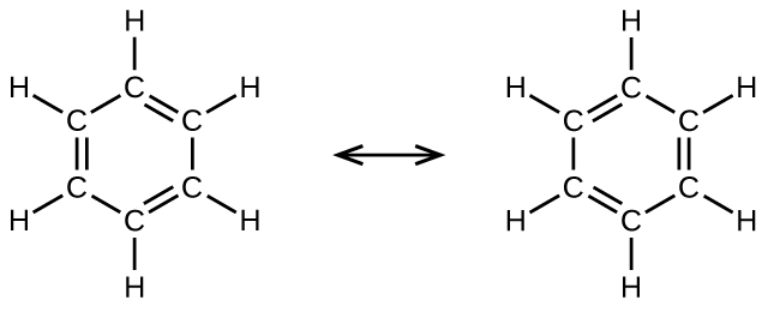
Benzene has a ring of six carbon atoms. The resonance structures show alternating single and double bonds. However, in the real benzene molecule, all six carbon-carbon bonds are exactly the same length. The six electrons from the double bonds are delocalized around the entire ring, shared equally among all six carbon atoms. This delocalization makes benzene exceptionally stable.
Resonance is not a physical process of switching between structures. It's a conceptual tool to describe a single, more stable reality: the resonance hybrid.
Understanding resonance is key to predicting how molecules will behave. The added stability from delocalized electrons influences a molecule's shape, energy, and reactivity.
Let's review these new concepts.
What does the concept of resonance describe in chemistry?
Why is a molecule with resonance structures, like benzene, exceptionally stable?
Resonance helps us describe molecules that don't fit neatly into one Lewis structure, giving us a more accurate picture of bonding and stability.