REM vs Deep Sleep
Introduction to Sleep Physiology
The Architecture of Sleep
Falling asleep isn't like flipping a switch. It's more like descending a staircase. Your brain and body move through a series of distinct stages, each with its own unique characteristics. These stages are broadly categorized into two main types: Non-Rapid Eye Movement (NREM) sleep and Rapid Eye Movement (REM) sleep. Throughout the night, you cycle through these stages multiple times, building the restorative architecture of a good night's rest.
The Quiet Descent: NREM Sleep
Most of your sleep time is spent in NREM sleep, which is divided into three stages. As you progress from Stage 1 to Stage 3, sleep becomes progressively deeper.
Stage N1: This is the brief, transitional stage of light sleep, the doorway between being awake and asleep. Your breathing and heart rate begin to slow down, and your muscles relax. You might experience sudden muscle twitches, known as hypnic jerks. It's easy to be woken up from this stage.
Stage N2: You spend about half your total sleep time in this stage. Your body temperature drops and your brain waves slow down, but with occasional bursts of rapid activity. These bursts, called sleep spindles and K-complexes, are thought to help protect sleep by dampening your response to outside stimuli. This stage is important for consolidating memories and processing information from the day.
Stage N3: This is deep sleep, also known as slow-wave sleep. It's the most difficult stage to wake up from, and if you are, you'll likely feel groggy and disoriented. During N3, your body focuses on physical repair, growing and repairing tissues, building bone and muscle, and strengthening the immune system. Your brain waves are at their slowest, appearing as large, rhythmic delta waves.
The Active Brain: REM Sleep
About 90 minutes after you fall asleep, you enter your first period of REM sleep. This stage is a paradox. Your brain becomes highly active, almost as if you were awake, while your body becomes temporarily paralyzed, a state called atonia. This paralysis prevents you from acting out your dreams.
As the name suggests, your eyes move back and forth rapidly behind your closed eyelids. Breathing becomes faster and more irregular, and your heart rate and blood pressure increase to near-waking levels. This is the stage where most vivid, story-like dreaming occurs.
The Nightly Cycle
Sleep isn't a simple descent into deep sleep followed by a gradual ascent. Instead, we cycle through the stages in a predictable pattern throughout the night. A single sleep cycle typically lasts between 90 and 120 minutes.
A typical cycle looks like this: You progress from N1 to N2, then into the deep sleep of N3. After N3, you ascend back to N2 for a short time before entering your first REM stage. After REM, the cycle begins again.
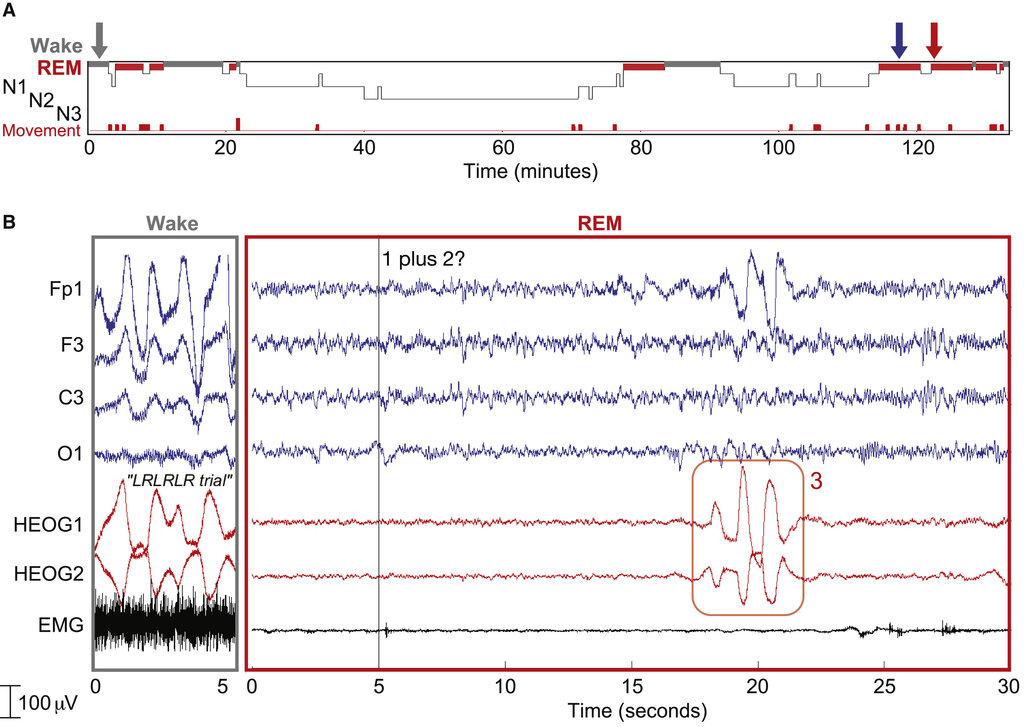
The composition of these cycles changes as the night goes on. In the first half of the night, you spend more time in deep N3 sleep. In the second half, the REM stages become longer, and deep sleep becomes shorter. This is why a full, uninterrupted night of sleep is so important. Cutting sleep short, even by an hour, can disproportionately reduce the amount of REM sleep you get, which is crucial for emotional regulation and memory consolidation.
Each complete sleep cycle, with its balance of deep sleep and REM, plays a vital role in keeping you physically healthy and mentally sharp. They work together to help you learn, solve problems, manage your emotions, and recover from the day's activities.
Let's review the key terms we've covered.
Now, check your understanding of sleep physiology.
What is the primary characteristic of REM sleep that prevents you from acting out your vivid dreams?
A person who consistently sleeps for only five hours a night instead of a full eight is most likely to experience a disproportionate reduction in which type of sleep?
Understanding this nightly rhythm is the first step in appreciating the powerful role sleep plays in our overall health and well-being.