Relativity Explained
Classical Mechanics
The Clockwork Universe
Before Isaac Newton, the motion of objects was a bit of a mystery. Planets wandered across the sky, and objects on Earth fell, rolled, or flew without a single, unifying explanation. Newton changed everything. He provided a set of clear, powerful rules that described how things move, from an apple falling from a tree to the Moon orbiting the Earth. These rules are the bedrock of what we now call classical mechanics.
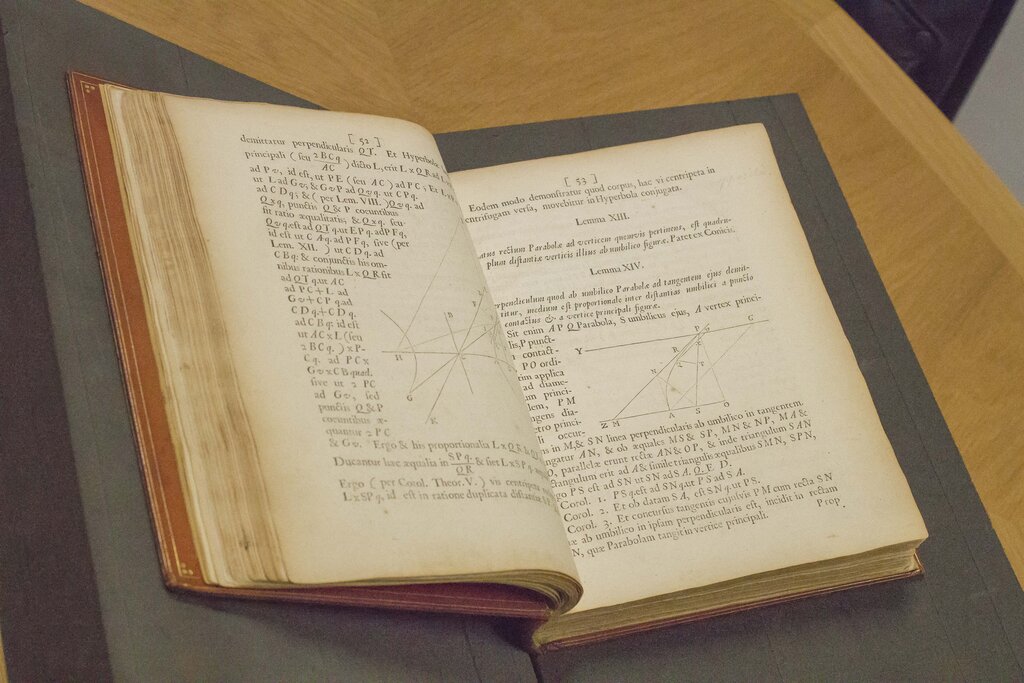
His first law deals with inertia. It simply states that an object likes to keep doing what it's already doing. If it's sitting still, it will stay still. If it's moving, it will continue moving in a straight line at a constant speed.
An object at rest stays at rest, and an object in motion stays in motion with the same speed and in the same direction unless acted upon by an external force.
This only changes if a force, like a push or a pull, gets involved. On Earth, friction and air resistance are ever-present forces that slow things down, which is why we don't see objects coasting forever. But a hockey puck gliding on an almost frictionless sheet of ice is a pretty good approximation of this law in action.
Newton's second law is the mathematical core of his mechanics. It connects force, mass, and acceleration.
This equation says that the force () required to move an object is equal to its mass () multiplied by its acceleration (). In other words, more massive objects require more force to accelerate. It's much easier to push a bicycle into motion than a truck. This law lets us calculate exactly how much force is needed for a specific change in motion.
Finally, his third law describes a fundamental symmetry in nature: action and reaction.
For every action, there is an equal and opposite reaction.
When you push on a wall, the wall pushes back on you with the same amount of force. A rocket pushes hot gas out its nozzle (the action), and the gas pushes the rocket forward (the reaction). This law reveals that forces always come in pairs.
An Unchanging Stage
For Newton's laws to work, they needed a consistent backdrop. He imagined space and time as absolute, forming a fixed, unchangeable stage on which the events of the universe played out.
Absolute space, in this view, is a rigid, three-dimensional grid. It's the same everywhere and for everyone, regardless of whether they are moving or not. An object's position and motion can be measured against this fixed background. It is immovable and provides a universal frame of reference.
Absolute time flows at a constant rate for all observers everywhere. A second on your watch is a second on a spaceship's watch, no matter how fast it's moving. Time is universal, marching forward relentlessly and unaffected by events happening in space.
In the Newtonian world, rulers don't shrink and clocks don't slow down, no matter how you move.
Whose View Is Correct?
This brings us to a key idea: relativity. Not Einstein's relativity, but an earlier version credited to Galileo. Galilean relativity deals with how motion looks from different points of view.
Imagine you are on a smoothly moving train and you throw a ball straight up. To you, the ball goes up and comes straight back down into your hand. But to someone standing on the platform watching your train go by, the ball travels in a wide arc. It moves up and down, but it also moves forward along with the train.
So who saw the
correct
adjective
Conforming to an accepted standard; accurate.
path? According to Galileo, both of you did. The principle of Galilean relativity states that the laws of mechanics are the same for all observers moving at a constant velocity. There is no special
preferred
frame of reference; no experiment you could perform inside the moving train could tell you that you were moving without looking outside.
We can describe this mathematically. If the person on the platform measures the ball's horizontal position as and the train is moving at velocity , your measurement of the ball's position, , would be related by a simple transformation.
This formula allows you to translate between reference frames. It's a straightforward way to see the world from another person's moving perspective. Crucially, time () remains the same in both frames. This combination of Newton's laws, absolute space and time, and Galilean relativity formed a remarkably successful picture of the universe. For over two centuries, it seemed to explain everything about motion.
A hockey puck slides across a nearly frictionless sheet of ice for a long distance without any apparent force pushing it. Which of Newton's laws best explains this phenomenon?
According to Newton's Second Law of Motion, if you apply the same amount of force to two objects, one with a small mass and one with a large mass, what will be the result?
These classical ideas provide the essential foundation we need. They paint a picture of an orderly, predictable universe. But as scientists began to study light and electromagnetism, cracks started to appear in this perfect clockwork model.