Refrigerator Repair Essentials
Refrigeration Basics
How Refrigerators Move Heat
A refrigerator doesn't create cold. Instead, it moves heat from the inside of the fridge to the outside. Think of it as a heat pump. It pulls warmth away from your food and releases it into your kitchen.
This process happens in a sealed system of tubes filled with a special fluid called a refrigerant. The refrigerant continuously cycles through four key components, changing from a liquid to a gas and back again. Each component plays a specific role in moving heat.
This diagram shows the journey of the refrigerant. Let's walk through what happens at each stage.
The Four Key Components
The entire refrigeration cycle relies on the interplay between four parts. Understanding each one is key to knowing how the system works.
1. Compressor: This is the heart of the system. It's an electric pump that squeezes the refrigerant, which arrives as a cool, low-pressure gas. Compressing the gas raises its pressure and temperature significantly. It leaves the compressor as a hot, high-pressure gas.
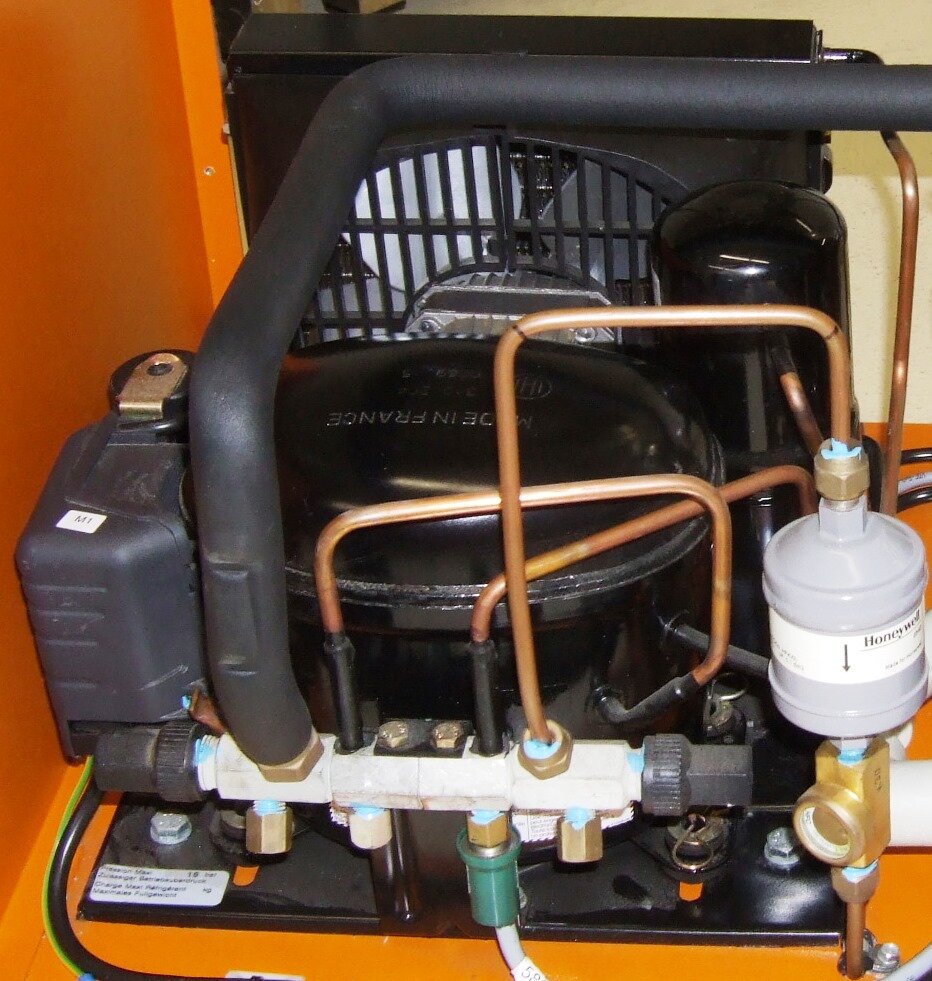
2. Condenser: The hot, high-pressure gas then flows into the condenser coils. These are usually located on the back or bottom of the refrigerator. As the gas travels through these coils, it releases its heat into the surrounding air. This is why the back of your fridge feels warm. As it cools, the refrigerant condenses into a warm, high-pressure liquid.
3. Expansion Valve: The warm liquid refrigerant now reaches the expansion valve, which is a very narrow opening. As the liquid is forced through this tiny passage, its pressure drops dramatically. This sudden pressure drop causes the refrigerant to rapidly cool and partially vaporize, becoming a very cold, low-pressure mist of liquid and gas.
4. Evaporator: This cold mist flows into the evaporator coils, which are located inside the refrigerator and freezer compartments. Here, the cold liquid refrigerant absorbs heat from the air and the food inside the fridge. This absorption of heat causes the refrigerant to boil and turn completely back into a cool, low-pressure gas. The gas then flows back to the compressor, and the cycle begins all over again.
Types of Refrigerant
The fluid that makes all this possible is the refrigerant. Its ability to boil at a very low temperature is what allows it to absorb heat effectively. Over the years, the chemicals used as refrigerants have changed due to environmental concerns.
HFC-134a
noun
A hydrofluorocarbon that became a common refrigerant in the 1990s. It was developed to replace older CFCs (chlorofluorocarbons) that were damaging the ozone layer.
While HFC-134a doesn't harm the ozone layer, it is a potent greenhouse gas. This means it contributes to global warming when released into the atmosphere. Because of this, the industry has been moving toward alternatives with a lower environmental impact.
R-600a
noun
The chemical name for isobutane, a hydrocarbon refrigerant. It has a very low global warming potential and is now the standard in most new domestic refrigerators.
R-600a is a natural, non-toxic refrigerant that has no ozone-depleting properties and a negligible effect on global warming. Its efficiency also means that refrigerators using it often require less energy to run. The main safety consideration with R-600a is that it is flammable, which requires careful handling during repairs.
What is the primary function of a refrigerator?
In which component of the refrigerator does the hot, high-pressure refrigerant gas cool down and turn into a liquid?
Understanding this cycle is the first step in diagnosing any cooling problem. When a refrigerator fails, the issue can almost always be traced back to a problem with one of these four components or the refrigerant itself.