Reading Medical Scientific Papers
Evidence Hierarchy
The Pyramid of Evidence
Not all scientific evidence is created equal. A doctor's personal opinion on a treatment is worlds away from a study that combines results from dozens of clinical trials. To make sense of this, researchers use a framework called the hierarchy of evidence. It's a way to rank different types of studies based on how reliable they are and how much they reduce the risk of bias.
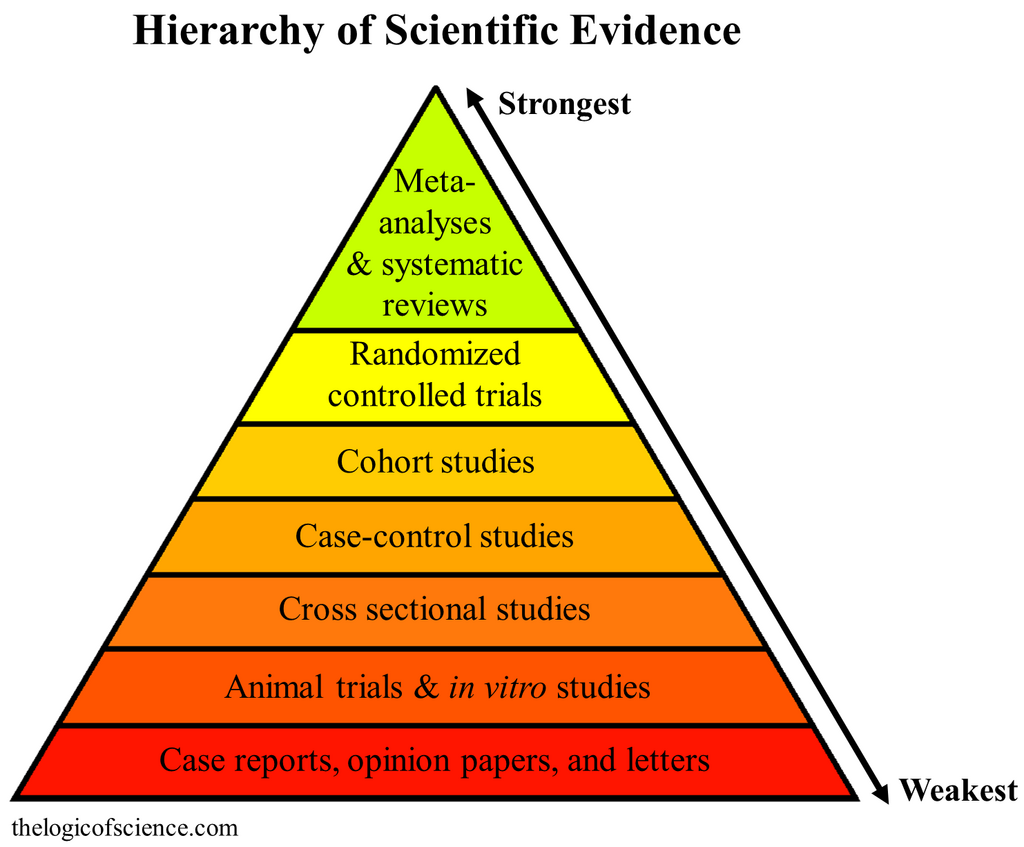
Think of it as a pyramid. The studies at the top are the strongest. They synthesize a large body of research and give us the most confidence. As you move down the pyramid, the study designs become more prone to error and bias, offering weaker evidence. A single, well-designed study can be powerful, but its true strength is often realized when it's considered alongside other similar studies.
The Top Tiers
At the pinnacle of the pyramid are studies that gather and analyze other research. They don't produce new data from experiments themselves; instead, they synthesize existing data.
A answers a specific clinical question by finding and summarizing all the high-quality evidence that fits a certain criteria. Imagine researchers wanting to know if a new drug lowers cholesterol. They would conduct a massive search for every relevant study, assess each one for quality, and then write a comprehensive report on what the collective evidence says. A meta-analysis goes one step further. It uses statistical methods to combine the numerical results from multiple similar studies, effectively creating one large, powerful study. This increases the statistical power and provides a more precise estimate of a treatment's effect.
Meta-analyses and systematic reviews provide the highest level of evidence because they compile findings from the existing body of scientific literature.
The Gold Standard and Observational Studies
Just below the top tier sits the (RCT). For a single study, this is often considered the gold standard. In an RCT, participants are randomly assigned to one of two or more groups. One group receives the treatment being tested (the intervention group), while the other receives a placebo or the standard treatment (the control group). Randomization is key; it minimizes differences between the groups, so any observed effects are more likely due to the treatment itself, not some other factor. RCTs are powerful, but they can be expensive, time-consuming, and sometimes ethically impossible to conduct.
When RCTs aren't feasible, researchers turn to observational studies. These studies don't involve an intervention; investigators simply observe. There are two main types:
Cohort Studies: These studies follow a group of people (a cohort) over time. Researchers might track a group of smokers and a group of non-smokers for decades to see who develops lung cancer. Cohort studies are forward-looking (prospective) and are excellent for identifying risk factors.
Case-Control Studies: These are retrospective, or backward-looking. Researchers start with people who already have a disease (cases) and compare them to a similar group of people without the disease (controls). They then look back in time to identify differences in past exposures. This design is efficient for studying rare diseases.
| Study Type | Time Direction | Key Question |
|---|---|---|
| Cohort Study | Forward (Prospective) | Does exposure X lead to outcome Y? |
| Case-Control Study | Backward (Retrospective) | Did people with outcome Y have exposure X? |
The Foundation of the Pyramid
At the bottom of the pyramid, we find evidence that is useful for generating ideas but not for making firm clinical recommendations. This includes (detailed reports on individual patients), expert opinion, and animal or in-vitro studies. A case report might describe a patient with a rare disease who responded to an unusual treatment. This is interesting and might inspire a larger, more rigorous study, but it doesn't prove the treatment works. It's just an anecdote. Expert opinion, while valuable for its experience, is still just an opinion and is highly susceptible to personal bias.
Understanding this hierarchy is not about dismissing studies at the bottom of the pyramid. It's about context. Every level of evidence has its place, but for making critical decisions about health, we should always look for the highest quality evidence available.
Now, let's test your understanding of the evidence hierarchy.
What is the primary purpose of the hierarchy of evidence in research?
A research paper uses statistical methods to combine the results from 20 different studies on the effect of a vitamin supplement on bone density. This is an example of a:
By understanding where a study sits on this pyramid, you can better judge the strength of its claims and make more informed decisions about medical information.