ReactJS Fundamentals
Introduction to ReactJS
What is React?
React is a JavaScript library for building user interfaces. Think of it like a set of advanced LEGO bricks for the web. Instead of building a webpage as one giant piece, you build it out of small, independent, and reusable parts called components. This approach, created by Facebook, makes developing complex applications much more manageable.
React.js is an open-source JavaScript library used for building user interfaces, especially for single-page applications where you want a fast, interactive user experience.
At its core, React’s job is to make sure your user interface stays in sync with your application's data. When the data changes, React efficiently updates and renders just the right parts of your page. This makes applications feel fast and responsive.
Building with Components
Everything in React is a component. A component is a self-contained piece of code that represents a part of the user interface. A button, a search bar, a user profile card—these can all be individual components.
You can then combine these simple components to build more complex ones. For example, a photo feed component might be made up of many individual photo components, and each photo component could contain a like button component and a comment component.
This component-based structure keeps your code organized and allows you to reuse parts of your UI across your application without duplicating code.
By breaking a complex interface into smaller, manageable pieces, you can work on each part in isolation, making development and debugging much simpler.
The Virtual DOM
Web browsers use a structure called the Document Object Model (DOM) to represent a webpage. You can think of it as a tree of all the elements on the page. Directly manipulating this 'real' DOM is slow and can hurt performance, especially in applications with a lot of user interaction and data updates.
React solves this problem with something called the Virtual DOM. It's a lightweight copy of the real DOM that exists only in memory.
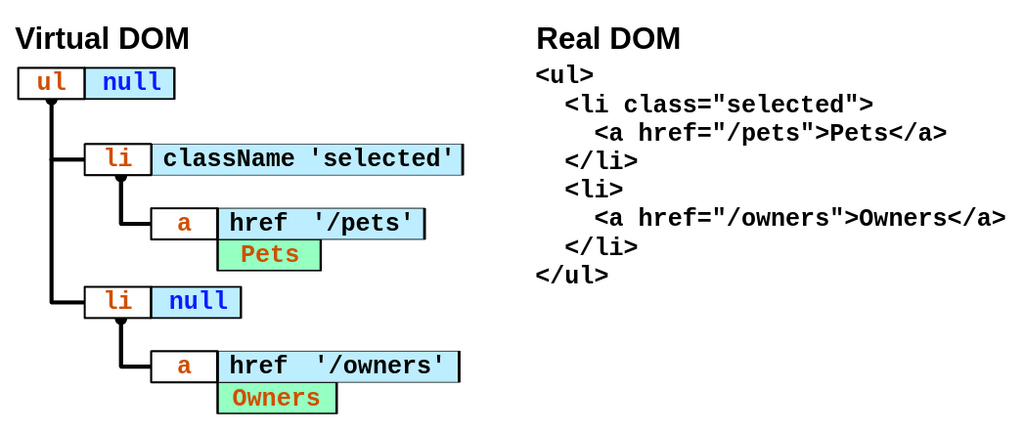
When the data in your application changes, React first updates the Virtual DOM. Then, it compares this new Virtual DOM with the previous version to figure out the most efficient way to update the real DOM. This process is called 'diffing.'
Instead of rebuilding the entire webpage, React only changes the specific elements that need updating. This makes the process incredibly fast and is a key reason why React applications feel so smooth.
One-Way Data Flow
In React, data flows in a single direction, from top to bottom. This is known as unidirectional data flow. Parent components pass data down to their child components via 'props' (short for properties).
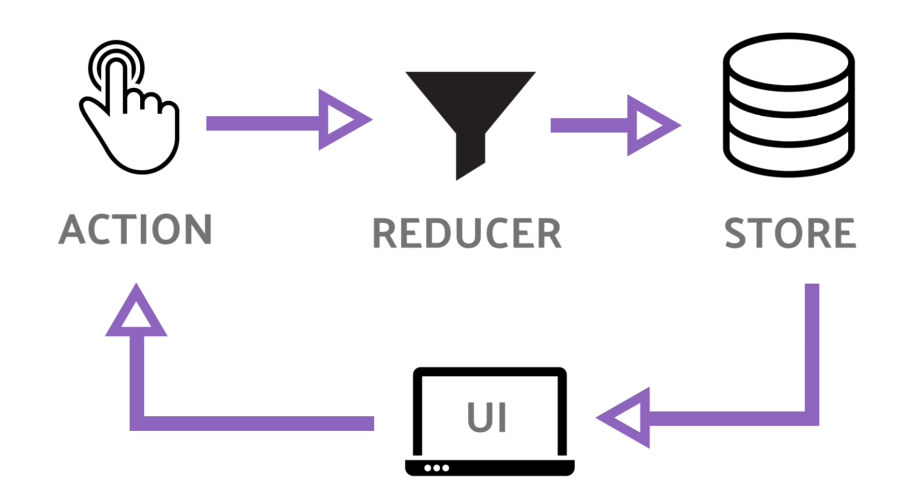
Imagine a waterfall. The water only flows down. A child component can't directly modify the data it receives from its parent. If a change is needed, the child has to signal the parent, and the parent is responsible for making the change. The new data then flows back down to the child.
This might seem restrictive at first, but it makes your application much more predictable. When something goes wrong, it's easier to trace the flow of data and find the source of the problem. This clear structure prevents messy bugs that can be hard to track down in applications with more complex data interactions.
These fundamental concepts—components, the Virtual DOM, and unidirectional data flow—work together to make React a powerful and popular choice for building modern web applications.