React Web Development Fundamentals
Introduction to React
What is React?
React is a JavaScript library for building user interfaces. Think of it like a set of advanced LEGO bricks for the web. Instead of building a website with one giant, complicated piece of code, you build small, independent, and reusable pieces called components.
React is a JavaScript library designed to create fast, dynamic, and scalable user interfaces.
These components can be anything from a single button to an entire navigation bar. You assemble them to create complex UIs. When data in your application changes, React efficiently updates and re-renders only the necessary components, making your application feel fast and responsive.
React uses a special syntax called JSX (JavaScript XML), which lets you write HTML-like code directly inside your JavaScript. This makes it intuitive to describe what your UI should look like.
const element = <h1>Hello, world!</h1>;
That might look like HTML, but it's actually JavaScript. This combination is what makes React so powerful for building interfaces.
Setting Up Your Environment
To start building with React, you need a couple of tools: Node.js and its package manager, npm. Node.js lets you run JavaScript outside of a browser, and npm helps you manage project dependencies, like React itself.
Once you have Node.js installed, the easiest way to create a new React application is by using a tool called Create React App. It sets up a complete development environment for you with a single command. Open your terminal and run the following:
npx create-react-app my-first-react-app
This command creates a new directory called my-first-react-app with all the necessary files and configurations. To see your new app in action, navigate into the directory and start the development server:
cd my-first-react-app
npm start
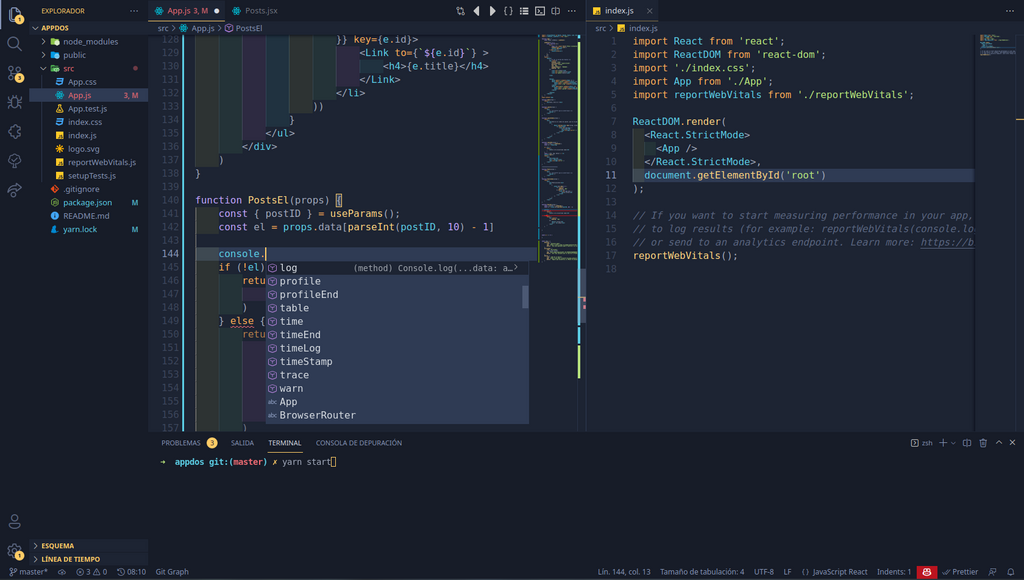
A new browser tab will open with your running React application. The main code for your app lives inside the src folder. The most important file to start with is App.js, which contains the main component of your application.
Your First React Component
Components are the core of React. A component is essentially a JavaScript function that returns a piece of the UI. Let's look at the default App.js file and simplify it to its most basic form.
// src/App.js

import React from 'react';

function App() {
  return (
    <div>
      <h1>Hello, React!</h1>
      <p>This is my first component.</p>
    </div>
  );
}

export default App;
Let's break this down:
import React from 'react';This line is necessary for any file that uses JSX.function App() { ... }This is a function component. It's a standard JavaScript function.- The
return (...)statement contains the JSX that describes the UI. It looks like HTML, but it's rendered by React. export default App;This makes theAppcomponent available for other files in our project to use, specificallysrc/index.js, which is responsible for rendering it to the webpage.
Notice that the JSX returned by a component must have a single root element. In this case, we've wrapped our <h1> and <p> tags in a <div>.
Components let you split the UI into independent, reusable pieces, and think about each piece in isolation.
You can create as many components as you need. For example, you could create a Header component, a Sidebar component, and a Content component, and then assemble them inside your main App component. This component-based structure keeps your code organized and easy to manage.
Now that you understand the basic building blocks, let's see how they can be used to create a more dynamic interface.
What is the primary purpose of React?
What is JSX?
You've just taken your first steps with React, from understanding its core idea to creating your first component. In the next section, we'll dive into how to pass data between components and make them truly dynamic.