React Fundamentals
Introduction to React
What Is React?
Think of a webpage as a complex structure built from LEGO bricks. In the past, if you wanted to change one small part, you might have had to rebuild a whole section. React, a JavaScript library created by Facebook, changes that. It lets you build user interfaces (UIs) out of small, reusable pieces called components.
Instead of treating a webpage as one giant document, React breaks it down into these independent components. A search bar, a button, a user profile—each can be its own self-contained unit. This makes building and managing complex applications much simpler.
This component-based approach is the core idea behind React. It allows you to build a complex UI by composing simple, isolated pieces of code. This makes your code easier to understand, reuse, and debug.
React is a JavaScript library for building user interfaces.
The Virtual DOM: React's Secret Sauce
Web browsers use something called the Document Object Model (DOM) to represent a webpage. The DOM is like a tree-like structure of all the elements on the page. Directly changing this 'real' DOM is slow and resource-intensive. Every time you update an element, the browser has to do a lot of work to recalculate the layout and repaint the screen.
React introduces a clever solution: the Virtual DOM. Think of it as a lightweight copy, or a blueprint, of the real DOM. When the data in your application changes, React first updates this virtual blueprint. It then compares the new virtual blueprint with the old one, figures out the most efficient way to make the changes, and applies only those specific updates to the real DOM. This process, called reconciliation, is incredibly fast and is a key reason why React applications feel so snappy.
One-Way Data Flow
In a React application, data has a clear and predictable path. It flows in one direction, from parent components down to child components. This is known as unidirectional data flow.
Imagine a waterfall. Water flows from the top down, never the other way around. Similarly, in React, a parent component can pass data down to its children as properties (or "props"), but a child component cannot directly modify the data of its parent. If a child needs to change something, it sends a message back up to the parent, and the parent is responsible for making the change.
This might seem restrictive at first, but it makes applications much easier to understand and debug. When something goes wrong, you know exactly where to look: the data flows from a single source, making it simple to trace issues back to their origin.
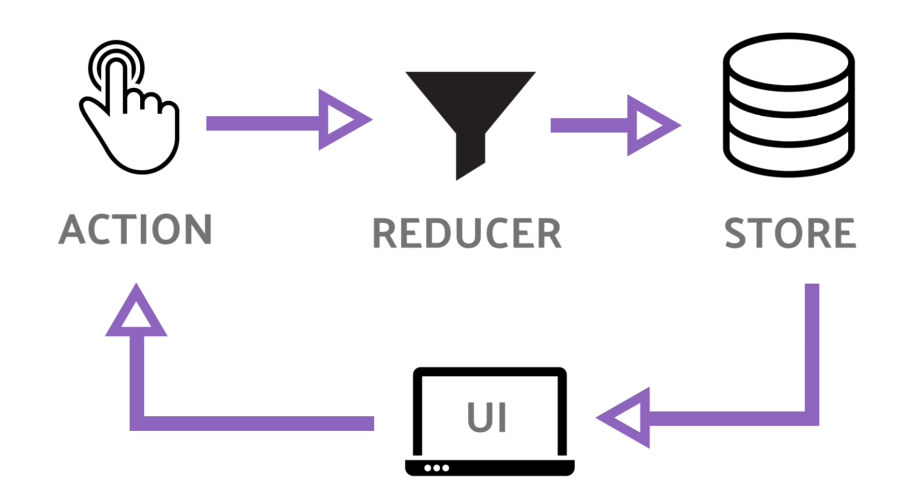
This one-way data flow, combined with components and the Virtual DOM, forms the foundation of what makes React a powerful and popular choice for building modern web applications.
What is the core principle behind React's approach to building user interfaces?
What is the primary advantage of using a Virtual DOM in React?