React Fundamentals
Introduction to React
Building with Blocks
React is a popular JavaScript library for building user interfaces, the parts of an application that users see and interact with. Its main idea is simple but powerful: you build complex UIs by combining small, isolated pieces of code called “components.”
Think of it like building with LEGOs. Instead of creating a huge, single structure, you build individual bricks. You can have a “button” brick, a “menu” brick, and a “search bar” brick. Each brick is self-contained and knows how to display itself. You can then reuse these bricks anywhere you need them and snap them together to create entire pages. This approach makes your code cleaner, easier to manage, and much faster to develop.
Components are the fundamental building blocks of any React application.
This modularity is a core strength of React. If you need to change how a button looks, you only have to update the button component. Every button throughout your application will automatically update. This saves time and reduces the chance of introducing bugs.
A Smarter Way to Update
Web applications often need to change what’s on the screen. A new message arrives, a user clicks a button, or data is loaded from a server. Traditionally, updating the web page directly, known as manipulating the DOM (Document Object Model), can be slow and inefficient, especially for complex applications.
React solves this with a clever concept called the Virtual DOM. Imagine the Virtual DOM as a lightweight blueprint of the actual UI. When something in your application needs to change, React doesn't immediately touch the real DOM. Instead, it creates a new Virtual DOM blueprint with the change included.
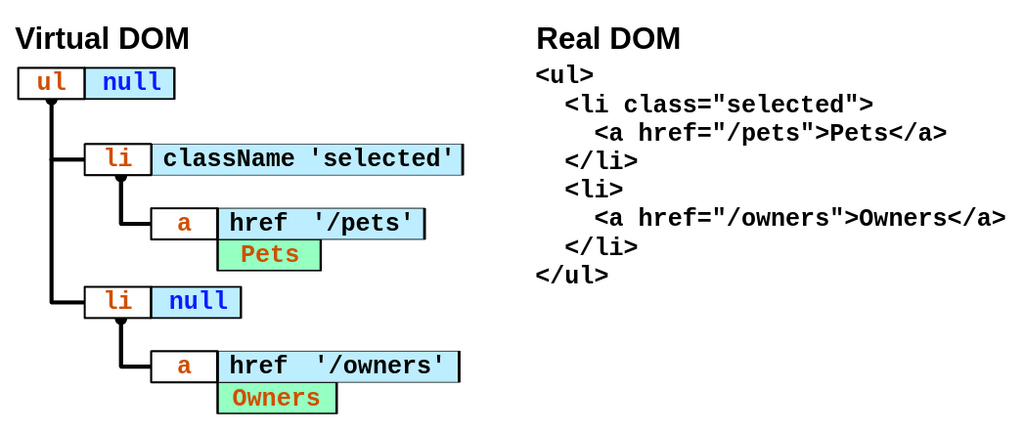
Next, React compares this new blueprint to the old one, figures out the exact differences, and then updates only those specific parts of the real DOM. It’s like telling a construction worker to only replace a single windowpane instead of rebuilding the entire wall. This process, called “reconciliation,” makes React applications feel incredibly fast and responsive because it minimizes the slow work of updating the actual browser display.
Tell Me What, Not How
Another key principle of React is its declarative approach. This means you tell React what you want the UI to look like, and React handles how to make it happen.
Think about giving directions. An imperative approach would be: “Walk five steps forward, turn left, walk ten steps, open the door.” You're giving step-by-step instructions.
A declarative approach is simply: “Please go to the office at the end of the hall.” You describe the desired end state, and the person figures out the steps to get there. React works like this. You declare what the UI should look like for any given state of your application, and React takes care of all the DOM manipulations to get it there.
With React, you don't manage the UI updates step-by-step. You just describe the final result, and React efficiently brings the screen to that state.
This makes your code more predictable and easier to debug. Instead of tracking every little change, you can look at your code and immediately understand what the UI is supposed to be showing. It’s a simpler way to think about and build interfaces.