React Fundamentals
Introduction to React
Building with Digital Blocks
Imagine building a complex website, like a social media feed or an online store. In the past, developers treated the entire webpage as one big, interconnected piece. If a small part of the page needed to change, like a new comment appearing, the entire page might need to be reloaded or redrawn by the browser. This was slow and inefficient.
React, a JavaScript library for building user interfaces, changed this by introducing a simple but powerful idea: build web pages out of individual, reusable pieces called components.
Components are the fundamental building blocks of any React application.
Think of components like Lego bricks. You have different types of bricks: a button brick, a navigation bar brick, a user profile brick. You can build each brick separately, make sure it works perfectly on its own, and then snap them together to create a full application. You can even reuse the same button brick in multiple places without having to build it from scratch each time.
This component-based architecture makes your code organized, easier to manage, and much faster to develop. You can break down a complex user interface into small, self-contained units.
A header, a footer, and the articles in the main feed could all be separate components. The beauty is that the article component can be reused for every single post, simply by feeding it different information.
The Virtual DOM
So React uses components to build the page. But how does it handle updates so quickly? The answer lies in something called the Virtual DOM.
Your web browser has a representation of the page's structure called the Document Object Model, or DOM. Think of it as the live, official blueprint of the page. Interacting with the real DOM directly is computationally expensive. Making a small change can force the browser to recalculate and redraw large portions of the page, which is slow.
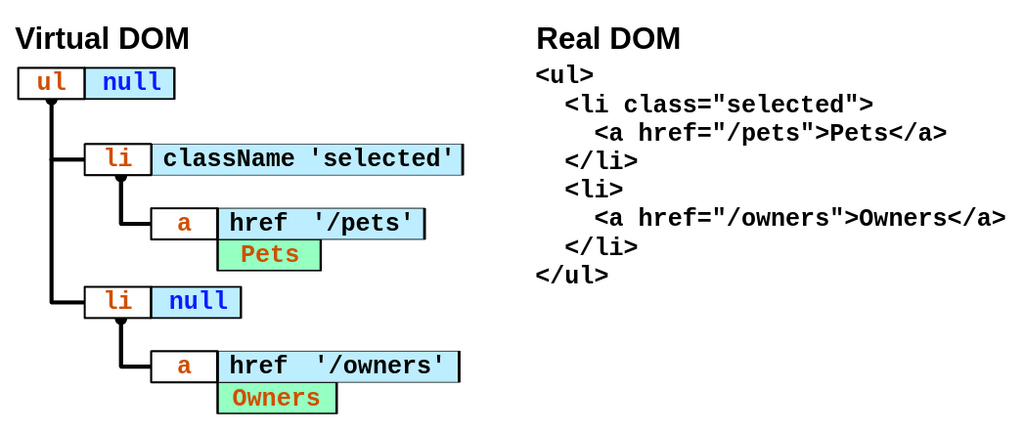
React gets around this by creating its own, lightweight copy of the DOM in memory: the Virtual DOM.
The Virtual DOM is just a JavaScript object that represents the real DOM. It's like a fast, temporary draft of the webpage's structure.
When something changes in the application, React doesn't immediately touch the slow, real DOM. Instead, it follows a three-step process:
- A new Virtual DOM is created with the updated changes.
- React compares this new Virtual DOM with the previous one. This process is called "diffing."
- It calculates the most efficient way to make these specific changes and then applies only those changes to the real DOM.
By updating only what's necessary, React minimizes direct manipulation of the real DOM, making the application feel incredibly fast and responsive.
One-Way Data Flow
To keep all these components and updates organized, React enforces a strict rule: data flows in one direction. This is called unidirectional data flow.
In a React application, data is held by parent components and passed down to their children. A child component can't directly change the data it receives from its parent. If a change is needed, the child has to signal the parent, and the parent is responsible for making the change. The new data then flows back down to the children.
This might sound restrictive, but it makes the application's behavior predictable. When something goes wrong, you can trace the data flow back up the chain to find the source of the problem. It prevents the kind of confusing bugs where a change in one obscure part of an application unexpectedly breaks another, completely unrelated part.
What is the fundamental building block of a React application's user interface, often compared to a reusable Lego brick?
To make UI updates fast and efficient, React creates a lightweight copy of the real DOM in memory. What is this copy called?
These three core ideas—a component-based architecture, the Virtual DOM, and unidirectional data flow—are what make React a powerful and popular choice for building modern web applications.